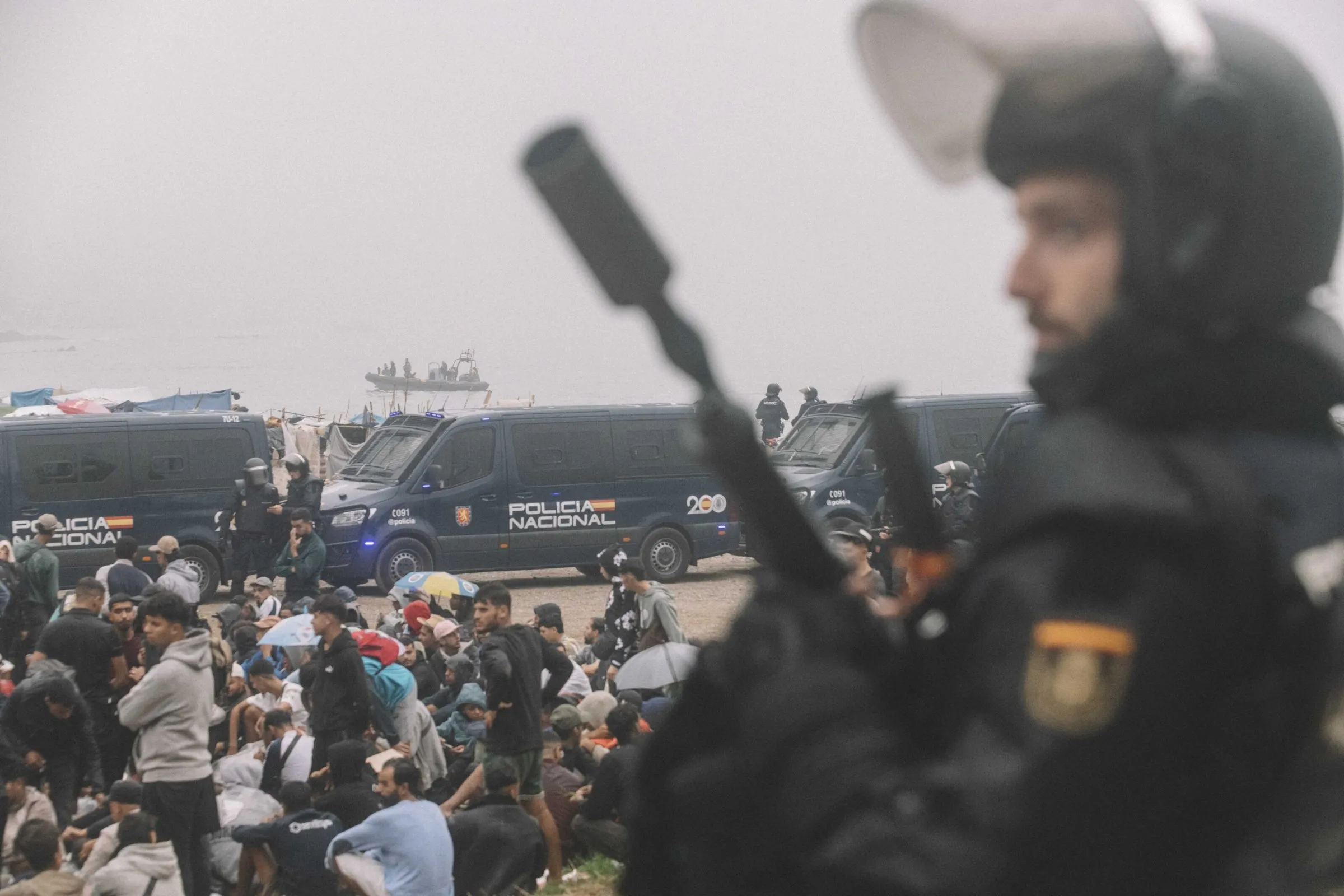
On Sunday, the Spanish police executed another round of deportations, forcibly transporting hundreds of individuals back to Morocco. The events unfolded at dawn, when a significant contingent of officers from the Policía Nacional, accompanied by military personnel, descended upon Playa Trampolín, a beach in Ceuta, to remove people from their tents and corral them into groups. Armed with riot gear, batons, rubber bullet guns, and flanked by armored vehicles, the operation was marked by a show of overwhelming force. It is estimated that around 500 individuals were taken to the border, stripped of their dignity and rights.
In stark contrast to the adults, who exhibited fear, minors engaged with the process. However, police quickly intervened, redirecting them to a camp on the opposite side of the city, where they had already waited in vain for weeks. Witnesses reported being surrounded by teenagers, aged 14 to 16, pleading with officers to be liberated from their plight and registered properly.
Nolte Bauer, the chairperson of Mission Lifeline International, an NGO primarily focused on maritime rescue operations, has been actively involved in providing assistance alongside Humanitarios Sin Fronteras since the onset of the crisis in Ceuta. As the situation escalated, the narrative presented by authorities suggested that individuals were voluntarily returning to Morocco to avoid registration. Yet, surrounded by police and military, without translation services or legal representation, one cannot genuinely consider these actions voluntary. For two months, officials failed to adequately inform these individuals about their options, contributing to a climate of fear and confusion.
The area surrounding the border was completely off-limits, even to the press. My attempts to capture footage of the buses used for deportation were swiftly thwarted by military personnel, indicating a deliberate effort to obscure the events taking place.
Similar deportation actions had occurred the previous week, with reports indicating that around 1,000 individuals were forcibly gathered and sent back to Morocco under even more violent circumstances than witnessed recently. Many were told they would be taken to a camp, only to find themselves abandoned in southern Morocco, far from their homes, without phones or means of support, forced to make their way back to northern regions where they had originally resided.
The repressive measures disproportionately affect individuals who possess every right to cross borders as refugees and seek fair asylum proceedings. Reports suggest that minors were also among those deported recently. Contrary to claims made by authorities, there is substantial evidence that many individuals at Playa Trampolín wished to apply for asylum. While some expressed fatigue and a willingness to return voluntarily due to the inhumane treatment they received, those who made such choices still faced deportation and were punished for their desire to escape.
At the border, the option to apply for asylum appeared nonexistent, either due to a lack of understanding or a complete absence of legal counsel and translators. A looming threat hung over those who remained: anyone whose asylum application was denied would face a five-year ban from the entire Schengen Area, a punitive measure that does not occur automatically with the rejection of international protection. Consequently, individuals were pressured into making hasty decisions out of fear.
The deportations primarily targeted Moroccan nationals, while sub-Saharan migrants appeared to remain present, though exceptions cannot be ruled out. The Spanish government claimed to have 'returned' over 11,000 people since late July, some forcibly and some 'voluntarily,' including minors. The actual number of individuals still in Ceuta is difficult to ascertain, but it is certainly in the thousands. Those who had gathered at Playa Trampolín are now scattered, hiding in the city or forests, fearful of being deported even while their asylum applications are pending. Many seek shelter and a way into protected areas, living in constant fear.
While the mood among locals in Ceuta once leaned towards hostility against refugees, it appears to have calmed somewhat. However, incidents of verbal insults and the occasional threats directed at aid workers still occur. Reports indicate that police and military personnel have been targeting individuals, sometimes for amusement, assaulting them and destroying their phones, insisting they have no place in Ceuta and should return to Morocco. These individuals are often released afterward, sometimes with serious injuries.
Mission Lifeline continues its work in Ceuta by providing medical assistance, drinks, and charging stations for phones, while also focusing on the needs of unaccompanied minors and women, including pregnant individuals. This task remains incredibly challenging, as there are still insufficient facilities to accommodate these vulnerable groups. When we bring children to the police, they are supposed to receive care once they are in the system, yet they frequently face rejection and are sent away.
Importantly, our organization operates on the principle that no one should pay to access information. While this may not be a sustainable business model, we prioritize independent journalism and equitable access over profit. Journalism incurs costs—research, printing, and the labor of those who produce it. Thus, we rely on support from the public to continue our work. By the end of the year, we need to raise 300,000 euros. Every contribution, whether one-time or recurring, counts towards sustaining our mission.
As reported by nd-aktuell.de.