
On a sultry Thursday evening in July, a group of American schoolchildren strolls along the Seine, their eyes squinting against the bright sun as six military helicopters hover ominously above Notre-Dame. This scene unfolds against the backdrop of Paris, where the authorities, alongside anxious residents, grapple with the tension in the air. Just weeks earlier, a masked group had rampaged through the streets following Paris Saint-Germain's victory in the Champions League, looting stores and clashing with police. Now, the city braces itself for a monumental clash: a World Cup quarter-final between France and Morocco, a match steeped in historical complexities between the former colonizer and its erstwhile protectorate.
This highly anticipated match echoes a similar encounter from four years prior, where France emerged victorious with a 2-0 scoreline, yet the aftermath saw over 250 arrests in the country and a tragic loss of life in Montpellier. In stark contrast, the current atmosphere in Paris is calm, albeit tense, with the warm July night drawing thousands into the streets. With temperatures soaring to 33 degrees Celsius, the city is on high alert, as 8,000 police officers prepare for potential unrest. Subway stations on the Champs-Élysées are locked down, and water cannons are positioned at major intersections, while the world-renowned boutiques of Louis Vuitton and Hermès erect barricades, signaling a city in a state of readiness.
The day after the match, reports emerge from northern France of a tragic incident where a young girl lost her life after being struck by a truck. Meanwhile, in London, fans wreak havoc on the streets while Parisian police detain ten individuals amidst a flurry of brawls and stabbings. However, for the Île-de-France region, the night of the quarter-final is marked by a surprising tranquility, devoid of the chaos that had been anticipated. Observers offer two potential explanations for this unexpected calm. One voice among them is Aissam, a 28-year-old born in Morocco and raised in France, who views the nation as the land of his education, where his parents built their lives and where he currently works for a major bank. For Aissam and many others like him, the dual identity of being both Moroccan and French is a complex yet enriching experience.
Renowned author Leïla Slimani once articulated, "On est toujours l’étranger dans le regard de l’autre," suggesting that one is always seen as an outsider in the eyes of others. Her journey, having lived between Morocco and France, lends weight to her observations about identity. With her father having once presided over the Moroccan Football Association, Slimani now stands as a prominent figure in Francophone literature, passionately supporting her homeland. She argues that perceptions of the French of tomorrow are often misleading, as one-third of them possess roots in other nations, indicating a rich tapestry of multiculturalism that binds Morocco and France in both economic and political spheres.
As the match approaches, Aissam and his friends rally behind Morocco, their ancestral homeland, yet they express a willingness to accept a French victory as a less painful defeat. For them, the stakes are not merely about football but about belonging and the love each country holds for its people. Within those 90 minutes, many French Moroccans and Moroccan French negotiate their identities, as they cheer for players who are often products of diaspora. The match becomes a microcosm of their lives—celebrating a team with roots in Morocco while also grappling with the reality of being part of France.
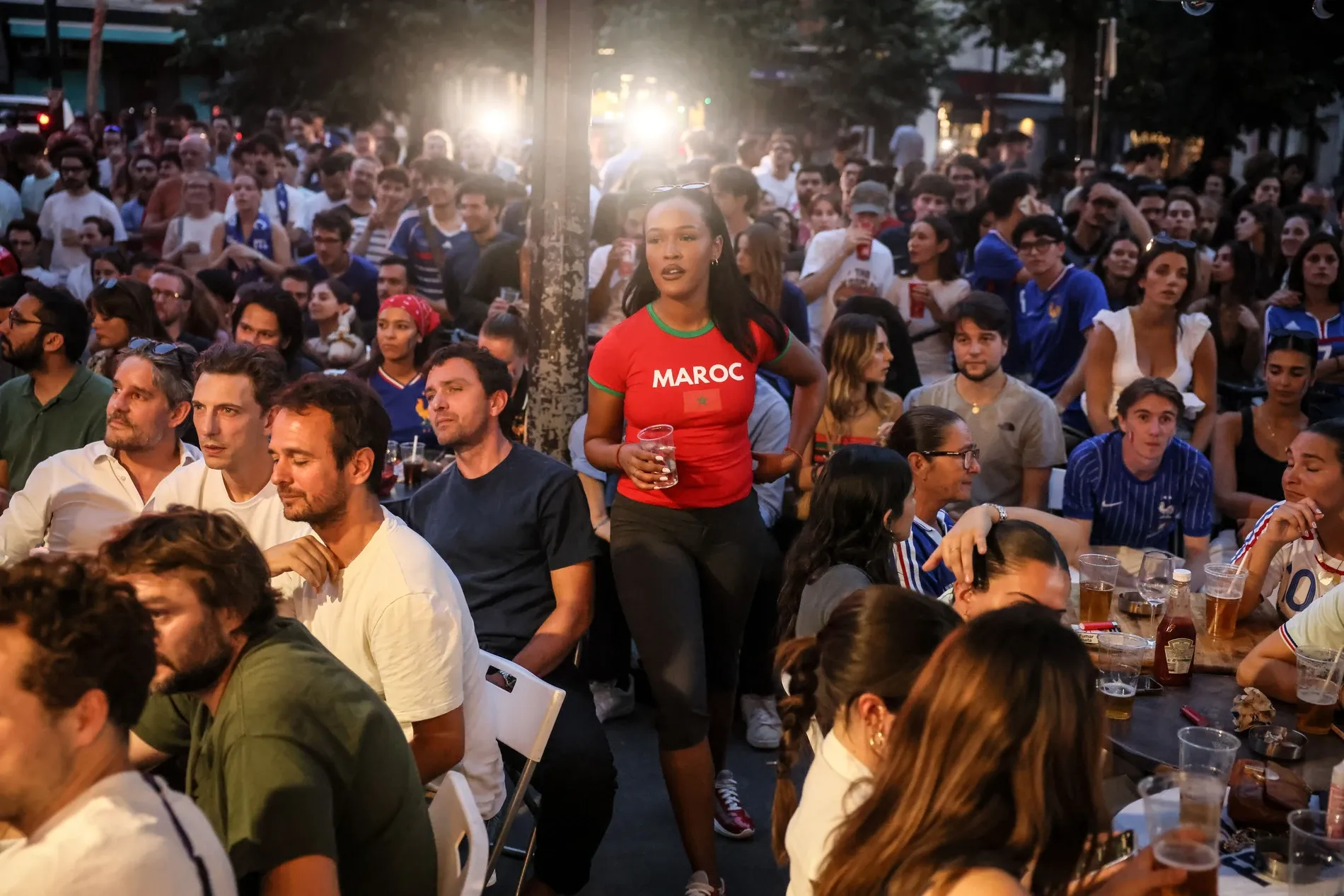
In the lively bistros of Paris, the atmosphere is charged with anticipation. When Kylian Mbappé, the son of an Algerian mother, misses a penalty, younger fans wearing Moroccan jerseys leap from their seats, filled with a mix of hope and anxiety. As the match unfolds, the cheers and jeers from diverse tables reflect the complex relationship between the two countries. A poignant quote from a fan, captured by "Le Monde," sums up the spirit of the evening: "In the end, we are all brothers," yet the reality is more nuanced, akin to distant cousins reconnecting after years apart.
As the clock winds down, amidst celebrations and fireworks lighting up the Parisian sky, the match concludes with France securing victory once again. Amidst the jubilation, Aissam reflects on the dichotomy of their identities—a shared love for football that transcends borders yet is marked by the scars of history. Ultimately, even as they cheer for their respective teams, the essence of their shared experience resonates deeply, uniting them in a unique bond. As Aissam types into his phone, "We have won and lost," he encapsulates the bittersweet nature of the night, one filled with both rivalry and kinship, as the team of cousins from Paris continues to thrive amidst the vibrant tapestry of their lives.
As reported by faz.net.