
African Lion 2026: Strategic Military Advancements in North Africa
The African Lion 2026 military exercises have marked an unprecedented qualitative leap in the security architecture of North Africa and the Atlantic Façade of the continent. Rather than being just a routine training deployment or a mere diplomatic showcase, the execution of the largest military exercise by the United States Africa Command (AFRICOM) on Moroccan soil is a reflection of long-term structural planning. This deployment signifies a consolidation of Washington's defense diplomacy and Western military staffs, establishing a doctrine of facts on the ground. From a strategic analysis perspective, the strength of this relationship is not derived from isolated declarations; rather, it is supported by a dense framework of documents, including interoperability reports, sectoral roadmaps, operational assessments from U.S. Army Europe and Africa, and official planning directives. When analyzed collectively, these documents position the Royal Armed Forces (FAR) of Morocco in a tactically advantageous position within their geographic context.
The significance of this year’s maneuvers lies in the complex international scenario framing them, characterized by the decline of European influence in the Sahel region and the increasing penetration of rival state actors like Russia and China. Under the ten-year defense framework agreement between the two nations, African Lion 2026 has served as the ultimate examination to certify the modernization of the FAR, translating strictly technical concepts derived from various U.S. defense directives into high-stakes geopolitical realities.
Operational Excellence and Technological Integration
The political-military direction of this exercise mobilized the highest echelons of defense from both nations, under the direct supervision of General Michael Langley, the commander of AFRICOM, and General Mohamed Berrid, the inspector general of the Moroccan forces. On the ground, the leadership of the Joint Task Force fell to the U.S. Army and Africa's Joint Task Force Command (SETAF-AF), led by Major General Dagvin Anderson, who coordinated efforts with Major General Mohamed Benlouali, commander of the Southern Zone of the FAR.
Together, they managed a multinational contingent exceeding 5,600 personnel from over 40 allied nations and observers, showcasing the operational presence of elite units such as the U.S. Army's 173rd Airborne Brigade, elements of the U.S. Marine Corps (USMC), and Moroccan mechanized battalions. While complementary scenarios were activated in Senegal, Ghana, and Tunisia, the core focus and logistical center of gravity remained concentrated in the tactical sectors of Tan-Tan, Benguérir, Agadir, and the coastal range of Cap Draâ. The deployment necessitated a massive logistical effort that served to audit the capabilities of the FAR's Directorate of Logistics and Transportation.
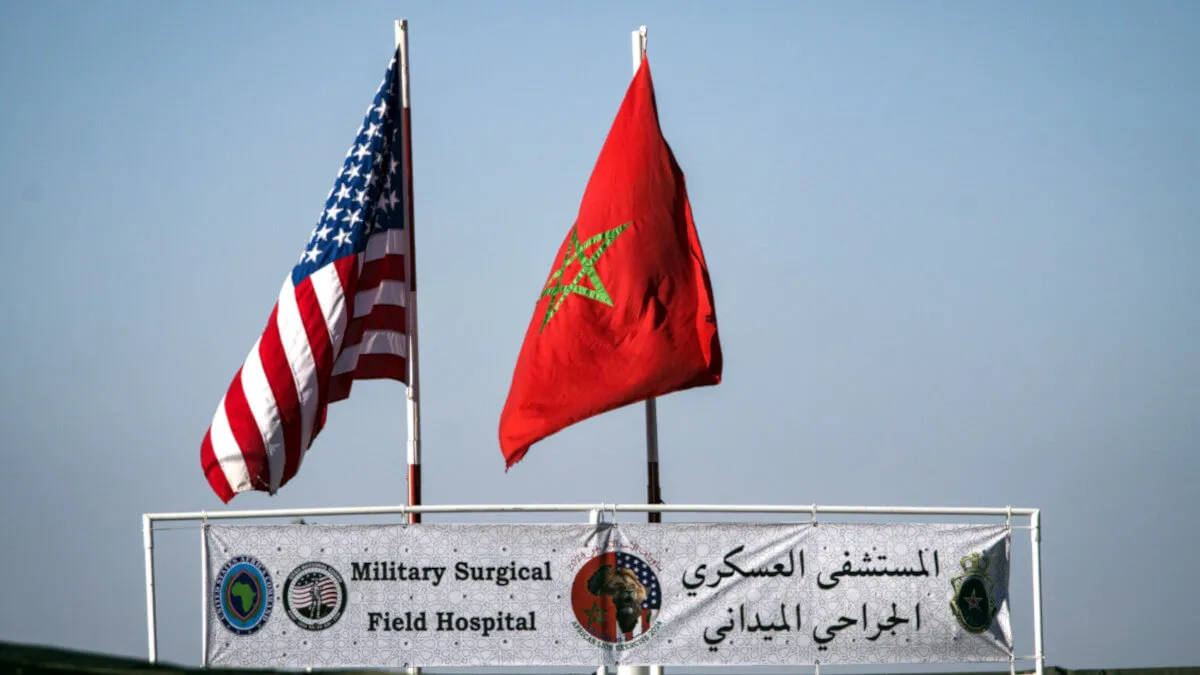
The coordinated movement of heavy equipment began months prior with a maritime bridge managed by the U.S. Military Transportation Command (USTRANSCOM), offloading tons of supplies, combat vehicles, and live ammunition at the ports of Agadir and Tan-Tan. The joint forces operated under an integrated sustainment network that included the deployment of Military Medical Campaign Hospitals (MEDRETE), which not only assisted civilian populations but also served as real-world testing grounds for Combat Medical Evacuation (MEDEVAC) protocols.
The military medical units, under the direction of the FAR's Military Health Service Inspection, coordinated mass casualty drills in austere environments using FAR’s CH-47D Chinook helicopters and American UH-60 Black Hawk aircraft. The informational and procedural aspect of the exercise demonstrates how the strictly technical language of U.S. Army Europe and Africa conceals a profound strategic reading. Concepts such as “multidomain interoperability” or “high-intensity combined operations” signify Morocco’s assimilation of the most advanced combat doctrines from the West.
The Cap Draâ range has functioned as the primary operational laboratory for what has been termed algorithmic warfare on the continent. Joint staffs established a unified Command, Control, Communications, and Computing (C4I) Center where FAR transmission specialists and technicians from the U.S. Defense Information Systems Agency (DISA) connected terminals through the standardized tactical data network Link 16. This digital architecture facilitated the instantaneous fusion of Intelligence, Surveillance, and Reconnaissance (ISR) signals, unifying information collected by military satellites, AN/TPQ-53 counter-battery radars, and optics from unmanned aerial platforms.
The primary objective of this algorithmic deployment was the extreme optimization of the sensor-to-shooter cycle, automating the identification and prioritization of threats using predictive analysis software. Once reconnaissance drones detected a simulated target deep within the enemy apparatus, algorithms instantaneously assigned the most efficient attack vector available in the network, reducing the decision-making process from hours to mere minutes. This level of automation demonstrates that bilateral cooperation has surpassed the mere transfer of conventional weaponry.
To delve deeper into the implications of these maneuvers, it is vital to analyze the inventory of weaponry used during African Lion 2026, which reflects an arsenal designed for high-intensity conventional combat against advanced area denial defenses (A2/AD). In the realm of ground artillery, the spotlight fell on the M142 HIMARS high mobility rocket systems, operated both by the 2nd Battalion of Field Artillery of the U.S. Army and the artillery regiments of the FAR, executing precision fire with guided GMLRS munitions against targets situated at great distances. These actions were complemented by saturation salvos from Moroccan M109A5 self-propelled howitzers and heavy M1A2 SEPv3 Abrams tanks, leading the maneuvers to breach fortified lines while firing kinetic energy munitions under the protection of M2A3 Bradley infantry fighting vehicles and Moroccan VAB APCs.
The air dimension of the exercise showcased seamless technical integration in deep strike missions. The FAR's F-16 Block 52+ and the new F-16V (Viper) fighters, under the operational direction of Major General el-Abbed Alaoui Bouhamid, inspector of the Royal Air Forces, carried out joint escort and Suppression of Enemy Air Defenses (SEAD) missions alongside the heavy B-52H Stratofortress bombers from the U.S. Air Force Global Strike Command (AFGSC). This technological showcase directly links to Rabat's defense industrial strategy, aimed at transforming the country into a regional Maintenance, Repair, and Overhaul (MRO) hub. Through U.S. Foreign Military Sales (FMS) programs, the exercise has certified that the FAR's advanced workshops and military engineers are capable of providing third-tier logistical support.
From a strictly military analytical perspective, one of the most relevant phenomena of African Lion 2026 is the transformation process occurring within the operational doctrine of the Royal Armed Forces. Traditionally, Morocco's military has been optimized for positional warfare and static attritional defense, a strategic profile sculpted over decades of historical experience managing and maintaining the defensive wall in Western Sahara. However, the demands of modern warfare and the nature of contemporary threats have propelled Moroccan military staffs to evolve rapidly, breaking away from classical defensive molds in North Africa. During the conduct of the maneuvers, this evolution translated into the execution of complex air assault missions and nighttime airborne operations behind simulated enemy lines. Additionally, on the coast of Tan-Tan, units from the FAR's Marine Infantry executed amphibious landing operations in coordination with the Royal Navy's assault vessels.
This capability to operate simultaneously across land, maritime, air, electromagnetic, and cyberspace domains provides the FAR with operational flexibility that redefines their projection capacity along the Atlantic axis. The execution of a deployment of this magnitude and technological intensity casts direct shockwaves across the geopolitical landscape of North Africa and the sub-Saharan region. The consolidation of the FAR's fire infrastructures and support bases in the southern regions of the country practically validates Morocco's sovereign and military control over the territory of Western Sahara, sending a clear message of structural deterrence.
In a geopolitical context marked by the collapse of French missions, the withdrawal of international contingents in the Sahel, and the consequent military and economic expansion of Russia and China, Washington views Rabat's institutional and operational solidity as the only reliable bulwark on the southern flank of Western Europe. The strategic military partnership under AFRICOM positions Morocco as the preferred interlocutor in the fight against transnational jihadist terrorism and organized crime networks operating in the Saharan corridors. This operational shielding deepens the technological gap against Algeria, whose defense model remains conditioned by rigid conventional structures and complex external logistical dependencies. Morocco's assimilation of American combat doctrine tips the regional balance of power, establishing the FAR as the indisputable axis of collective security in the western Maghreb.
The robustness and reliability of a shared military integration architecture are not solely demonstrated through the fulfillment of pre-established scripts in the phases of staff planning, but also in the organic, autonomous, and unified reaction capacity to critical contingencies in the real world. During the tactical exercises on the coast of Cap Draâ, the real-time response capabilities of the joint forces underwent an unexpected audit due to a serious operational incident: the disappearance of two American personnel assigned to the AFRICOM deployment, Corporals Kendrick Lamont Key Jr. and Mariyah Symone Collington, who accidentally fell from cliffs during a nighttime tactical movement in adverse weather conditions.
The activation of unplanned contingency protocols highlighted the total fluidity of the mixed chain of command established between the FAR and AFRICOM. In less than 24 hours, the joint command post coordinated a combat search and rescue (CSAR) operation that mobilized over 1,000 specialized personnel from both armies. Under a unified command structure led in the coastal sector by colonels from the FAR's Southern Zone General Staff, helicopters from the Royal Gendarmerie and the FAR, fast patrol boats from the Moroccan Royal Navy, combat diver teams, and ground reconnaissance sections equipped with state-of-the-art thermal imaging drones were integrated into the response effort. The management of this real crisis validated the compatibility of secure radio frequencies, the communion of emergency operational procedures, and the absence of bureaucratic friction between American and Moroccan officers, a level of coordination rarely achieved outside of NATO's permanent structure.
As reported by atalayar.com.