
In a surprising turn of events, Algeria has distanced itself from Tehran following the American-Israeli strikes on February 28, 2023. This diplomatic repositioning comes at a time when Washington is engaged in secret negotiations regarding Western Sahara and pursuing a broader goal: reconciling Algeria and Morocco to firmly anchor the Maghreb within the Atlantic sphere and counter Chinese influence in Africa. Just three months after the heartfelt scenes witnessed during the CAN 2025, where the peoples of both nations might have paved the way for a new chapter.
On March 1, the day after the US and Israeli attacks on Iran, Algeria's foreign minister hosted ambassadors from Arab nations affected by Iranian retaliation, including the UAE, Bahrain, and Saudi Arabia. Notably, Algeria refrained from condemning the strikes on Iran, opting instead to align itself with the Gulf monarchies—a significant evolution for a country previously seen as a key ally of Tehran in the Maghreb region. This shift is not occurring in a diplomatic vacuum; it fits into a carefully orchestrated American strategy, as revealed by journalist Ignacio Cembrero in a March 8 article for Middle East Eye.
Donald Trump's envoy for Africa, Massad Boulos, orchestrated three rounds of secret negotiations concerning Western Sahara between late January and late February, with two held in Washington and one in Madrid. For the first time since March 2019, diplomatic leaders from Morocco (Nasser Bourita), the Polisario Front (Mohamed Yeslem Beissat), Algeria (Ahmed Attaf), and Mauritania convened at the same table, with UN Secretary-General's envoy Staffan de Mistura in attendance, although the UN organization itself was effectively sidelined. The latest round, conducted on February 23-24 in Washington during Ramadan, did not significantly bridge the fundamental divergences between the parties involved, but it did mark tangible advancements.
At the heart of the negotiations was an expanded Moroccan autonomy plan, which ballooned to 38 pages in January from a mere three pages in its original 2007 version. Crafted by three royal advisors at Trump's administration's behest, the document proposes autonomy under Moroccan sovereignty, complete with stringent conditions: the regional president would be appointed by the king rather than elected, no Sahrawi identity symbols (flag, anthem) would be acknowledged, and any agreement would require ratification through a constitutional referendum by all 37 million Moroccans. This scenario appears to be at odds with the current structures of the Moroccan state.
Morocco's goal is to leave no avenue open that could lead toward self-determination. Conversely, the Polisario Front demands a status of freely associated state, akin to Puerto Rico's relationship with the United States, complete with its own constitution, and insists that any agreement be ratified solely by the Sahrawis, including the 165,000 refugees residing in camps in Algeria. The chasm between these two positions remains vast.
Yet for Washington, Western Sahara is merely a stepping stone. The strategic aim is reconciliation between the two heavyweight nations of the Maghreb, whose relations have been severed since 2021. Steven Witkoff, Trump's envoy for the Middle East, announced as early as October 2025 on CBS: "We're working on Algeria and Morocco right now. And I believe there will be a peace agreement within 60 days." While four months have passed and the rapprochement is not yet official, American efforts are evident.
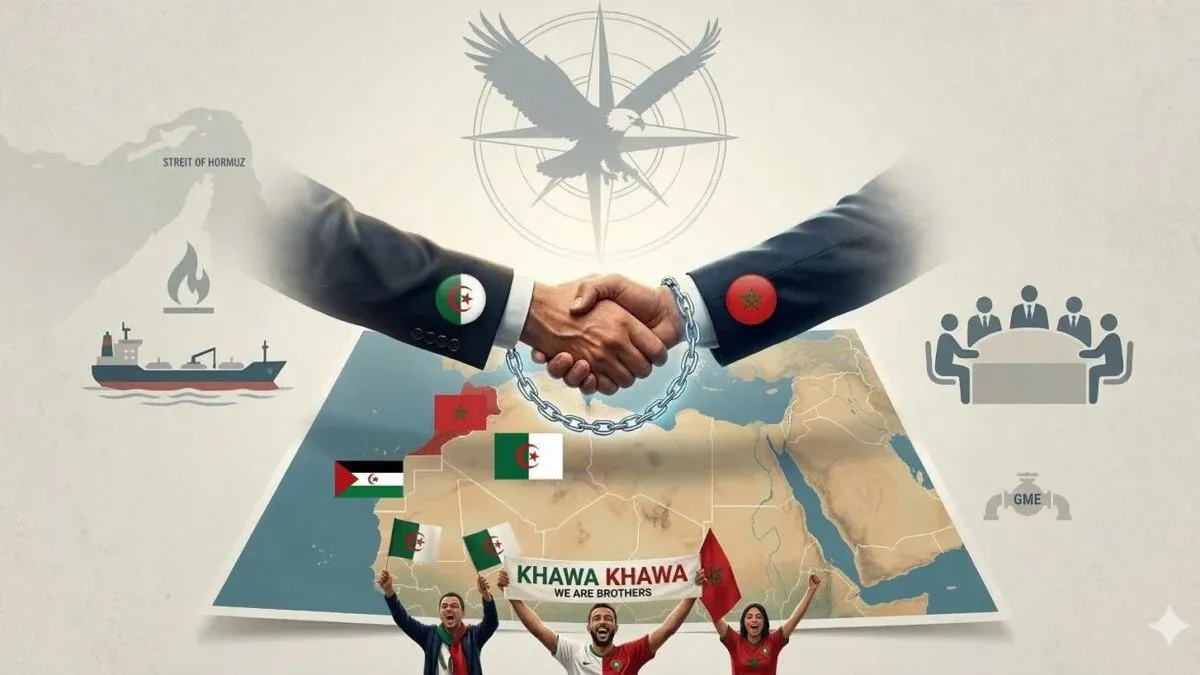
The stakes extend far beyond the Saharan desert. As analyzed in a December 2025 note by the Jean-Jaurès Foundation, titled "The Audacity of Reconciliation," the aim is to firmly embed the Maghreb within an Atlantic security architecture, to curb Russian expansion in the Sahel, and, importantly, to contain Chinese penetration on the continent. A reconciled Maghreb would present an entirely different geopolitical landscape. The same note discusses the reopening of the Maghreb-Europe gas pipeline as a primary symbol of economic rapprochement, even outlining a potential strategic alliance between Algeria's Sonatrach (offering cheap gas and green hydrogen) and Morocco's OCP Group (technology and logistics). The IMF estimates that deep integration could boost national GDPs by 30% over ten years by creating a market of 100 million consumers.
In this context, the ongoing conflict between the United States, Israel, and Iran is reshuffling the cards. The effective closure of the Strait of Hormuz since February 28, which has seen maritime traffic plummet by 97% according to UNCTAD, presents Algeria with a strategic choice. By aligning with the Gulf monarchies, Algeria is doing precisely what Washington expects of it while also acting in the best interest of its population, economy, and influence.
This repositioning is not inconsequential. Iran was one of the few allies supporting Algeria's stance on Western Sahara. By distancing itself from Tehran, Algeria weakens a crucial pillar of its diplomatic posture while sending a strong signal to the Trump administration at a critical moment when the latter seeks to finalize an agreement—a gesture that logically anticipates some form of reciprocity.
The global energy crisis related to Hormuz also endows Algeria with a significant card: its natural gas reserves become a strategic asset for Europe in search of diversification. Already approached to compensate for the withdrawal of Russian supplies, Algeria is becoming indispensable.
While diplomatic efforts may be sluggish, the peoples of both nations have already demonstrated the way forward. The CAN 2025, held in Morocco in December-January, showcased unprecedented scenes of Algerian-Moroccan fraternity. In Rabat, thousands of Algerian supporters were warmly welcomed by Moroccans offering tea and pastries, while the slogan "khawa khawa" ("we are brothers") echoed in the stands from both sides.
Finally, another intriguing sign emerged: at the end of February, a direct flight between Casablanca and Algiers was conducted by a private plane operated by a Slovenian company. The use of a third-party operator suggests a desire for discretion surrounding potential unofficial diplomatic contacts.
However, significant obstacles remain. The Algerian regime has made support for the Polisario a cornerstone of its strategic identity for half a century. Any compromise would necessitate a softening of Algeria's position regarding the independence movement. Yet if the Sahrawi population were to benefit alongside Algerians and Moroccans, that would certainly be worth considering. Meanwhile, Morocco, despite its recent diplomatic achievements, must make concessions as well. Indeed, the law favors the Sahrawi position, and without legal security, commercial development will remain limited.
Thus, in the current energy crisis, it is Algeria that holds the potential to tip the scales. As noted by the Jean-Jaurès Foundation, what the Maghreb lacks is not resources but rather trust. The Hormuz crisis could paradoxically open a window that fifty years of diplomacy have failed to achieve.
No date has yet been set for the next round of negotiations. However, in Washington and throughout the Maghreb capitals, there is a shared awareness that time is of the essence. The peoples, for their part, have not waited.
As reported by afrik.com.