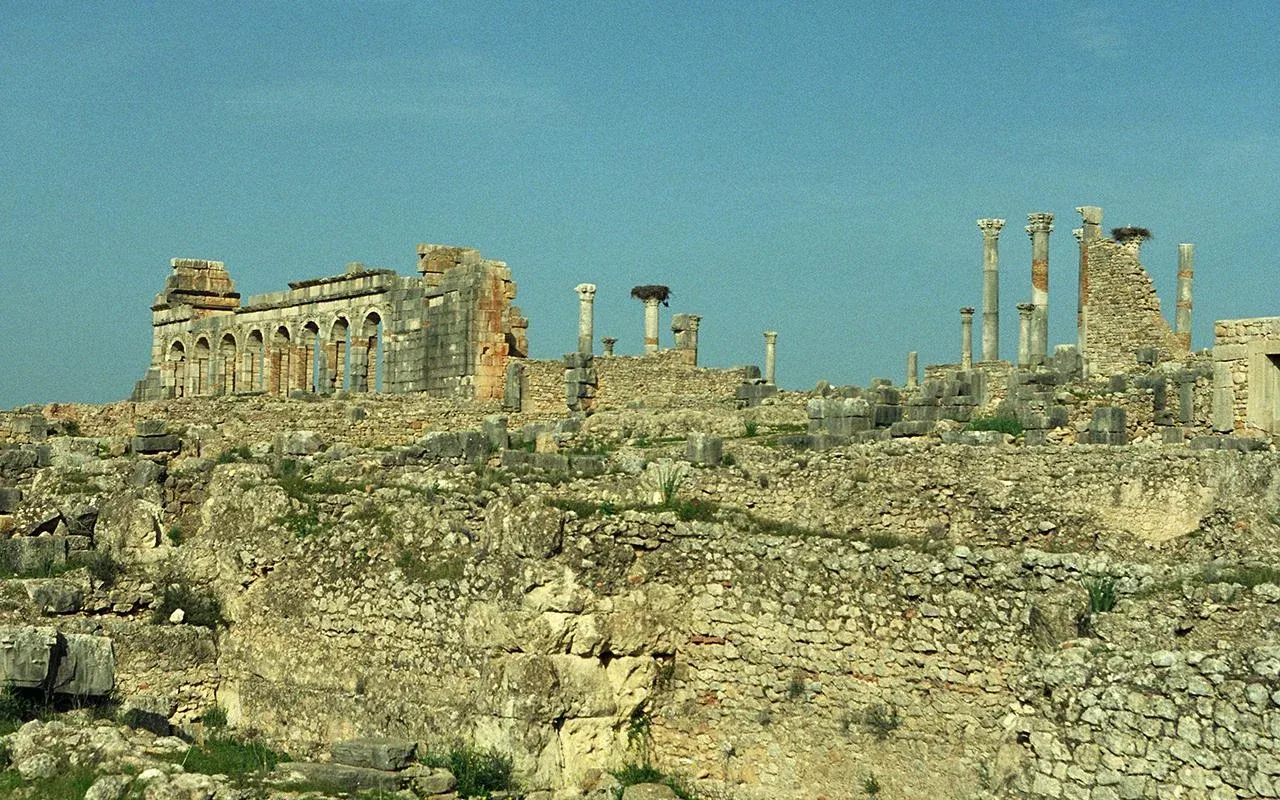

Archaeologists excavating the historic site of Walīla, which was established on the remnants of ancient Volubilis in Morocco, have unearthed a fascinating artifact: a carved stone game board situated within a public bathhouse that dates back to the early Islamic period. This remarkable discovery provides invaluable insight into the recreational activities that were prevalent in North Africa during the late eighth to tenth centuries CE. The significance of this find cannot be overstated, as it sheds light on the social practices of the time, particularly in leisure and gaming.
The game board itself was ingeniously carved into the upper step of a cold-water pool located within a hammam that dates back to the Idrisid period. Researchers believe that the design of the board corresponds to a strategy game known today as tāb or sīg, a game that continues to be played in various parts of North Africa and the Middle East. If validated, this interpretation would mark the board as the earliest known evidence of this game in the region, highlighting the continuity of cultural practices through centuries.
Board games have long been referenced in medieval Arabic literature, emphasizing their integral role in everyday life. However, archaeological evidence detailing gaming practices in early Islamic societies has been relatively scarce. One of the primary challenges in this area of research is dating the numerous carved game boards, as many were etched onto structures and pavements that have remained in use for extended periods, thus obscuring their chronological context.
The context surrounding the Walīla game board is much clearer. The bathhouse in which it was found was constructed in the late eighth or early ninth century and fell into disuse by the tenth or eleventh century. The presence of coins, pottery, and radiocarbon dating from the site provide a reliable framework for establishing the timeframe in which the game board was actively used.
Measuring approximately 34 centimeters in length and 9.5 centimeters in width, the board features three rows of at least thirteen shallow holes that were meticulously cut directly into the stone step using tools such as hammers and chisels. Researchers have noted that the unevenness of the carving suggests it may have been created by a non-professional craftsman rather than a skilled stoneworker, adding another layer of intrigue to this historical artifact.
The specific placement of the board within the bathhouse appears to have been intentional. Located at the entrance to the cold-water pool, it would have been easily visible to bathers entering or exiting the water. This strategic positioning implies that two players could comfortably sit across from each other while engaging in the game, suggesting that the board was integral to the social fabric of the bathhouse, rather than being merely a random or unauthorized carving.
Researchers also explored the possibility that the board could be associated with mancala, a family of games played throughout Africa and Asia. However, several characteristics argue against this theory. Mancala boards typically feature deeper holes designed to accommodate multiple game pieces, whereas the Walīla board has only shallow depressions. Additionally, the arrangement of holes does not align with common mancala layouts, further reinforcing the idea that the board is more closely related to tāb or sīg.
In the context of early Islamic history, Walīla was a significant settlement. Prior to the arrival of the Idrisids, the area already maintained extensive trade networks across the Mediterranean and produced its own copper coinage. Under Idrisid rule, the city experienced rapid expansion, with new residential areas and bathhouses constructed outside the ancient Roman walls.
The architectural features of the bathhouse draw connections to eastern Mediterranean architectural traditions. Excavations at Walīla have revealed imported goods from Egypt and the Levant, indicating cultural exchanges that influenced local building designs. Moreover, similar game boards from the early Islamic period have been discovered in regions such as Arabia, Jordan, and Syria, suggesting that the spread of gaming practices may have paralleled the movement of people and trade throughout the Islamic world.
This discovery underscores the broader social significance of medieval bathhouses. While hammams served essential functions related to washing and ritual cleanliness, they also functioned as social hubs where individuals gathered for conversation and recreation. Evidence from another early Islamic bath complex at Hammat Gader in the Golan Heights includes several carved game boards dating to the seventh century, reinforcing the notion of gaming as an integral aspect of the bathhouse experience.
The game board from Walīla enriches the growing body of evidence suggesting that gaming was a common feature of life within these bathhouses. Its prominent location indicates that players likely engaged in their games in full view of other patrons, transforming what might be a routine visit to the hammam into a vibrant opportunity for social interaction.
Researchers argue that artifacts such as game boards and other remnants of play are often overlooked in archaeological excavations. However, these simple yet profound carvings provide critical insights into the everyday lives of people in the past, capturing the essence of activities that written records frequently neglect. In the case of Walīla, this pattern of shallow holes etched into a stone step preserves a tangible connection to the past, revealing a pastime that was enjoyed over 1,200 years ago.
As reported by archaeologymag.com.