
Unraveling the Secrets of Ancient Life in Morocco's High Atlas Mountains
In a remarkable discovery, researchers have identified unusual wrinkle patterns in ancient rock layers located in Morocco’s Central High Atlas Mountains, shedding light on the conditions that prevailed approximately 180 million years ago. These intriguing ripple marks, layered with creases and carbon-rich deposits, suggest the presence of microbial mats, likely formed by chemosynthetic microbes—organisms capable of thriving on chemical reactions rather than relying on sunlight. According to a news release from the Geological Society of America dated January 14, 2026, these findings challenge previous understandings of how life existed in deep marine environments.
Typically, wrinkle structures are associated with shallow, sunlit waters where photosynthetic microbes can flourish. This raises a perplexing question: how did these shallow-water textures manifest at depths of around 590 feet? If similar structures can develop in the absence of light, it implies that geologists might be overlooking vital clues within deep-water rock formations. This revelation could redefine our understanding of ancient ecosystems and their adaptations to various environmental conditions.
From Discovery to Interpretation: The Role of Turbidites and Microbial Mats
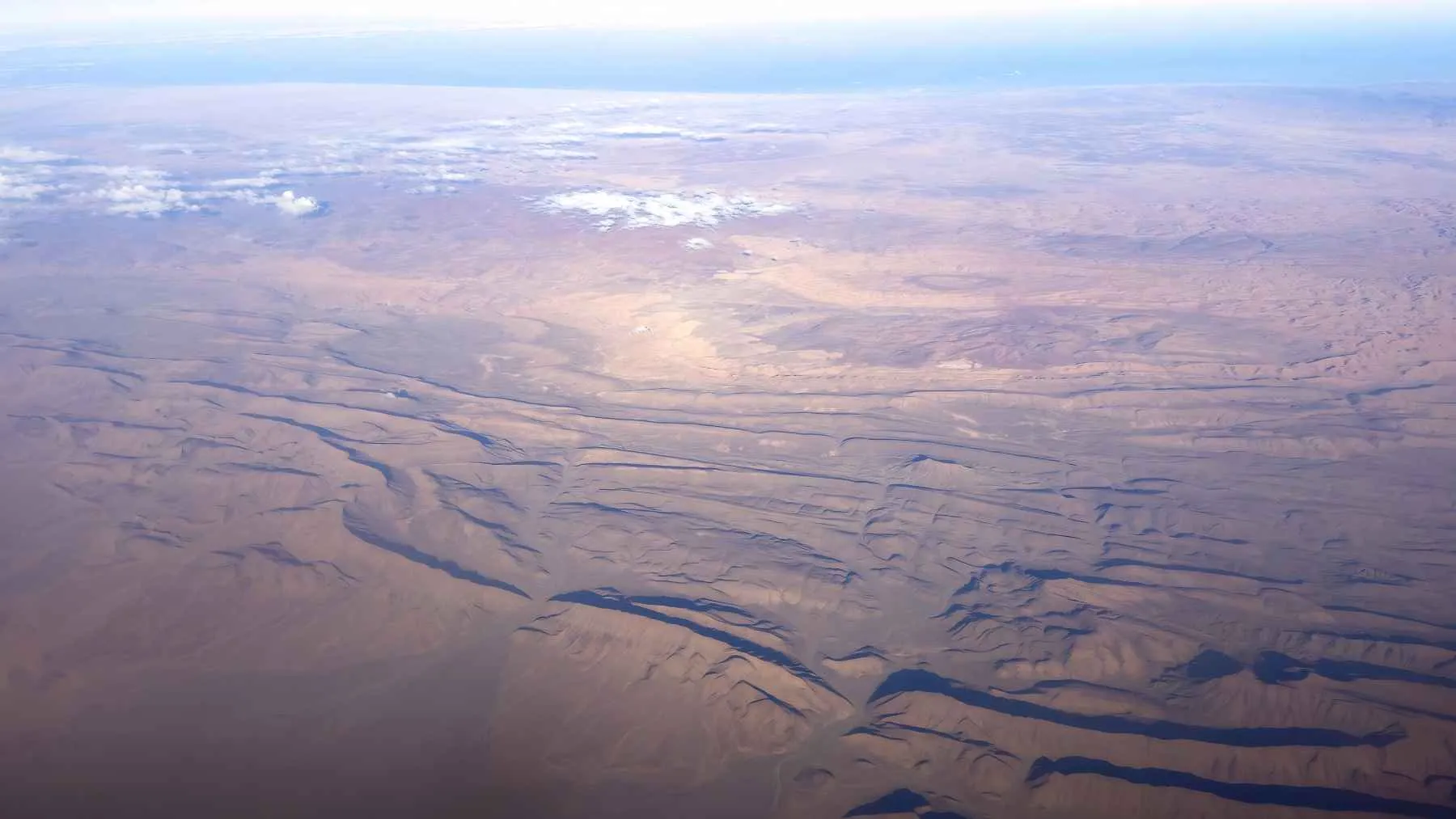
The discovery of these wrinkled textures traces back to 2016 when Dr. Rowan Martindale, a paleoecologist and geobiologist at the University of Texas at Austin, stumbled upon the unique rock formations while hiking in the Dadès Valley of Morocco. She highlighted the significance of these “wrinkle structures” to her colleague, Stéphane Bodin from Aarhus University, noting their striking resemblance to the texture of “elephant skin.” The geological history of these rocks reveals that they originated on an ancient seabed before being uplifted into mountainous terrain over millions of years. While initially studying ancient reefs, the researchers encountered this peculiar layer that added an unexpected dimension to their exploration.
The geological context involves traversing through stacks of turbidites—rock beds formed by rapid, sediment-laden flows, reminiscent of underwater avalanches. As these turbidity currents slow, they deposit layers of sediment that can encapsulate living organisms, provided the conditions are right. The wrinkled structures observed are small ridges and pits that form when algae and microbes create a living mat across the sediment, effectively sealing in the tiny details of their existence. If quickly buried by subsequent sediment flows, these structures can be preserved in rock, providing a snapshot of ancient life.
Interestingly, most modern examples of such structures are found in shallow tidal zones where sunlight penetrates, allowing for photosynthesis. However, the depths at which these Moroccan wrinkles formed present a significant challenge for organisms dependent on sunlight, as the ocean’s photic zone is generally limited to around 660 feet. Thus, the researchers propose that the unique geological conditions of the time may have allowed for the preservation of these microbial mats despite the presence of more complex animal life that typically disrupts such formations.
In their investigation, the researchers also analyzed the layers beneath the wrinkles, discovering elevated carbon levels indicative of organic material at the time of sediment formation. While this alone does not serve as definitive proof, it bolsters the hypothesis of a biological origin for the structures, especially as the geometry of the wrinkles aligns with known microbial mat formations. To further validate their findings, the team referenced contemporary observations of microbial mats thriving in deep-sea environments, associated with chemosynthetic bacteria that do not rely on sunlight.
The researchers propose that turbidites might have created a temporary “window” for these microbial communities to establish themselves and be preserved. Nutrient-rich debris flows could facilitate the growth of microbial mats by providing essential organic matter while simultaneously reducing oxygen levels that typically deter many animals from disturbing the sediment. This delicate balance could allow microbes to flourish for brief periods, culminating in the formation of the distinctive wrinkled textures.
Ultimately, this discovery compels geologists to reconsider the interpretation of wrinkle structures, which have traditionally been linked to shallow-water environments. The findings suggest that these structures can also represent chemosynthetic communities in deeper waters, extending our understanding of ancient marine ecosystems far beyond the limitations of sunlight-driven life. The team advocates for further laboratory experiments to explore the frequency of such formations and to determine whether other deep-water rock outcrops warrant closer examination.
As reported by ecoticias.com.