
Brahim Ghali's Strong Critique of Spain's Colonial Actions
Brahim Ghali, the leader of the Polisario Front, has vehemently criticized Spain for what he describes as a "conspiracy" and an "illegal agreement" made with Morocco during Spain's exit from its former colony, which he claims deprived the Sahrawi people of their right to self-determination. He emphasized Spain's ongoing responsibility as the administering power of a territory that the United Nations still classifies as pending decolonization. This assertion was made during the commemoration of the 50th anniversary of the proclamation of the Sahrawi Arab Democratic Republic (SADR), which took place on February 27, 1975, just one day before Spain officially lowered its flag in what was once its 53rd province. Ghali argued that this proclamation was a timely, appropriate, and decisive response to a comprehensive colonial conspiracy orchestrated by the entity responsible for Western Sahara's administration.
Addressing a large crowd of Sahrawis gathered in the Auserd refugee camp in Tindouf, Algeria, Ghali stated that Spain attempted to evade its legal obligations concerning its colony through an illegal agreement that violates international law. He referred specifically to the Tripartite Agreement signed in Madrid in November 1974 between Francoist Spain and the governments of Morocco and Mauritania for the division of the territory. According to Ghali, the purpose of this agreement was to "strip the Sahrawi people of their right to existence and self-determination while paving the way for a new occupying force to seize their national territory," referring directly to Morocco. In the presence of various delegations from across Spain, including representatives from the political party Sumar, Ghali reminded Spain of its "non-expiring legal responsibility" regarding the completion of the decolonization process in Western Sahara, despite successive governments claiming that this responsibility ceased with a letter sent to the UN on February 26, 1975, announcing Spain’s final departure from the territory.
Call for International Support and Recognition
Furthermore, Ghali directed a message to the European Union, urging it to "respect judicial decisions and international law, avoiding agreements that involve the exploitation of Sahrawi resources under occupation." This statement came in light of a ruling by the EU Court of Justice that invalidated fishing and agricultural agreements between the EU and Morocco. Additionally, he asserted that the Sahrawi state, recognized by over 80 countries, including many outside of Spain, is currently a "national, continental, and international reality" with embassies and representations of the Polisario Front around the globe. The SADR is also a founding member of the African Union, taking on responsibilities in promoting peace, security, stability, and development.
In a context where the conflict with Morocco remains active since the cessation of the ceasefire in 1991, Ghali reinforced the SADR's determination to "strengthen and consolidate its relationships with countries and peoples around the world," particularly in the region, including Morocco. He emphasized that the Sahrawi people would not be a source of threat but rather a partner willing to engage in peace and cooperation. Ghali reiterated that the SADR has always sought peace based on respect for international borders and regional stability, recalling that it previously signed a peace agreement with Mauritania and continues to aspire to a fair and definitive solution with Morocco.
Ghali also referenced the mediation efforts recently undertaken by the United States and the United Nations, including a round of talks held in Madrid in February with the participation of the Polisario, Morocco, Algeria, and Mauritania. This was prompted by the UN resolution 2797, which encourages the parties to negotiate based on Morocco's autonomy plan for Western Sahara presented in 2007, a proposal that Spain has supported. He maintained that the ultimate goal is to "achieve a solution that guarantees the Sahrawi people's inalienable right to self-determination and independence." He stressed that exercising this right is the only path to achieving a just and lasting peace, viewing the 50th anniversary of the SADR as a global message of resistance, national unity, and a firm rejection of any conspiracy against the rights of the Sahrawi people.
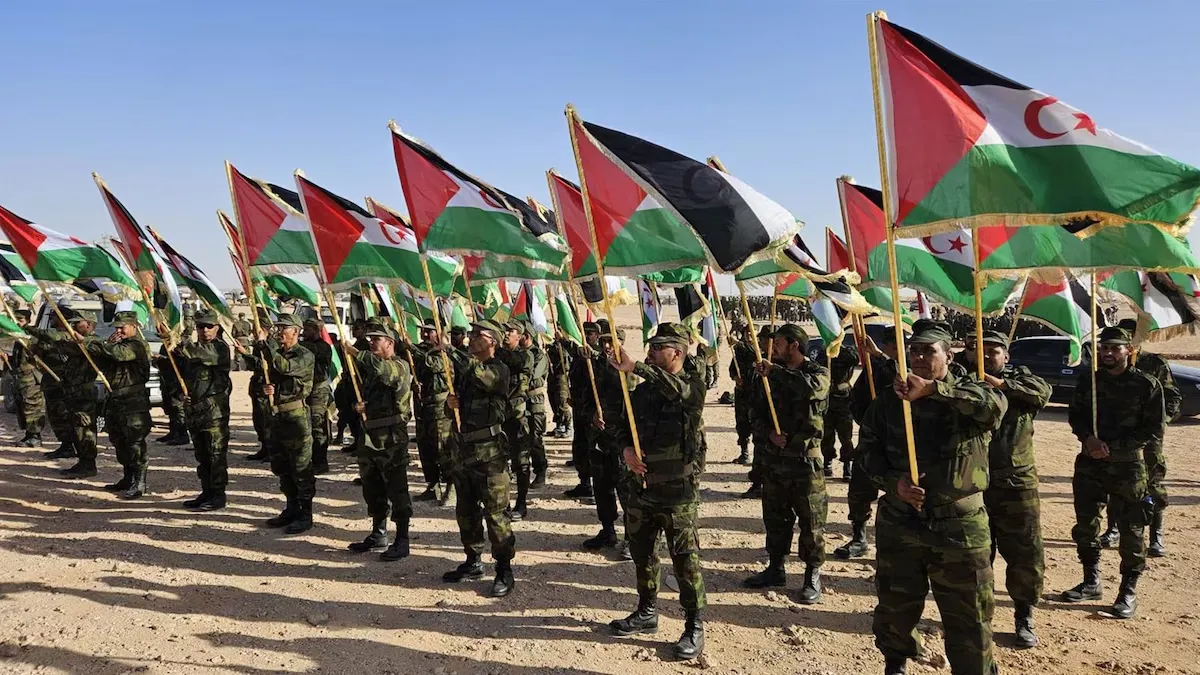
Following Ghali's address, where he urged the Sahrawis to maintain unity in the face of challenges to achieve their sovereignty, a military parade took place. This parade, which included veteran fighters of the Polisario Front, showcased military units accompanied by dromedaries. Among the veterans was Batir Mohamed, who began fighting at the age of 14, and Noussa, who was born in Villa Cisneros and was injured during the war against Morocco in 1982. One Sahrawi, who still has family in the Moroccan-controlled part of Western Sahara, expressed hope for a favorable solution for the Sahrawi people’s independence but affirmed that the struggle would continue if such a solution was not reached.
The parade, attended mainly by women and children waving flags and ululating, featured various units of the Popular Liberation Army currently facing off against the Moroccan Army near the wall separating the territory controlled by the Polisario from that under Moroccan control, showcasing armored vehicles, launchers, and mortars. "It is my duty to help," declared Wanna, a 43-year-old Sahrawi born in the camps, who now resides in Alicante but works in Ibiza during the summer. He expressed his commitment to always respond to the call to defend the positions of the Polisario Front.
As reported by infobae.com.