
Brazil and Morocco: A Meeting of Two Worlds
The opening match of Group C at the Men's World Cup will feature a captivating encounter between Brazil and Morocco, two national teams that embody distinct football philosophies and varying future prospects for the sport in their respective countries. Brazil, the most successful participant in World Cup history with five titles, aims to uphold its grand tradition, yet it has not reached a final since 2002 and has only made it to the semifinals once during this period, suffering a staggering 7-1 defeat against Germany in 2014. In stark contrast, Morocco represents an emerging football force, not just within its borders but across the African continent as well. The Moroccan team made headlines during the 2022 World Cup in Qatar, reaching the semifinals after eliminating formidable opponents like Spain and Portugal. Currently, both teams are closely matched in the FIFA rankings, with Brazil holding the sixth position and Morocco just behind in seventh.
Wycliffe W. Njororai Simiyu, a Kenyan researcher specializing in kinesiology, sports pedagogy, and sports science, predicts an intriguing clash of styles. He notes, "Brazil, under Carlo Ancelotti's guidance, plays with fluid and creative attacking rotations while relying on individual brilliance to breach defenses. Conversely, Morocco will employ its signature suffocating midfield pressing to counter Brazil's attempts. They will aim to tighten the spaces between the lines to restrict the Brazilian forwards' movement and leverage their impeccably organized defense to force errors and launch rapid counterattacks down the flanks. It will be a tactical chess match between patience and explosive speed," he elaborates.
A Historic Moment for African Football
Simiyu highlights that this match marks a unique moment in African football history. "Traditionally, a game between an African national team and Brazil has been perceived as a showcase of joyful and unpredictable football against an untouchable giant. However, during the 2022 World Cup, Cameroon managed to defeat Brazil 1-0, marking Brazil's first loss to an African national team in World Cup history," he recalls. The respect that teams like Morocco have earned on the field is shifting the narrative around the game. "This time, Morocco steps onto the pitch as a legitimate world power. If they can neutralize a traditional football powerhouse like Brazil in a high-stakes tournament and achieve a favorable result, it will change the entire narrative, demonstrating that African football is not merely a talent pool for raw diamonds to be exported, but a cradle of tactical excellence capable of dominating the old guard on the biggest stage in the world," he asserts.
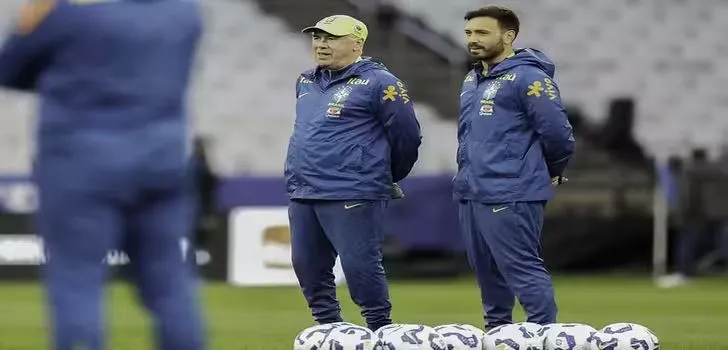
Beyond the clash of different traditions on the field, this match also symbolizes profound changes in the leadership of the national teams. Notably, this will be the first World Cup without a Brazilian coach present, as the team is led by Italian Carlo Ancelotti. Conversely, Morocco will be under the stewardship of Mohamed Ouahbi, who was born in Belgium to Moroccan parents and won a World Championship with the country's U20 national team. Ouahbi follows in the footsteps of another son of the diaspora, Walid Regragui, who guided Morocco to its historic semifinal run in Qatar.
Eight out of ten African national teams at this World Cup are coached by local trainers or members of the diaspora, a crucial factor in the rise of these teams. "For decades, African associations routinely turned to European nomadic coaches. This often resulted in cultural and linguistic disconnects, with coaches attempting to impose rigid and foreign models without understanding the nuances of their squads," Simiyu explains. "The ascent of Walid Regragui in Morocco and Emerse Faé in Ivory Coast represents a significant shift towards technical decolonization in African football."
As reported by latina-press.com.