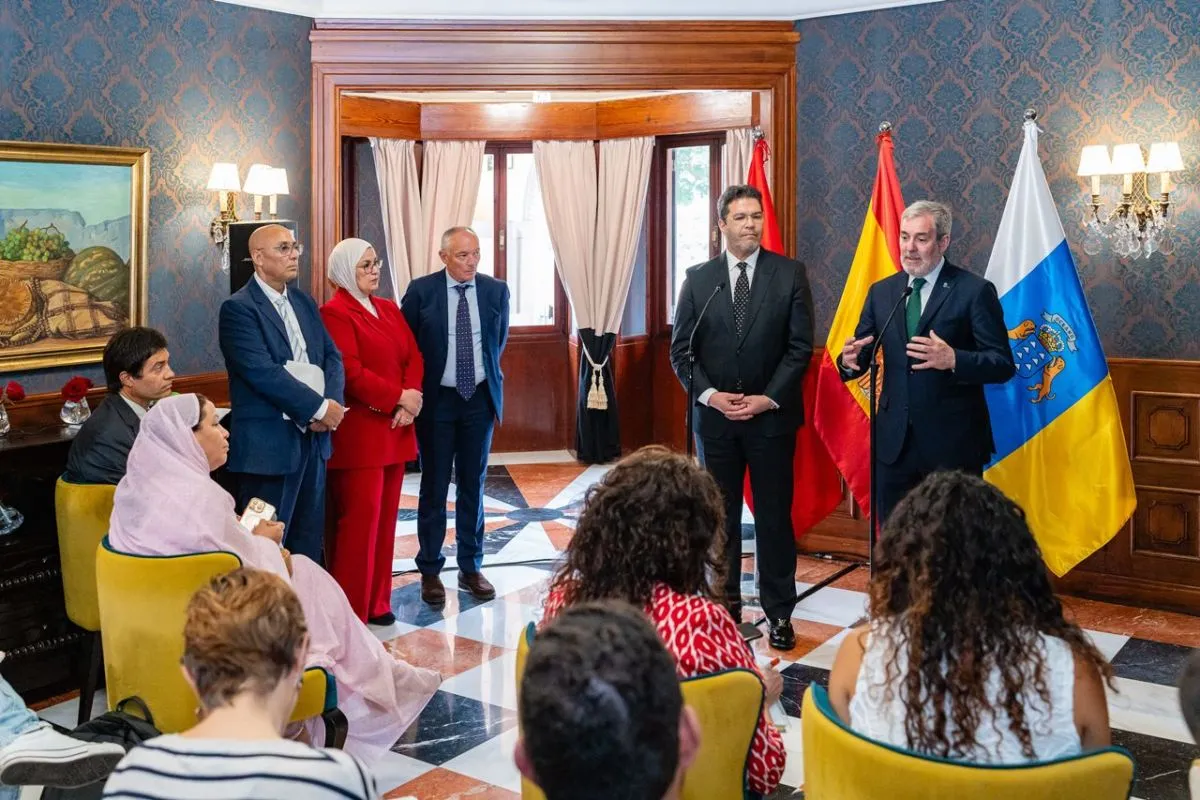
The head of the Canary Islands government, Fernando Clavijo, recently affirmed his full support for the Spanish government's position regarding the Western Sahara issue. He emphasized that this stance is grounded in a United Nations resolution, which views autonomy under Moroccan sovereignty as a "realistic solution" for the disputed territory. During a press conference held in Las Palmas de Gran Canaria, following his meeting with Karim Achengli, the president of the Souss-Massa Regional Council in Morocco, Clavijo reiterated that the authority to manage Spain's international relations lies solely with the central government. He stated, "We are part of Spain, and we fully comply with the decisions made by our government. We share and respect this agreement completely."
Clavijo recalled that he had previously expressed similar sentiments during an earlier visit to Rabat, where he acknowledged Spain's support for a future in Western Sahara that aligns with Moroccan autonomy, clarifying that he was merely accepting Spain's foreign policy. Clavijo and Achengli also discussed various opportunities for economic collaboration, particularly in the areas of blue economy and tourism between their regions. This institutional visit included over 80 representatives from various sectors in Souss-Massa and is a follow-up to an earlier Canary delegation that visited the Moroccan city of Agadir in January, which has already begun to yield positive outcomes.
According to Clavijo, notable advancements have been made in academia, with student exchanges and joint research projects between universities, as well as developments in port and maritime sectors. Since 2023 began, three commercial missions from the Canary Islands to Morocco have taken place, two of which Clavijo personally attended. These missions have helped strengthen "opportunity ties" that span from blue economy and tourism to academia and water management. Clavijo expressed confidence that through cooperation and institutional loyalty, significant opportunities will be generated for the benefit of the local population. Achengli highlighted that this mission enables the construction of a shared future that transcends geographical proximity across several sectors, including agriculture, tourism, innovation, and investment. Both leaders acknowledged the challenge of quantifying bilateral agreements in monetary terms.
At the conclusion of the high-level meeting between representatives from the Canary Islands and Souss-Massa, Clavijo and Achengli announced the establishment of a technical committee aimed at monitoring and assessing the impact of the signed agreements. Clavijo underscored the development potential of the Moroccan region in sectors such as agro-industry, maritime industries, energy, logistics, water management, health, and tourism. He stated, "By better connecting our businesses, facilitating trade missions, and organizing B2B meetings along with joint projects, we will be creating a real economy. A real economy translates to jobs, investment, activity, and future prospects." Achengli emphasized that during the meeting, they specifically defined the collaborative axes in areas such as innovation, investment, tourism, and agriculture, and both leaders recognized the substantial potential within the sports sector.
As reported by diariodeavisos.elespanol.com.