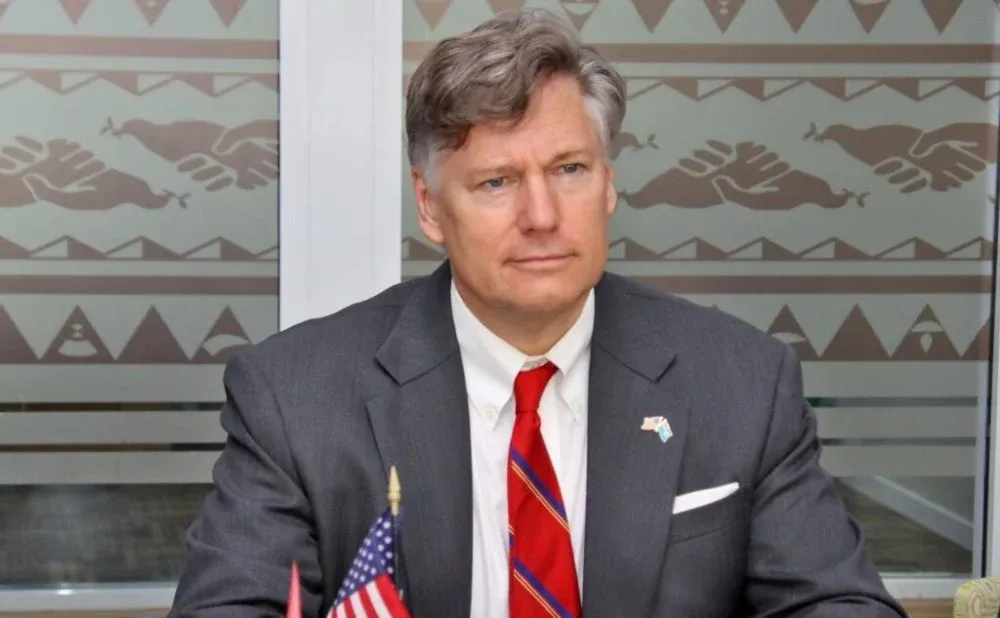
Christopher Landau, the U.S. Under Secretary of State, recently arrived in Rabat, Morocco, with an agenda that includes what the American diplomacy refers to as 'long-standing security cooperation.' However, beyond this terminology, significant implications lie beneath. This marks Landau's inaugural Maghreb tour since taking office, taking place from April 27 to May 1, with stops in Algiers first, followed by Rabat. This visit falls within a narrow diplomatic window, as the United Nations Secretary-General is set to present a strategic review to the Security Council concerning MINURSO, as mandated by resolution 2797 from October 2025. The official statement released by the U.S. State Department leaves no ambiguity regarding the prioritization of issues at hand. From Algeria, Washington discusses 'joint efforts to tackle regional security concerns' and 'significant trade agreements with American companies,' while the tone shifts in Rabat, focusing on 'advancing technological and space coordination' alongside a 'long-standing security cooperation relationship.'
Calvin Dark, president of RC Communications and a geopolitical analyst, provides a clear analysis of the underlying significance of Landau's visit: 'The timing of Under Secretary Christopher Landau's visit is meaningful. It demonstrates that Rabat and Washington share strategic priorities: security, technology, space... and that a definitive resolution to the Sahara conflict will unlock these fields of cooperation in unprecedented ways,' he stated.
As Morocco prepares for this visit, it does so with a well-defined roadmap. The security partnership between Rabat and Washington is not a new topic; it has evolved into one of the longest-standing military partnerships in the Mediterranean's southern region, structured around Morocco's designation as a major non-NATO ally in 2004 and the annual African Lion exercises that gather tens of thousands of military personnel on Moroccan soil. Landau's discussions in Rabat aim to extend and broaden this existing framework, which is structured around three key areas.
- The first involves the expansion of defense industrial cooperation, with advanced discussions on technology transfers, furthering Morocco's investments in high-tech value chains.
- The second pertains to the space sector: Morocco has yet to sign the Artemis Accords, an international framework led by the United States that sets the rules for the exploration of resources on the Moon, Mars, as well as on asteroids and comets (63 signatory states as of late April, including four African countries). Morocco could be associated with this initiative, reinforcing its Atlantic anchoring and scientific positioning on the continent.
- The third concerns digital technology and sensitive technologies, aiming for a structured bilateral framework on cybersecurity and artificial intelligence—two areas where Morocco has made remarkable institutional advancements in recent years.
Calvin Dark elaborates on the significance of this development: 'What we observe today is the culmination of a bipartisan leadership in Washington, the strategic vision of His Majesty King Mohammed VI, and the targeted and sustained efforts of Moroccan diplomacy across multiple U.S. administrations.'
The other facet of this sequence plays out in Congress. In the House of Representatives, Joe Wilson (Republican from South Carolina) and Jimmy Panetta (Democrat from California) introduced the Polisario Front Terrorist Designation Act (H.R. 4119) in June 2025, seeking to officially request that the U.S. administration designate the Polisario Front as a foreign terrorist organization. This initiative gathers twelve sponsors and co-sponsors, including prominent members of the Foreign Affairs Committee. In the Senate, the Polisario Front Terrorist Designation Act of 2026 (S. 4063) was introduced on March 11 by Ted Cruz, Tom Cotton, and Rick Scott, joined by David McCormick, who chairs the Counterterrorism Subcommittee on the Foreign Relations Committee. This alignment between the executive and legislative branches is rooted in a long-standing genealogy.
Calvin Dark emphasizes this alignment: 'The current synchronization between the American executive and legislature on Moroccan issues is not new; it reflects a long-standing, rich, and multidimensional bilateral relationship—a natural outcome of what becomes possible when two countries like the United States and Morocco align their values, priorities, and visions for the benefit of their peoples. I recall 2009 when 233 bipartisan members of the House publicly supported the Moroccan autonomy plan to the executive branch, followed in 2010 by 54 senators from both parties.'
Furthermore, Landau's visit aligns with a structural transformation in U.S. diplomacy concerning the Sahara issue. 'What is truly unprecedented is the trajectory initiated since the American recognition of Moroccan sovereignty over the Sahara in December 2020,' analyzes Calvin Dark. 'Since then, Washington has directed the UN Security Council toward a solution-focused approach, rather than a process for the sake of process. The Council now concentrates on the only realistic, credible, and widely supported option internationally: the Moroccan autonomy plan.'
This dynamic finds converging support today. Staffan de Mistura, the Secretary-General's personal envoy, noted earlier this week that the Moroccan plan represents 'a real opportunity' to resolve the dispute. On the European side, High Representative Kaja Kallas formalized during her visit to Rabat on April 16 and 17 the alignment of the Twenty-Seven with the centrality of the Moroccan initiative. In Rabat, Christopher Landau does not come to persuade; he comes to affirm a trajectory that Moroccan diplomacy, under Royal guidance, has patiently constructed.
As reported by lematin.ma.