
Upon arriving at one of the chosen filming locations for Christopher Nolan's ambitious project, _The Odyssey_, Matt Damon posed a rhetorical question that echoed the challenges of the production: "Who on earth thought it was possible to shoot a film here?" Before him stood the majestic Castello di Santa Caterina, a 9th-century fortress perched atop the island of Favignana, located off the western coast of Sicily. Historically, Favignana was considered by some scholars to be the last stop of Odysseus before confronting the Cyclops Polyphemus. Two millennia later, Nolan returned to this same landscape to recreate the Homeric universe in what is deemed the most ambitious production of his career. Just as the tale of Odysseus is fraught with obstacles, Nolan aimed to ensure that his adaptation mirrored this arduous journey. The only access to the Castello di Santa Caterina is a steep and narrow 45-minute mountain trail, presenting significant challenges for transporting the equipment of a major film production. Those who were able would hike up, while the others were transported by helicopter.
In an interview with the _Los Angeles Times_, Nolan shared insights about the filmmaking process: "We filmed as if it were a documentary." Over the course of 91 days, the team traveled through Morocco, Greece, Italy, Iceland, Scotland, and Universal Studios in the United States, assembling a production valued at around $250 million. The actors engaged in extensive training, learning to sail and paddle, and Nolan emphasized that they discovered insights that would have remained elusive had they been confined to a studio setting.
From Iceland to Greece: The Demanding Landscapes of 'The Odyssey'
Among the most challenging shooting locations was Iceland, which was transformed into Hades with its glaciers and volcanic landscapes. The crew braved extreme cold and powerful winds, conditions so intense that actress Zendaya recalled her face becoming numb on her first day of filming. "I had my lines perfect, but my mouth was frozen. I couldn't move it. Only incomprehensible sounds were coming out," she recounted on the podcast _Happy Sad Confused_.
In Greece's Ionian Sea, Nolan filmed the iconic confrontation between Odysseus and the Cyclops Polyphemus in the legendary Nestor's Cave. True to his aversion to digital effects, the director ordered the construction of an 18-meter tall mechanical Cyclops inside the cave, erected with a temporary structure to protect the archaeological site. A similar philosophy was applied in Psychro Cave in Crete, where the team built a set within the natural cavity instead of resorting to green screens.
The quest for authentic locations led the production to the Moray Firth coast in Scotland, where the ruins of Findlater Castle and Culbin Forest were used to recreate some of the most dramatic passages of Odysseus's journey. Filming also took place in Morocco, with its deserts, mountains, and historic fortresses—from Marrakech to Essaouira—reinforcing Nolan's commitment to real locations over studio sets.
Transforming Filmmaking Techniques with IMAX Cameras
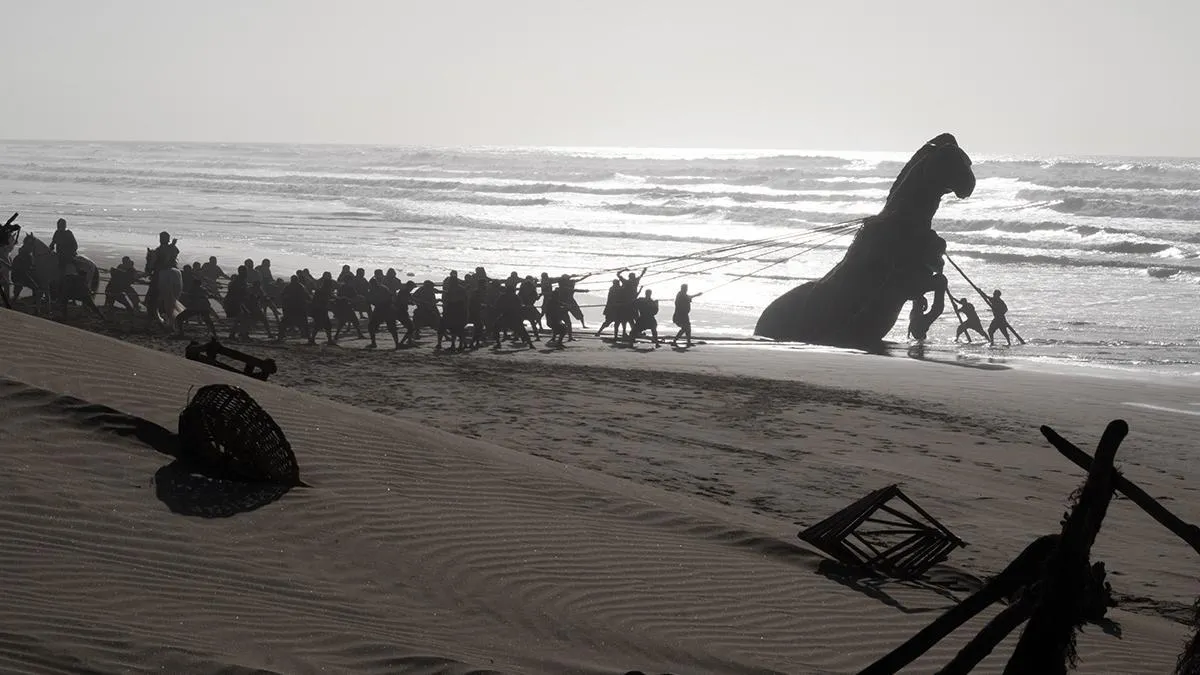
The sheer scale of the production astonished even Tom Holland, despite his experience with Marvel's blockbusters. On his first day, he walked for half an hour along a beach without spotting any cameras or lighting equipment, only encountering Greek ships, extras dressed as warriors, and a military camp. "I kept asking the production assistant where the crew was. It didn’t feel like a set; it was a historical recreation," he explained to _Extra_.
Matt Damon faced some of the harshest conditions while filming. Upon arriving in Morocco, he anticipated a reprieve, as the location was meant to depict the paradise where Odysseus meets the nymph Calypso, played by Charlize Theron. However, he humorously remarked, "It turned out to be the kite surfing capital of the world. There was so much wind that sand got in our eyes, and there was nothing we could do to protect ourselves."
Beyond its breathtaking locations, _The Odyssey_ made history as the first film shot entirely with IMAX film cameras, a format known for its exceptional quality but requiring a roll change every two and a half minutes of filming. Tom Holland confessed to journalist Jacqueline Coley that he was unaware of this. "Every time I heard 'Cut!', I thought, 'Why does he keep cutting? Doesn’t he like what we’re doing?'" It was only later that he realized the pauses were due to the film running out, not his performance.
Additionally, the IMAX cameras posed other challenges, being notoriously loud, making it difficult to capture the actors' dialogues. Nolan described his determination to solve this issue in a conversation with Fandango, stating, "I went to IMAX and asked: 'What can we do?'" Consequently, the engineers developed a soundproof casing to envelop the camera, dampening noise enough to record dialogue without compromising the stunning image quality of the format.
When the team returned to Los Angeles to film at Universal Studios, they anticipated a break after weeks outdoors. However, Nolan orchestrated a storm in the massive water tank of Falls Lake for the final scenes of Odysseus's journey, with two enormous jet engines unleashing thousands of liters of water against the replica ship while the cast worked soaked through and contended with frigid temperatures. In Matt Damon’s words, it turned out to be a "very fitting" conclusion to their epic adventure.
As reported by lavanguardia.com.