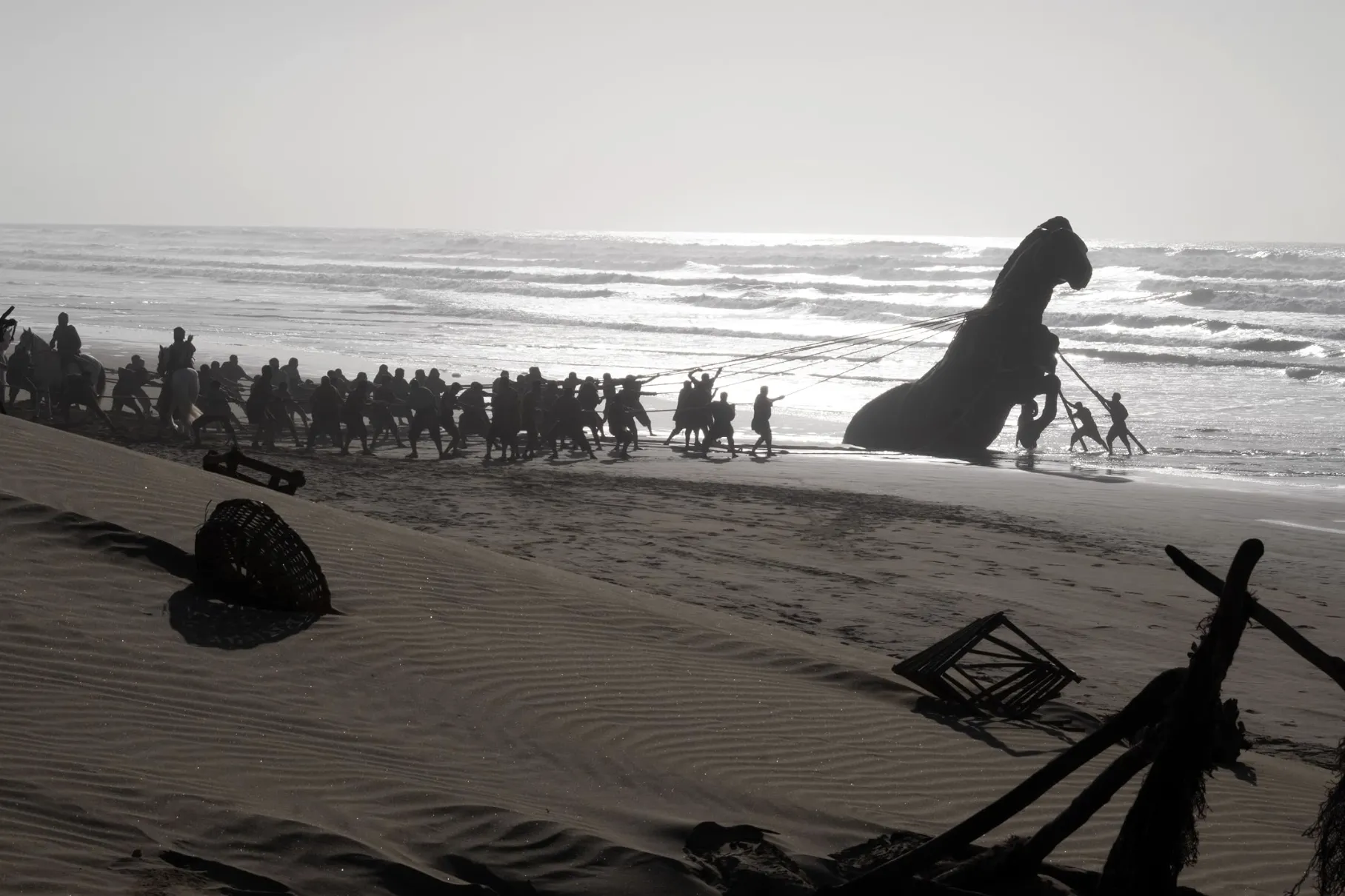
Christopher Nolan's _The Odyssey_, an ambitious cinematic venture with a staggering budget of $250 million, has emerged as a focal point in one of Africa's most enduring territorial disputes, following its filming in the controversial region of Western Sahara. This film, which stands as the most expensive of Nolan's illustrious career, not only showcases his distinctive storytelling but also inadvertently underscores the intricate interplay between international entertainment, investment, and geopolitics within the African context.
Filming for _The Odyssey_ spanned multiple countries, including Greece, Italy, Iceland, Scotland, Morocco, and notably, Western Sahara. Released on July 17, the film has been touted as one of Hollywood's marquee events of the year, with its production costs marking a significant milestone in Nolan's career. Among the scenic locations utilized for the film was the captivating White Dune near Dakhla, a picturesque region where the Sahara Desert meets the Atlantic Ocean, which has become increasingly popular among kitesurfers, birdwatchers, and tourists. Moroccan authorities have actively promoted this area as an emerging tourism hotspot, further entrenching its significance.
Critics Raise Concerns Over Location Choice
However, the choice of filming location has sparked considerable controversy, particularly among advocacy groups like FiSahara, the Western Sahara International Film Festival. This organization, which operates within Sahrawi refugee camps in Algeria, aims to use cinema as a means to elevate awareness surrounding the Western Sahara conflict and to amplify the voices of the Sahrawi people. FiSahara has publicly condemned the production, arguing that filming in Moroccan-controlled Western Sahara without the consent of the Sahrawi population serves to normalize Morocco's governance of a territory whose status remains unresolved under international law. An open letter spearheaded by FiSahara, endorsed by filmmakers, actors, and human rights advocates, urged Nolan and Universal Pictures to engage with the Sahrawi perspective, cautioning that high-profile projects may inadvertently legitimize Morocco's claims over the disputed area. As of now, there has been no public response from either Nolan or Universal Pictures addressing these criticisms.
The Historical Context of Western Sahara's Dispute
Western Sahara, a territory rich in natural resources such as phosphates and fisheries, was a Spanish colony until its withdrawal in 1975. Following Spain's exit, Morocco and Mauritania both laid claim to the region, while the Polisario Front emerged seeking independence for the Sahrawi people. The Green March, organized by Morocco in 1975, escalated tensions, leading to armed conflict. Mauritania eventually relinquished its claims in 1979, allowing Morocco to control the majority of the territory, which it administers today. Currently, Morocco governs approximately 80% of Western Sahara, while the Polisario Front, supported by Algeria, maintains control over sparsely populated areas to the east of a sand berm, continuing to advocate for the independence of the Sahrawi Arab Democratic Republic (SADR).
Despite a UN-brokered ceasefire in 1991 and the establishment of the United Nations Mission for the Referendum in Western Sahara (MINURSO) to facilitate a self-determination vote, internal disagreements have stalled progress toward a resolution. A resurgence of low-intensity conflict erupted in 2020 following skirmishes near the Guerguerat crossing. The geopolitical implications of this dispute have attracted global attention, with the United States recognizing Morocco's sovereignty over Western Sahara in 2020, while countries like France and Spain have endorsed Morocco's autonomy plan. Conversely, the United Nations and the European Union continue to advocate for a UN-led political process without formally acknowledging Moroccan sovereignty over the area.
In conclusion, the arrival of a high-profile Hollywood production like _The Odyssey_ serves not only as a significant cultural event but also highlights Morocco's aspirations to establish Dakhla as a center for tourism, renewable energy, logistics, and international investment. Yet, for many critics, it serves as a stark reminder of how global business and cultural narratives can become intertwined with unresolved issues of sovereignty and national identity. The ongoing controversy surrounding _The Odyssey_ illustrates how a film that has captivated audiences worldwide can simultaneously shine a light on a modern dispute that has influenced North Africa for over fifty years.
As reported by africa.businessinsider.com.