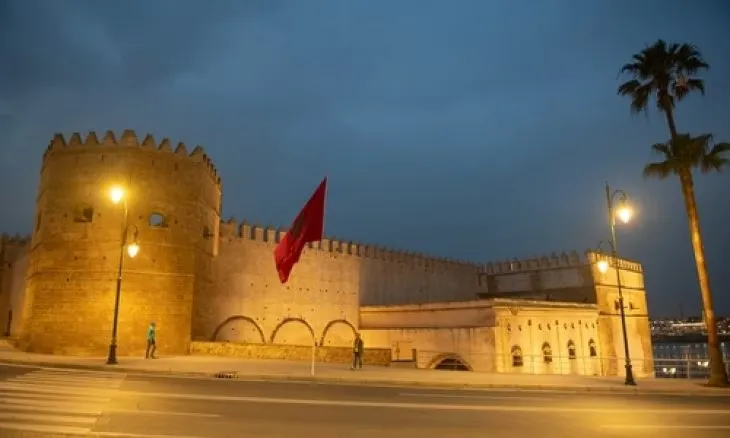

Religious Rituals Spark Debate in Historic Marrakech
The historic city of Marrakech recently became the center of a significant controversy when a bus carrying Jewish tourists stopped in front of the ancient Bab Doukkala wall for a religious ceremony at a predetermined time. Observers suggest that this choice was not incidental but rather carried deep semiotic and narrative implications aimed at creating a parallel between historical sites in Morocco and the Western Wall in occupied Jerusalem. The decision to hold prayers at such a historically Islamic site, as opposed to modern locations or public squares like Jemaa el-Fnaa, raises serious questions regarding the intentions behind this act. The justification that it coincided with prayer times appears weak in light of the possibility of scheduling tourist trips with precision to avoid stirring sensitivities in public spaces that hold national significance.
Some interpret this behavior as an attempt to establish a foothold for Zionism in Morocco, insinuating that practicing prayers within the Moroccan context is akin to doing so in Jerusalem. This comes at a time when Palestinians face ongoing restrictions on praying at Al-Aqsa Mosque due to provocations from settlers and the occupying forces. The incident provoked strong public reactions, with many viewing the deliberate parallel as a violation of public space and a political intrusion cloaked in religious pretext. Analysts argue that what is presented under the banners of modernity and identity renewal is merely an effort to legitimize a Zionist presence that has become globally ostracized due to its continuous crimes.
Morocco's history is marked by a genuine tolerance born of Arab Islamic civilization, where Moroccan Jews coexisted peacefully with Muslims for centuries, sharing the hardships of life. However, this historical tolerance sharply contrasts with 'Zionization,' which adopts a doctrine of hatred towards others, justifying violence and the destruction of sacred sites. Those of Moroccan descent who have adopted Zionist ideologies and hold positions within the occupying entity have no relation to the authentic Moroccan identity that rejects racism. Moroccans have historically not harbored hostile attitudes toward Jews as a religion; however, they firmly oppose Zionism, which does not believe in dialogue and bases its existence on myths of expansion and extermination.
Proponents of Zionism often tout religious freedom while simultaneously enacting the most heinous discrimination against what they derogatorily refer to as 'human animals,' a reference to Palestinians. These contradictions reveal the falsity of the rational and modern claims they attempt to market through social media to justify their expansionist policies. Conversely, the historical truth of Morocco has emerged through public responses rejecting attempts at discord and division. Young Moroccans took it upon themselves to clean the area where the prayers had taken place, expressing their disapproval of the exploitation of historical walls for political messages that serve the agendas of Israeli occupation.
This incident has also highlighted serious concerns among the overwhelming majority about the transformation of their homeland into a space for Zionist provocations under the guise of religious tourism. Observers note that the lack of transparency in certain political relations opens the door to behaviors that provoke the national and religious sentiments of Moroccans. Distinguishing between tolerance and capitulation is essential in this context; tolerance must come from a position of strength and the ability to enforce the law, rather than accepting unauthorized transgressions. If Moroccan citizens were to hold a rain prayer at the same location without permission, they would likely face strict legal repercussions for unauthorized assembly.
In conclusion, Morocco remains committed to the Palestinian cause with its living memory and rejects all forms of normalization that threaten its sovereignty or historical identity. What transpired before the Bab Doukkala wall was not merely a fleeting prayer; it served as a wake-up call emphasizing the necessity to protect public spaces from incursions that seek to rehabilitate the reputation of the occupation at the expense of national symbols.
As reported by alquds.com.