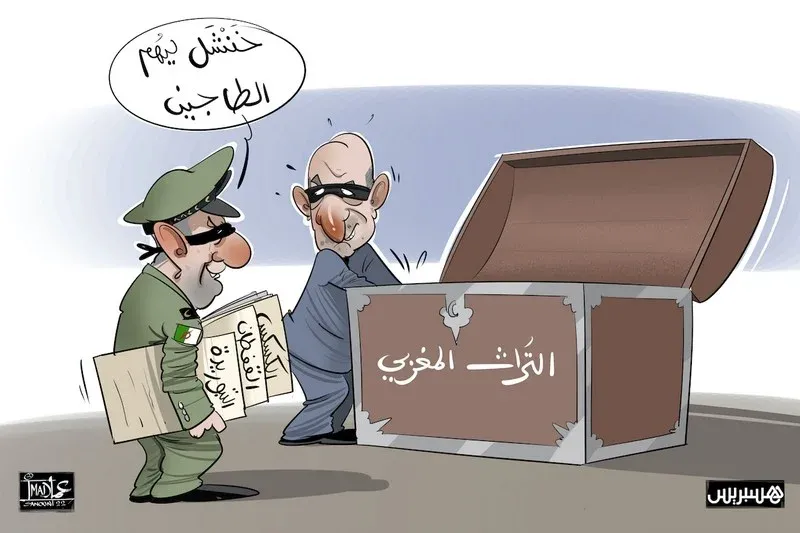

Cultural Struggles Over Heritage: Algeria's Claims on Moroccan Traditions
In recent times, Algeria's attempts to claim various elements of Moroccan cultural heritage have often been met with ridicule or dismissal, often characterized as mere reactions stemming from a sense of inferiority or unhealthy jealousy. Some view these actions as simple imitations that warrant little more than fleeting commentary. However, such simplifications obscure the deeper implications of this phenomenon and strip it of its true context. It is vital to recognize that what is occurring cannot be understood through a superficial lens; rather, it must be situated within a broader and more intricate context where culture becomes a battleground, and symbols serve as powerful tools in shaping influence and presence.
Modern literature introduces a pivotal explanatory concept known as "Soft Power," articulated by Joseph Nye. This notion reflects the ability of nations to achieve their interests through attraction and persuasion rather than coercion. In this sense, culture, laden with symbols and meanings, transforms into an influential instrument in constructing the mental image of nations. Consequently, cultural heritage transcends mere inheritance; it becomes a symbolic capital that bolsters national presence and highlights distinctiveness. When a country successfully integrates its heritage elements into international institutions, it does not merely preserve its past but also enhances its symbolic presence and strengthens its cultural image.
This is where the significance of UNESCO emerges—not simply as a legal body that grants "ownership" but as an institution that generates international recognition. According to the 2003 Convention for the Safeguarding of the Intangible Cultural Heritage, the process of registering any element involves a meticulous pathway that begins with its inclusion in a national inventory, followed by the preparation of a scientific dossier containing historical and technical documentation, evidence of living practices within the community, and active participation from artisans and stakeholders. This process also requires a clear preservation plan. Subsequently, the dossier undergoes evaluation by international experts before being presented to an intergovernmental committee that makes the final decision. While this process does not grant legal monopoly, it provides something even more impactful: institutional legitimacy, internationally recognized authority, and substantial visibility.
The importance of this pathway has been underscored by several recent cases. In December 2020, the "Knowledge and Skills Associated with Couscous" was registered as a joint file among Morocco, Algeria, Tunisia, and Mauritania, reflecting its shared nature as cultural heritage while underscoring Morocco's integral and distinctive role within this cultural space. Furthermore, on December 10, 2025, during the twentieth session of the intergovernmental committee held in New Delhi, the Moroccan caftan was recognized as a distinctive Moroccan element, marking significant acknowledgment of a comprehensive traditional system that encompasses weaving, embroidery, and the functions of clothing within Moroccan society.
Additionally, the art of zellige entered the international registration process when Morocco initiated in November 2025 a project to register "The Art of Zellige in Fez and Tetouan." Recently, reports have emerged of a complaint filed with UNESCO regarding Algeria's attempts to appropriate this art form, potentially leading to confusion about its origins. This reflects a shift from media discussions to institutional advocacy concerning this matter.
In this context, Algeria's attempts to appropriate certain elements of Moroccan heritage cannot be understood as isolated incidents, but rather as part of a broader dynamic aimed at influencing narratives and creating a form of symbolic confusion. A crucial idea emerges here: conflicts between nations are no longer confined to military tools or traditional diplomacy; they now extend into cultural domains, where competition exists not only over material interests but also over meanings and symbols. The issue is not merely about proving ownership of heritage elements, but rather about introducing them into a gray area that obscures their clarity for the international audience. This is precisely what grants these files their significance, as they reflect a form of systematic cultural conflict that should not be underestimated or dismissed.
However, the challenge does not solely arise from external forces; it is also linked to how we, as Moroccans, engage with our heritage. While many Moroccan artisans work on external projects, particularly in decoration and restoration, reflecting the value of Moroccan expertise and the demand for it, the absence of clear frameworks may transform this into an indirect channel for transferring precise knowledge that can be re-employed or replicated. Moreover, digital platforms have contributed to broadening the recognition and dissemination of Moroccan traditional arts and skills, enhancing their cultural visibility and presence. Yet, this very openness can sometimes lead to the disclosure of certain intricate technical details associated with these crafts, making some of their knowledge transferable outside traditional frameworks. Therefore, it remains essential to adopt a balanced approach that maintains the dynamism of recognition and openness while being conscious of how this knowledge is presented, ensuring its continuation within an appropriate professional and cultural framework.
Thus, navigating this phase becomes a responsibility that requires achieving a delicate balance between openness and protection. Accelerating the documentation and registration of heritage, enhancing its presence within international institutions, and developing legal tools to safeguard traditional knowledge are imperative. Concurrently, it is crucial to direct digital content with greater awareness, ensuring it contributes to recognition without disclosing intricate details outside their professional context. Furthermore, consideration must be given to framing the transfer of artisanal expertise in a manner that preserves its value and mitigates exploitation outside its original context, along with supporting scientific research and building a documented archive that strengthens the Moroccan reference.
Ultimately, this issue transcends mere temporary reactions or fleeting debates; it embodies an awareness of the nature of this field and its limits. What is happening is not a simple matter that can be overlooked; it falls within forms of cultural conflict that necessitate attention and serious engagement. Nevertheless, this challenge does not place Morocco in a position of weakness, as its strength lies not only in discourse or documentation but also in deep historical roots, vibrant practices, a comprehensive system of artisans and institutions, precise architectural designs, and accumulated expertise and skill.
As reported by hespress.com.