
Understanding Sleep Patterns in Newborn Lambs
Sleep plays a critical role in the life of animals, particularly during the early stages of development. Recent research explores the sleep-wake patterns of newborn lambs, focusing on the changes that occur within the first 72 hours post-birth and the subsequent impact of rumination onset. In ruminants, rumination is a vital digestive process that significantly influences their behavioral and physiological states. This study, conducted by a team of researchers from Morocco, aimed to characterize the sleep profiles of eight newborn lambs and assess how the onset of rumination affects their vigilance states and activity patterns.
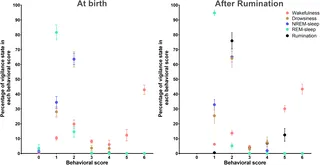
The researchers employed a non-invasive polysomnographic (PSG) method to monitor the lambs' sleep and activity. Initial recordings were taken immediately after birth, followed by a second set when the lambs reached 1 to 1.5 months of age, coinciding with the onset of rumination. The findings revealed that at birth, lambs exhibited a notable twilight activity pattern, peaking during the transitions between day and night, with an average of 5.3 hours of daytime activity. After the onset of rumination, daytime activity increased significantly to an average of 7.8 hours. The PSG analysis indicated a polyphasic sleep structure wherein lambs spent approximately 58.6% of the night and 39.6% of the day asleep. Notably, non-rapid eye movement (NREM) sleep was the predominant sleep state, outpacing both drowsiness and rapid eye movement (REM) sleep during both diurnal and nocturnal periods.
Impact of Rumination on Sleep Architecture
As the lambs matured and began rumination, researchers observed significant changes in their sleep patterns. By the time the lambs reached four to six weeks of age, rumination constituted around 28.6% of their night and 13.3% of their daytime activities. This shift coincided with a reduction in total sleep time, dropping from 11.3 hours to 6.9 hours, indicating a competitive relationship between rumination and sleep without affecting overall wakefulness. All stages of sleep were impacted, highlighting the complexity of sleep architecture in neonatal ruminants during this critical developmental phase.
The results of this study contribute valuable insights into the behavioral ecology of newborn ruminants, suggesting that the initiation of rumination may influence sleep patterns significantly. This research emphasizes the need for further investigations into how early-life experiences and physiological changes shape sleep architecture and activity levels in developing ruminants. Understanding these dynamics can enhance knowledge in the fields of veterinary science, animal husbandry, and behavioral biology.
As reported by journals.plos.org.