
Unveiling the Historical Journey of Edmond Duteil in Boulaouane
Edmond Duteil (1867–1926) was a distinguished French anthropologist and Arabist, renowned for his contributions to colonial sociology in the Maghreb during the early 20th century. Among his numerous scholarly works, his book titled 'Marrakech' (Paris, 1905) stands out as a comprehensive account of his expeditions in Morocco, intertwining sociological and anthropological observations. In this particular book, Duteil dedicates around twelve pages to his 1901 visit to Boulaouane and its surrounding areas, starting from Azemmour. His expedition comprised eight individuals equipped with supplies and gear, along with two horses, five mules, and two donkeys. Duteil also drew from earlier writings by the German geographer Theobald Fischer (1846–1910) regarding the same region.
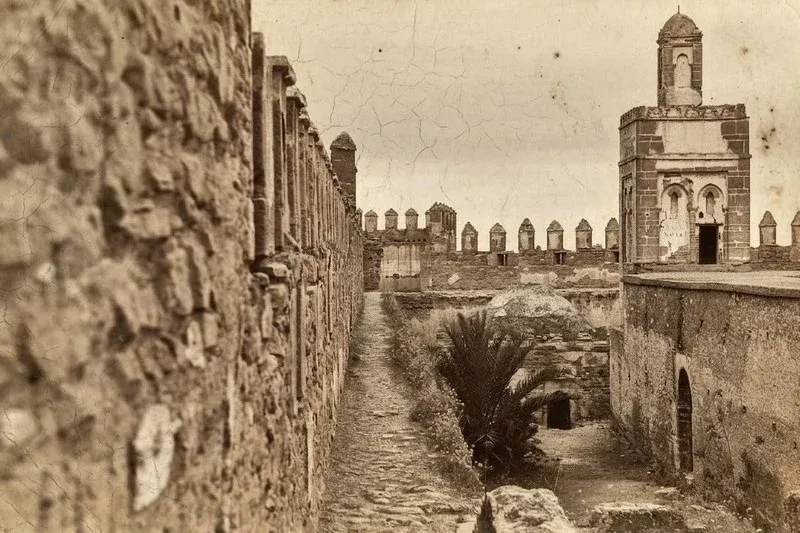
To retrace Duteil's journey to Boulaouane, we accompanied Jilali Sajai, a young professor and author of an Arabic book on the history of Boulaouane (currently in publication). Coming from the area he resides in, Sajai has traversed this route numerous times. The Boulaouane Kasbah, constructed in 1710 under the orders of Sultan Moulay Ismail, stands as a majestic historical fortress overlooking a bend of the Oum Er-Rbia River. The walls of the kasbah were built from hewn stones and served as a strategic point for securing royal routes, characterized by its defensive architecture.
Tracing the Path from Azemmour to Boulaouane
In his aforementioned book, Duteil meticulously documents his journey under the title 'The Route from Azemmour to Boulaouane,' noting the timing of the trip he undertook with his team. They commenced their journey from Azemmour on the morning of June 7, traversing the territories of the Houssa and Ouled Frej, passing through the Khritat and Sidi Mohammed Al-Zahir, and then the villages of Ouled Si Amer and Ouled Si Ammara, finally reaching the shrine of Sidi Ammara the Shlah. Upon crossing the marsh of Mcherra Kharma, they ultimately arrived at the Boulaouane Kasbah.
The kasbah is located approximately twelve kilometers from the current administrative center of Boulaouane, a distance we covered by car. Initially, we took the Aounat road before turning onto the road marked with a sign reading 'Boulaouane' in both Arabic and French. The paved road, which had some potholes, windingly traversed fields of potatoes and vineyards, a landscape familiar to our guide, Jilali Sajai.
Upon Duteil and his team's arrival at Mcherra Kharma, they found the river fully swollen, making it impossible to cross without using rafts supported by inflated leather bladders. Locals inquired about their reason for crossing, and when Duteil explained his desire to visit the kasbah visible on the opposite bank, they responded, 'Why would you want to cross the river twice?' At that moment, Duteil realized his mistake: the kasbah was not on the right bank but rather on the left bank where he was standing. Here, the river takes a sharp S-shaped bend, necessitating two crossings due to the absence of a bridge. The kasbah was only about three kilometers away from the marsh in a straight line.
To avoid transporting their luggage across the rafts, Duteil and his team opted to detour around the peninsula by land, a path that took an hour of walking, which he described as 'exhausting' but less arduous than crossing the river twice. As we approached within about a hundred meters of the fortress, we paused to admire this historical monument, following in Duteil's footsteps. He mentions on page 216 of his book Marrakech that he was struck by the view from that distance: the kasbah perched on a steep incline, with its tall crenellated walls. His team decided to spend the evening of their arrival and the following morning there before crossing the Oum Er-Rbia toward the Chaouia. During their stay, Duteil and his team began sketching a plan of the kasbah, although he described it as 'approximate' due to the lack of precise measuring tools.
Our host, Jilali Sajai, noted that Duteil's team pitched their tents on the night of June 8, 1901, in front of the kasbah's entrance, where a spacious courtyard exists. We observed that within the kasbah, about two-thirds of the buildings and walls were in a state of disrepair, a level of decay that Duteil did not mention during his visit in 1901. In the eastern corner, the mosque, with its minaret, remains in relatively good condition. Our companion explained that the mosque and the prayer niche underwent old renovations, likely dating back to the 1950s.
During our visit, a car passed through the entrance of the kasbah toward a hamlet called 'Douar al-Kasbah,' indicating that the area is used as a regular passage for residents. To facilitate residents' access to their homes, a new opening has been made in the northern wall, which did not exist during Duteil's time, raising concerns about the preservation of this historical monument. The walls were built from limestone (lime) over a foundation of stones, employing traditional methods ensuring durability. The marks of wooden molds used in construction are evident, employing a technique similar to rammed earth or adobe building.
We also noted circular openings in the ground that Duteil described as deep storages. From the top of the eastern wall, we observed a path descending towards an orange orchard, part of which has collapsed. We also found remnants of black and white pottery and nearly faded Arabic inscriptions. Duteil pointed out inscriptions in the Sultan's house repeating the phrase: 'The lasting fire.'
The current condition of the kasbah calls for urgent intervention to protect it. Aside from its beautiful facade, the interior suffers from significant deterioration. Despite repeated demands, no effective measures have been taken for its rescue. How can one envision Boulaouane without its kasbah, which is the essence of its identity? This heritage holds global significance, as I noted in my 2025 book on Boulaouane, where this area inspired the reflective work 'The Castle' by Antoine de Saint-Exupéry a century ago.
As reported by hespress.com.