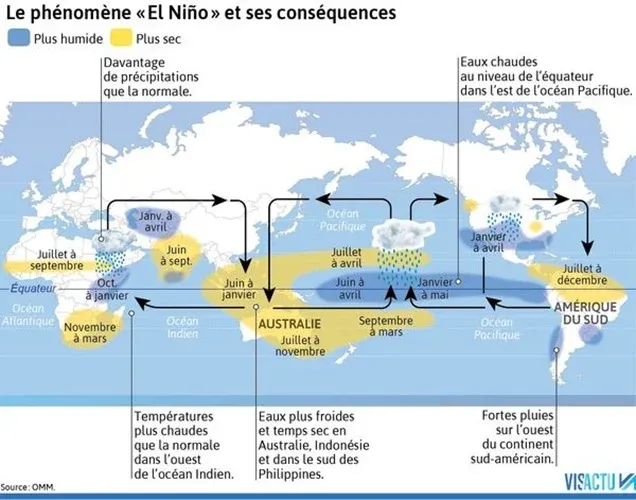

Understanding the Implications of El Niño for Morocco's Climate
The World Meteorological Organization (WMO) issued a significant warning on Tuesday regarding the anticipated resurgence of El Niño, a climatic phenomenon that could have profound implications for weather patterns across the globe. In its statement, the WMO urged nations worldwide to brace themselves for a series of extreme weather events expected in the coming months. Specifically for Morocco, the warning hints at an alarming probability of drought conditions resurfacing as the effects of El Niño begin to manifest.
After experiencing several months of abundant rainfall that alleviated the repercussions of a seven-year drought, Morocco now faces the prospect of returning to water stress due to the re-emergence of El Niño. The WMO indicated that conditions indicative of an El Niño episode are developing globally, largely attributed to unusually high temperatures in the tropical Pacific Ocean. The organization forecasts that this phenomenon will significantly influence temperature and rainfall patterns, thereby escalating the risks of extreme weather phenomena in the near future.
In its latest briefing, the WMO elaborated on how El Niño, through the warming of ocean waters, drives an increase in global temperatures and contributes to the establishment of more extreme weather patterns and fluctuating rainfall regimes. The forecast suggests that from June to August, above-average temperatures are likely to prevail across many regions. In Morocco, residents have already begun to feel the impact of these unusually high temperatures since the onset of spring, raising concerns about the potential severity of the impact on the kingdom.
The Changing Climate Landscape in Morocco
Climatologist and professor at Hassan II University, Mohamed Said Karrouk, shared his insights with Yabiladi, asserting that the phenomenon of El Niño is no stranger to Morocco. He noted that the recent weather conditions, which have often been labeled as extreme, are actually characteristic of a new climate paradigm that has been evolving since at least 2010. Karrouk emphasized that the climate conditions we are currently experiencing are markedly different from those of earlier decades, particularly since the late 1980s. He points out that the current climate is marked by a significant planetary energy surplus compared to previous decades, resulting in rising temperatures that are a direct response to this energy imbalance.
While the rise in temperatures is closely linked to anthropogenic greenhouse gas emissions, Karrouk stresses the importance of recognizing that this is not the sole factor at play. He explains that other processes are simultaneously shaping our climate, particularly changes affecting both continental and oceanic surfaces, which have absorbed vast amounts of energy due to rising temperatures. Consequently, these surfaces now serve as much larger reservoirs, creating a starkly different climatic landscape.
Under these circumstances, major climatic drivers like El Niño evolve as integral components of the system's natural functionality. Karrouk elaborates that El Niño manifests in the Pacific Ocean when warm surface waters, previously concentrated around the Indonesian archipelago, shift eastward toward the Americas. This redistribution of warm water expands the contact zone between the atmosphere and the ocean, thereby releasing surface energy over a broader geographical area. This influx of energy enhances atmospheric conditions, potentially resulting in excessive temperatures, particularly in the Northern Hemisphere.
Karrouk also highlighted a critical development: ocean waters have warmed to depths reaching approximately 100 meters, intensifying El Niño episodes. He describes the addition of energy to existing reserves as a phenomenon often referred to as a 'Super El Niño'. Although this term is not scientifically defined, it aptly conveys the magnitude of the event compared to its typical intensity, imposing elevated temperatures across the entire climate system, including Morocco. The climatologist emphasizes that the rise in atmospheric temperatures associated with El Niño is primarily of oceanic origin, but the dynamics of the water cycle and rainfall conditions must also be considered.
According to Karrouk's research from the 1990s, Morocco's climate is significantly influenced by El Niño through its effect on the Azores High. This anticyclone, which is strengthened by energy from the equatorial zone, creates stable conditions that hinder the development of rainfall systems. Historical data reveals that most El Niño episodes affecting Morocco have coincided with drought, indicating a troubling trend that could be exacerbated by the current episode highlighted by the WMO. As such, the risk of drought returning to the kingdom appears increasingly likely.
In conclusion, the climatologist draws attention to the relationship between El Niño-Southern Oscillation (ENSO) events and drought in Morocco, describing it as a cause-and-effect mechanism. The additional energy transferred to subtropical latitudes, including North Africa, reinforces the Azores High, altering atmospheric circulation patterns. Having presented this theory at the International Geographical Congress in the early 2000s, Karrouk refers to his approach as an 'energy-based approach'. He further explains that these conditions favor a positive phase of the North Atlantic Oscillation (NAO), characterized by a stronger Azores anticyclone, which in turn prevents cold air masses from reaching the region. Without these cold air masses, atmospheric water vapor cannot condense, making the conditions for rainfall unattainable.
As reported by en.yabiladi.com.