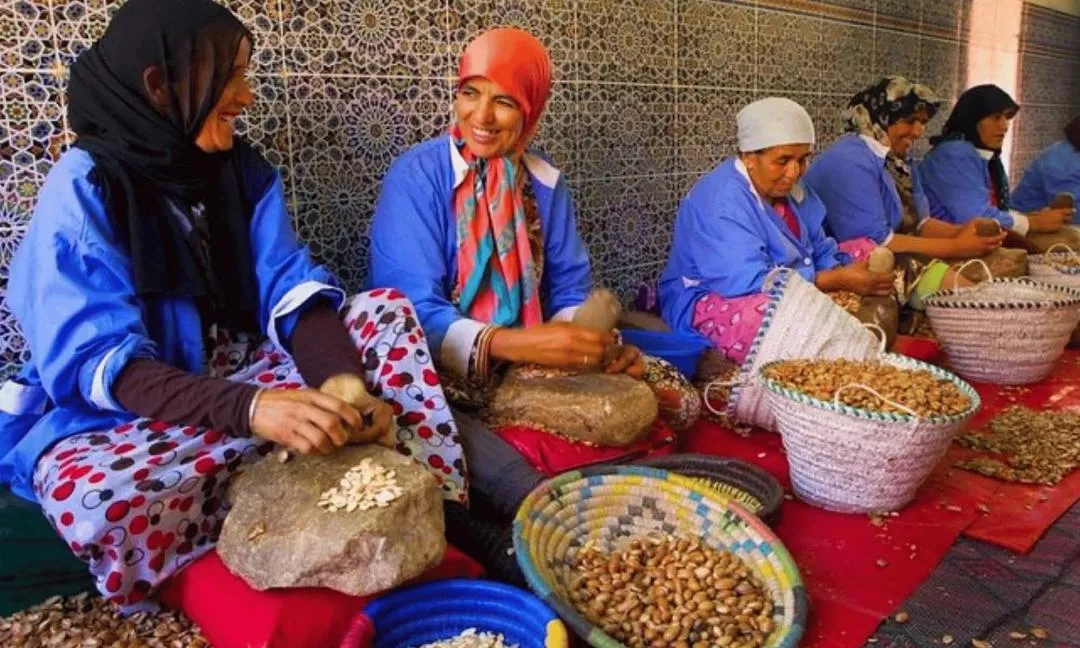

In the southern villages of Morocco, particularly between the cities of Agadir and Essaouira, the resilient Argan trees stand tall across arid lands ravaged by years of drought. Here, women spend countless hours in small cooperatives, manually breaking the fruit and meticulously sorting the seeds, ultimately transforming the oil into a luxury product sold in high-end beauty stores across Europe, America, and the Middle East. This oil can fetch prices that exceed many times the earnings of the workers who are at the first link in the production chain. This striking contrast highlights one of the most significant paradoxes within the framework of 'social and solidarity economy' in Morocco—a model where women generate wealth without actually owning it.
In recent years, women's cooperatives have emerged as a prominent feature of Morocco's official development discourse. Women, clad in traditional attire, are engaged in the production of Argan, couscous, honey, textiles, and medicinal herbs. These cooperatives have become the most visible representation in solidarity economy exhibitions, public programs, and international reports that showcase the Moroccan experience as a model of 'economic empowerment for women,' 'territorial integration,' and 'combatting vulnerability.' This discourse has been accompanied by a marked increase in the number of cooperatives, particularly female-led ones, supported by the National Initiative for Human Development and various public institutions promoting social and solidarity economy initiatives. The aim is to present this sector as a catalyst for local development and a component of building a 'social state,' as indicated by official data obtained by 'Al-Safir Al-Arabi' from the administration responsible for traditional crafts and social economy.
However, this rapid rise conceals questions that are more complex than the celebratory narrative often portrayed. While the number of cooperatives increases year after year, the female activity rate in Morocco remains one of the lowest regionally, hovering around only 20 percent, according to the High Commission for Planning. This statistic reveals that the expansion of the solidarity economy has not necessarily translated into the integration of women within a stable economic cycle capable of producing genuine financial independence.
In reality, many women's cooperatives appear to be more of a survival economy than viable economic projects capable of redistributing wealth. A significant number of these cooperatives remain reliant on public or seasonal support and suffer from inadequate funding, training, and marketing. Meanwhile, intermediary channels and distribution/export companies continue to capture the majority of the added value, particularly in lucrative sectors such as Argan and products directed towards international markets.
This raises critical questions about the actual success of women's cooperatives in economically liberating women and providing them with a more equitable position in the market. Are these initiatives merely reproducing vulnerability within a 'softer' model that grants women a minimal income without effectively altering their positions within the economic structure? Despite appearing to empower women by creating local economic resources, cooperatives often operate within a global economic framework marked by stark inequalities, where women are tasked with producing 'authentic local products' for international marketing without possessing the tools to control the market or negotiate favorable conditions.
With the global rise of the market for 'natural', 'organic', and 'sustainable' products, items such as Argan oil, saffron, aromatic roses, and medicinal plants have gradually moved beyond local consumption to enter some of the world's most profitable markets—those of 'authenticity.' Here, the value is not merely linked to product quality or utility, but also to the narrative that accompanies it, and the symbolic weight that can be marketed to global consumers seeking pure and traditional products associated with local communities and cultural identities distant from mass manufacturing.
Thus, while the emergence of women's cooperatives in Morocco might seem part of a broader shift in state perceptions of development, focusing on the valorization of local resources and encouraging self-initiatives, it is essential to recognize that this narrative often disguises a more ambiguous reality. The official statistics may illustrate growth, yet thousands of cooperatives established in the past two decades have not led to significant and stable integration of women into the formal labor market. Instead, they have contributed to expanding forms of precarious, low-income labor in rural and semi-urban margins. Therefore, addressing the question of whether these cooperatives genuinely succeed in empowering women necessitates a deeper exploration of the economic structures at play and the actual benefits women derive from these initiatives.
As reported by assafirarabi.com.