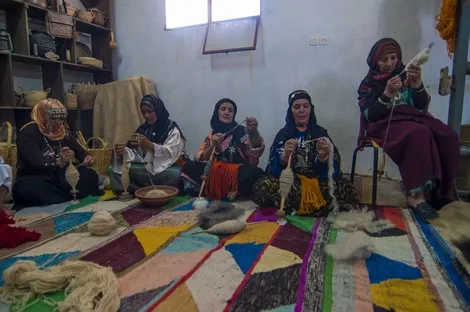

In a picturesque village nestled in the Azzilal region, where the echoes of the mountains resonate like the heartbeat of daily life, Hafida Qoubai diligently weaves colorful threads of wool with patience and precision. These vibrant yet harmoniously arranged colors come together to form the intricate details of traditional Moroccan carpets, a resilient craft passed down through generations and now a pillar of economic empowerment for women.
Hafida oversees the "Adra Nigaryoun" cooperative, dedicated to traditional carpet weaving in the city of Azzilal. She has successfully transformed a time-honored craft, inherited from grandmothers, into a collective project that offers hope to rural women who have found in cooperative work an opportunity for economic independence and improved living conditions.
The cooperative, led by this remarkable woman in her forties, includes a diverse group of rural women united by their resilience and sensitivity. Among them are widows, single mothers, and women with disabilities, creating a unique, solidarity-based experience that emphasizes the sharing of knowledge. Most importantly, this initiative aims to preserve the traditional craft heritage across generations.
In an interview with the Moroccan News Agency, coinciding with International Women’s Day, Hafida proudly reminisces about the inception of this project, which began with discussions among several local women on how to enhance their incomes and create job opportunities through skills they had learned from their mothers and grandmothers.
Despite the initial lack of sufficient resources, the founders of the "Adra Nigaryoun" cooperative relied on their own capabilities, pooling modest financial contributions from their savings to purchase raw materials and fulfill their first orders. This initiative reflects the spirit of entrepreneurship and self-reliance that has characterized their journey from the outset.
Hafida emphasizes that the choice of carpets as the primary product of the cooperative stems from their intrinsic value and presence in every Moroccan home. The weaving tools not only document the connection of Moroccan women, especially in rural areas, to this traditional craft, but they also serve as a medium through which they express their emotions and skills.
Hafida's passion for this authentic industry has motivated both her and her fellow cooperative members to enhance their knowledge and skills in carpet weaving, particularly through participation in training sessions organized by specialized institutions in traditional crafts, including the "Dar Sani". The goal has been to strengthen their management and marketing capabilities while improving the quality of their production.
The path for Hafida and her colleagues was not easy at first, as the cooperative faced numerous challenges, particularly regarding equipment shortages and difficulties in marketing their products. However, over time, these obstacles became a catalyst for increased efforts and particularly benefited from support provided by the National Initiative for Human Development, which enabled the cooperative to acquire equipment that significantly improved production conditions and quality.
With an open-minded approach to modernity, Hafida has sought to leverage digital marketing tools to promote their cooperative’s products. She successfully showcased the "Azzilali" carpets and other types of Amazigh rugs on international online platforms and social media, allowing this local craft to find its way into markets beyond Morocco.
Thanks to these efforts, the cooperative has become a genuine space for economic and social empowerment, continually attracting new members seeking financial independence and supporting their families in facing the demands of everyday life.
The experience of Hafida Qoubai and all the creative carpet makers exemplifies the model of the persevering rural woman who, through quiet determination and continuous work, has transformed weaving into a bridge toward hope and development. In every piece crafted by the hands of "Adra Nigaryoun," there lies a tale of struggle, as well as the outlines of a future woven by the mountain women through threads of labor and creativity.
As reported by madar21.com.