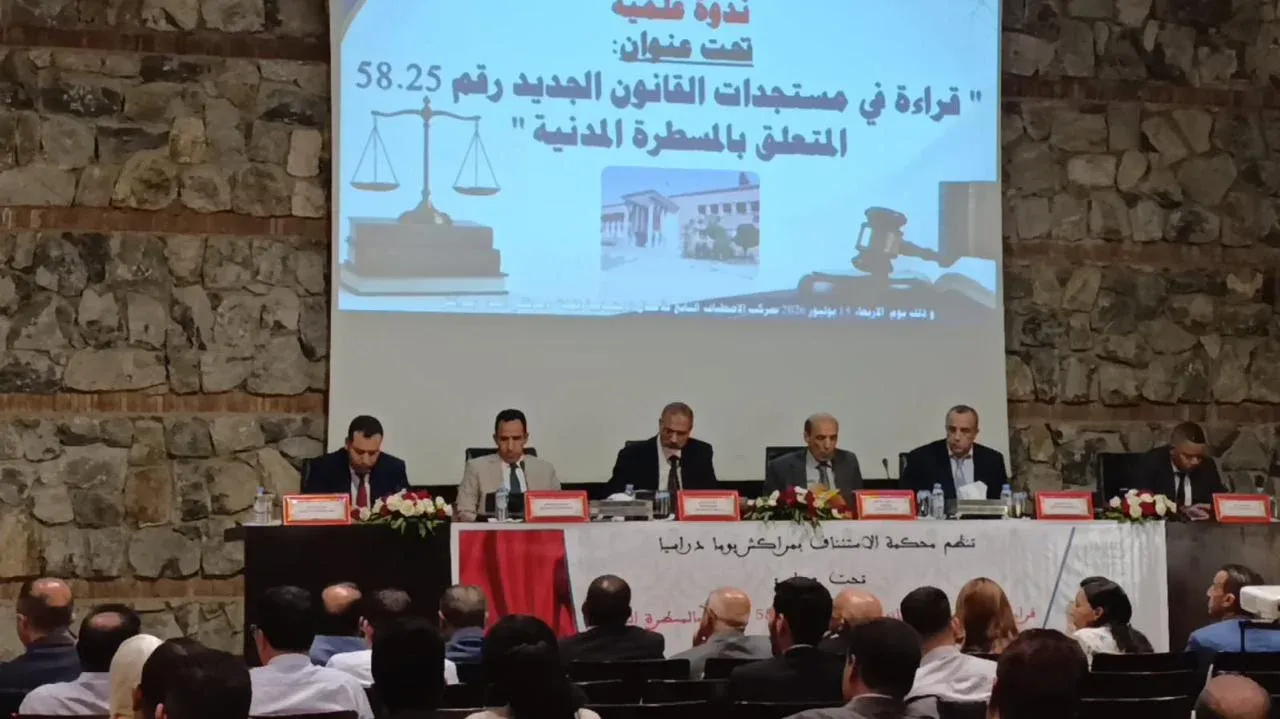

In a significant move to align with the major legislative reforms underway in the justice sector of Morocco, the Court of Appeal in Marrakech organized a prominent scientific seminar on July 15, 2026. The seminar, titled “Insights into the New Law No. 58.25 on Civil Procedure,” was held at the recreational complex affiliated with the Ministry of Justice in Marrakech. This event saw the participation of various judicial officials, judges, legal professionals, and researchers, all aiming to foster a rich dialogue on the new legal framework.
The seminar commenced with a warm welcome to participants and guests, followed by a recitation of verses from the Holy Quran. The organizing committee emphasized the significance of this scientific gathering in keeping pace with legal transformations aimed at modernizing civil justice and enhancing service quality.
In his opening remarks, Mr. Mustafa Ait Haloui, the President of the Court of Appeal in Marrakech, highlighted the crucial role of the new Civil Procedure Law as a fundamental text governing civil litigation. He underscored that the implementation of its provisions requires the engagement of all judicial stakeholders in a responsible scientific discourse that contributes to unified perspectives and improved judicial practices.
Mr. Khalid Kerdoudi, the Attorney General at the Court of Appeal in Marrakech, reiterated that the legislative reform represented by the Civil Procedure Law marks a pivotal moment in the modernization of justice. The law introduces new mechanisms aimed at enhancing judicial efficiency, promoting principles of good governance, and ensuring the rights of litigants.
The seminar featured a series of specialized scientific presentations that explored the key innovations brought forth by Law No. 58.25. Mr. Othmane Lekhdari, President of the Court of First Instance in Imintanoute, initiated the discussions with a presentation titled “Recent Developments in Enforcement Procedures under the New Civil Procedure Law.” He shed light on the advancements in judicial enforcement procedures and the mechanisms aimed at enhancing the effectiveness of court rulings while ensuring the protection of rights and achieving judicial security.
Following this, Mr. Nour Eddine Naimani, a counselor at the Court of Appeal in Marrakech, presented a talk entitled “New Developments in Ordinary Appeals: Opposition and Appeal.” He examined the innovations related to the ordinary appeal process, highlighting essential amendments aimed at balancing the right to litigate with the need for expedited resolution of disputes.
Judge Ismail Ikram from the Court of First Instance in Marrakech addressed the topic “Innovations in Notification Procedures under the New Civil Procedure Law,” focusing on the new provisions intended to develop the judicial notification system and address practical challenges that hinder effective judicial processes.
In another insightful session, Mr. Aziz Al-Aroui, a counselor at the Court of Appeal in Marrakech, analyzed “Investigation Procedures in the New Civil Procedure Law.” His presentation provided a critical reading of the key updates related to investigative methods and procedures, emphasizing their role in enhancing access to judicial truth and facilitating timely justice.
The seminar was characterized by a rich scientific discussion among participants and speakers, during which numerous questions and issues related to the application of the new law in daily judicial work were raised. This exchange of views aimed to unify the judicial application of the newly introduced provisions.
At the conclusion of the seminar, Mr. Mohammed Hamidouch, the rapporteur of the seminar, read a set of recommendations that emerged from the participants. These recommendations included the following:
- Increasing the number of scientific meetings and training sessions dedicated to explaining the provisions of Law No. 58.25.
- Preparing practical guides and explanatory notes to assist in the effective implementation of the new legal text.
- Enhancing coordination among various components of the justice system to ensure unified judicial practice.
- Continuing to engage with scientific and academic research to study practical issues related to the new law.
- Supporting digital transformation in managing civil procedures in line with the new legislative reform philosophy.
- Identifying practical challenges that may arise during implementation and proposing solutions to overcome them.
The seminar concluded with a reading of the recommendations and an exchange of opinions among attendees, followed by a tea reception in honor of the participants. The atmosphere was marked by a sense of scientific seriousness and a shared responsibility to ensure the success of the justice reform initiative and enhance the quality of judicial performance.
As reported by ardbladi.com.