Growing Chinese Investment in Morocco Raises EU Alarm
Concerns are intensifying within the European Union regarding the burgeoning Chinese industrial investments in Morocco, as there are increasing apprehensions that this trend could transform the North African nation into a significant manufacturing and export hub for subsidized Chinese products aimed at the European market. The European Union officials are wary that the influx of billions of dollars in planned Chinese investments may lead Morocco to become a conduit for exporting state-subsidized goods, potentially inundating European markets and exerting undue pressure on local industries.
Maroš Šefčovič, the European Commissioner for Trade, recently expressed to the Financial Times that these investments are indicative of Beijing's strategy to manage its excess domestic production capacity by redirecting exports to Europe through intermediary countries like Morocco. He characterized this development as a major concern for the European economy, highlighting the potential ramifications of such a shift.
Trade Defense Measures and Strategic Implications
In light of escalating trade tensions with China, the European Union has enhanced its trade defense mechanisms to combat what it perceives as attempts by China to circumvent established customs duties. As part of these efforts, the European Commission concluded last year that aluminum wheels exported from Morocco had benefited from unfair subsidies extended by both the Moroccan and Chinese governments under the Belt and Road Initiative. However, European officials recognize that differentiating between legitimate industrial cooperation between China and Morocco and attempts to evade European tariffs is not a straightforward task. The EU has already implemented tariffs as high as 45% on Chinese electric vehicles to protect its markets.
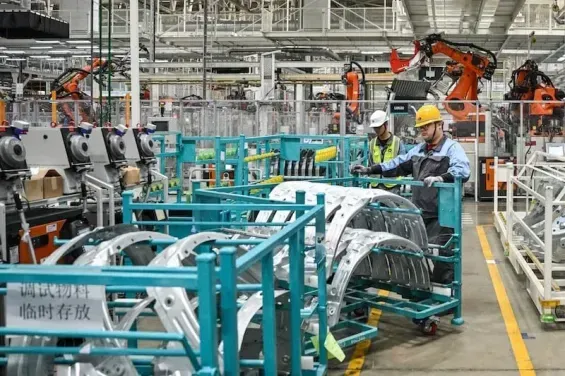
Proponents of Chinese investments, however, argue that Morocco has emerged as a pivotal link in the automotive supply chains serving Europe, complicating any future protectionist actions. Junji Cai, project manager at the Chinese braking systems manufacturer APG, stated that the company’s planned $70 million factory in the Tanger Tech industrial zone will utilize local labor and materials while incorporating Chinese technology and components. He emphasized that the collaboration between European, Moroccan, and Chinese firms yields mutual benefits, supplying competitively priced products to European manufacturers.
APG is set to join a growing roster of Chinese companies in the industrial zone, which already includes Sentury Tire, now operational, and BTR New Material Group, the largest global supplier of battery anode materials, which is in the process of constructing a new facility there. Other significant Chinese investments in Morocco encompass a $1.3 billion battery gigafactory being developed by Gotion High-tech in Kenitra, with Germany's Volkswagen Group holding a 25% stake in this groundbreaking project, marking the first of its kind in the Middle East and North Africa.
Mehdi Iraqi, chairman of the Morocco-China Business Council, noted that since the onset of the Covid-19 pandemic, Morocco has been hosting two to three delegations of prospective Chinese investors every week, underscoring the kingdom's growing allure to foreign investors. This appeal is attributed to various advantages, including a five-year tax exemption, a youthful labor force, access to renewable energy that can mitigate costs associated with the EU's carbon border tax, and preferential access to a market encompassing approximately 2.5 billion consumers through nearly 50 free trade agreements, including those with the EU and the United States.
Despite these advantages, Moroccan officials firmly reject the notion that the country’s special economic zones could serve as a gateway for Chinese industrial overcapacity to flood into Europe. Yassine Lahyani, head of emerging industries at the Moroccan Investment and Export Development Agency (AMDIE), asserted that Morocco aspires to be “one of the European Union’s best industrial partners.” He emphasized the mutually advantageous nature of cooperation between Morocco and the EU, while also noting that Chinese investors operating within the kingdom must adhere to rules of origin, which stipulate that products must undergo sufficient industrial transformation in Morocco to qualify for customs exemptions when exported to the EU.
As reported by en.yabiladi.com.