
Understanding Casablanca's Unique Urban Landscape
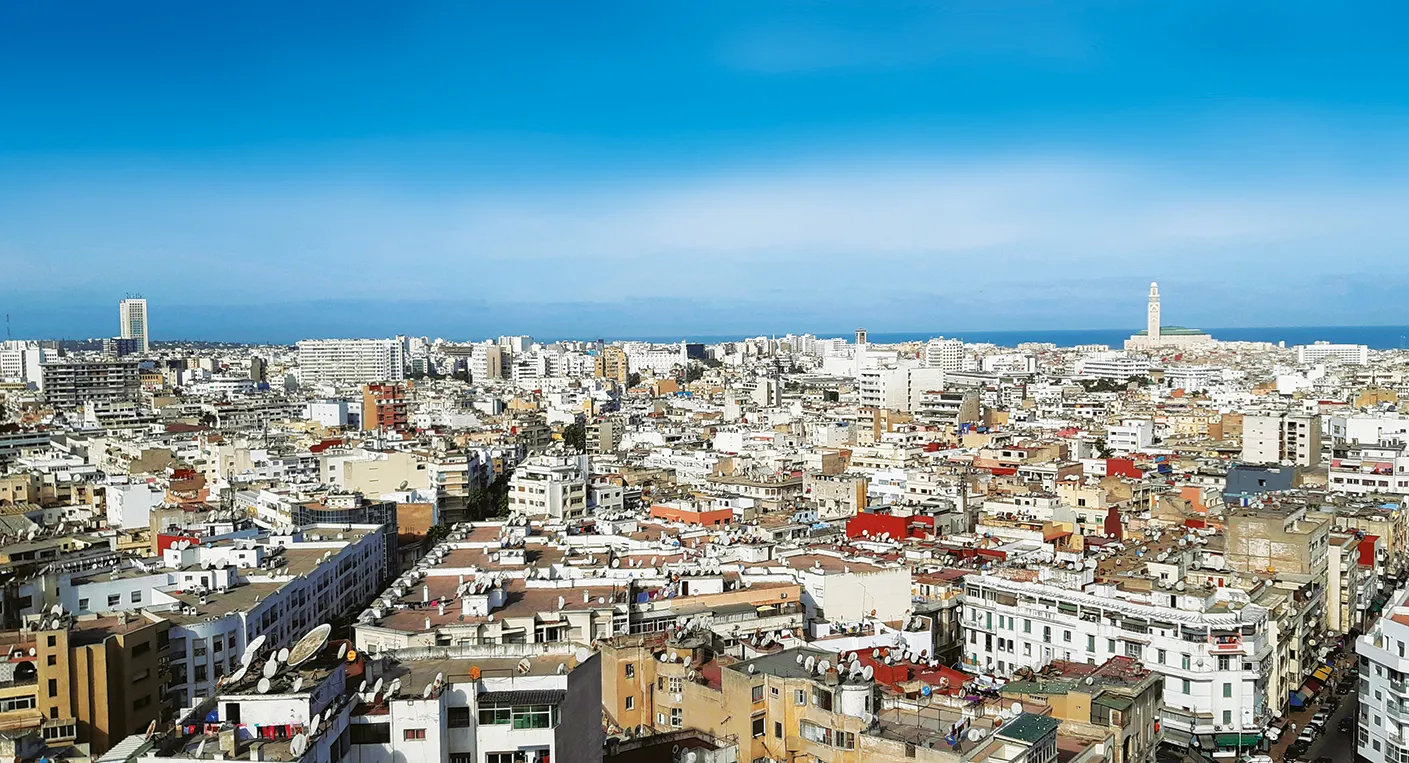
Casablanca is a city that must be felt rather than merely described; it is a vibrant hub of activity that attracts, concentrates, and absorbs a diverse population. As Morocco's economic capital, it plays a crucial role in the country's financial flows, hosting a significant number of corporate headquarters and investment dynamics. With over four million inhabitants living in a state of constant movement, Casablanca has established itself as the gravitational center of contemporary Morocco. This centrality is not just a matter of perception; it has been cultivated over time through a gradual concentration of economic and financial functions, as well as the development of spaces where corporate strategies and investment dynamics are formulated.
However, the economic functions that were once primarily concentrated in the historic center are now beginning to undergo a transformation. To fully grasp this evolution, one must revisit the origins of Casablanca's centrality.
From Port to Metropolis: The Historical Context
To understand Casablanca, one must return to its foundational element: the port. Long before the establishment of the Protectorate, Dar Al Beida was already an active trading hub, engaged with its hinterland of Chaouia and connected to extensive commercial circuits that extended far beyond the local scope, according to Leïla Meziane, Dean of the Faculty of Letters and Human Sciences at Ben M’sik in Casablanca, who specializes in maritime history, mobility, and negotiation. By the 19th century, regular maritime connections linked Casablanca to Europe, indicating that while it was not yet a metropolis, it had already forged significant connections.
The real turning point occurred in the early 20th century. Under the Protectorate, Casablanca underwent a transformation in scale. The port was modernized, expanded, and structured to become the primary entry and exit point for the country’s commercial flows. Between 1939 and 1952, nearly a million passengers passed through the port. The city firmly established itself as a crossroads, attracting not only rural workers and populations from other Moroccan cities but also foreigners. This influx created the foundation for rapid growth, which was often challenging to manage.
From an early stage, the city grew faster than it could be organized. The demands of housing, production, and expansion surged, leading to a lack of planning. As Ahmed Chitachni, a political scientist and urban anthropologist, notes, "Casablanca was already a city heading in all directions." The development of peripheral areas often occurred in haste, resulting in informal housing, slums, and uncontrolled expansions that responded to the city’s continuous growth. Casablanca expanded without always managing to create continuity between its various parts.
Over the decades, this dynamic became deeply entrenched. Industrialization further enhanced the city’s attractiveness, pushing the peripheries further out and increasing distances, thereby establishing long-term imbalances. Casablanca is built in layers, featuring a historical medina, neighborhoods from the Protectorate era, large housing complexes, industrial zones, and peripheral extensions. Each period adds its own layer, often without meaningful interaction with preceding ones.
As urban architect Rachid Ouzzani succinctly puts it, "Casablanca is an urban palimpsest," a city comprised of successive layers, where each era leaves its mark. This complexity presents both a wealth of history and a challenge for organization, as this accumulation results in disparities, such as distances between living, working, and service areas, leading to longer and more frequent commutes, and an increased dependency on mobility. The functioning of the city is often constrained by these factors, giving Casablanca a reputation as a "city that is unfinished." It is not incomplete, but rather a city in a state of perpetual tension.
However, this attraction comes at a cost. By continuously absorbing activities, investments, and populations, Casablanca has developed under pressure. Its growth has outpaced its organization, revealing enduring imbalances such as saturated centralities, strained mobility, and fragmented territories. While Casablanca operates, it does so at the expense of ongoing tension. Today, the city is actively seeking to correct this model, not by challenging it, but by striving for better management.
As reported by femmesdumaroc.com.