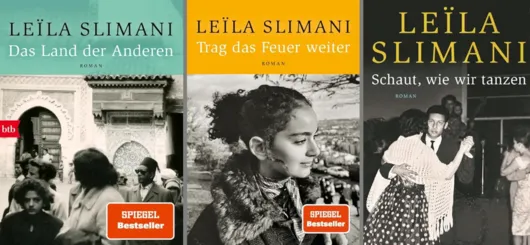
Unraveling the Narrative of Leila Slimani's Trilogy
Leila Slimani's captivating family saga unfolds across three volumes, encompassing approximately 1,200 pages of profound storytelling. The original trilogy consists of the novels titled "Le pays des autres," "Regardez-nous danser," and "J'emporterai le feu," which have been translated into German as "Das Land der Anderen," "Schau, wie wir tanzen," and "Trag das Feuer weiter." Set against the backdrop of post-World War II, the narrative introduces readers to Mathilde, an Alsatian woman, and Amine, a Moroccan soldier serving in the French army. Their chance meeting leads to marriage and a relocation to Morocco, near Meknès, where they endeavor to cultivate a farm amidst harsh agricultural conditions.
The couple welcomes two children into their lives: Aicha, born in 1947, and Selim, born in 1951. Their household is further enriched by the presence of Amine's family, including his brothers Omar and Jalil, and sister Selma. Amine's mother, Mouilala, who is illiterate, harbors admiration for Mathilde's courage, education, and independence, showcasing the generational and cultural dynamics at play within the family.
Identity, Tensions, and the Legacy of Colonialism
The story is deeply interwoven with the tensions between colonial powers and the Arab populace, reflecting the stark contrasts between modern Western ideals and traditional patriarchal family structures. These tensions manifest in the identity crises faced by the characters, particularly as Aicha pursues her medical studies in Strasbourg and later returns to Morocco, cementing her identity as a recognized gynecologist. Conversely, Selim embraces a more liberated lifestyle, joining a hippie movement and experimenting with drugs, thus highlighting the divergent paths taken by the siblings.
Aicha's marriage to Mehdi, a well-educated Marxist, produces two daughters, Mia and Inès, who embody contrasting approaches to life. Mia openly identifies as homosexual and navigates the complexities of mental health and societal expectations as a writer in Paris, while Inès aspires to a conventional life. Mia's return to her grandparents' farm serves as a poignant backdrop for her introspection regarding her childhood and the conflicting identities she grapples with as a French-speaking Arab with limited command of Arabic.
The narrative also poignantly addresses themes of social inequality, as Mia wrestles with her upbringing in a middle-class environment, juxtaposed with the harsh realities faced by many in her homeland. The silence surrounding her sexual orientation within her family compounds her struggles, as she seeks to reconcile her identity in a space that feels both familiar and alien.
Through select passages from the trilogy, Slimani explores the profound impacts of colonial experiences, the challenges of childhood education, and the intricate relationships between fathers and daughters. The depiction of Aicha's first day at a French boarding school in Rabat encapsulates her overwhelming fear of separation from her family, drawing a heart-wrenching parallel between her fear and that of animals facing slaughter. Similarly, the dynamic between Mia and her father Mehdi reveals the complexities of identity and expectation, as she witnesses him in a professional setting for the first time, experiencing a profound disconnection between her home life and his public persona.
Leila Slimani, born in Rabat in 1981 to a Moroccan father and a Franco-Algerian mother, has masterfully articulated the nuances of identity and the intricacies of human relationships throughout her work. She emphasizes the importance of empathy and understanding in literature, advocating for the recognition of vulnerability as a fundamental aspect of the human experience. Slimani's narrative not only sheds light on the rich tapestry of Moroccan society but also resonates with universal themes of identity, power, and the quest for belonging.
As reported by european-news-agency.de.