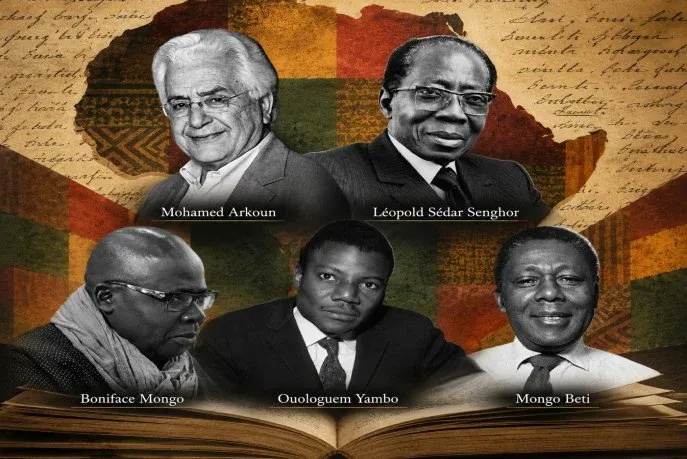

Inauguration of a New Seminar Series on African and Diasporic Literatures
The Academy of the Kingdom of Morocco has launched an innovative seminar series titled "The Essentials of African and Diasporic Literatures." This initiative is aimed at students, researchers, and literature enthusiasts, with the ambition of establishing a comprehensive reference library of African literature while fostering extensive discussions on the legacies, transformations, and imaginations within African letters. Designed as a platform for transmission and critical reflection, this seminar series will unfold in five segments dedicated to the significant dynamics that shape African literatures and those of their diasporas. The primary goal is to illuminate the historical continuities, narrative hybridities, and intellectual circulations that define these literary productions across their diverse linguistic, geographical, and cultural landscapes.
The inaugural meeting, themed "The Literary Matrices and Powers of the Continent," opened with remarks from the perpetual secretary of the Academy of the Kingdom. The keynote address was delivered by writer and academic Eugène Ébodé, who offered insights into the continuities and narrative hybridities found within African literature. The discussions were enriched by contributions from Moroccan academics associated with Mohammed V University in Rabat and Chouaïb Doukkali University in El Jadida. The event concluded with a comprehensive synthesis and the outlining of future directions for the next gathering scheduled for November 2026, which will focus on "African Classics and Established Figures." The seminar series will culminate in June 2027 with a segment dedicated to Moroccan literatures, featuring several prominent authors.
In his opening remarks, Abdeljelil Lahjomri emphasized that this initiative, supported by the Chair of African Literatures and Arts, invites researchers, writers, and African scholars to identify the works, authors, and legacies that shape the intellectual memory of the continent and its diasporas, while also contributing to the development of a reference library of African literature. The perpetual secretary of the Academy clarified that such an endeavor is not about creating a ranking or distributing certificates of immortality. Instead, it encourages us to rediscover constellations and revisit the sources in a way that renders them fertile once more.
The Essence of Discernment in Literature
The topic at hand may seem straightforward, yet it delves into profound contemplation regarding the "Essentials of African and Diasporic Literatures." When one utters the word "essential," a formidable question arises: what deserves to be retained when a civilization produces thousands of works, narratives, songs, poems, novels, myths, and thoughts that collectively constitute its living heritage? The choices involved in this endeavor are indeed complex.
However, the essence is not about exclusion. It does not claim to dominate the vast territory of creation. Rather, it signifies what is integral to a collective memory; it represents what endures when time has completed its process of selection, what continues to illuminate successive generations, and what resists oblivion because it continues to resonate with consciousness. The etymology of the term provides clarity: essence refers to that which allows something to remain itself despite the metamorphoses of time, the changes of eras, and the succession of seasons. Thus, seeking the essentials of African and diasporic literatures means attempting to approach this vital core, the nucleus of meaning, which is irreplaceable and without which our collective imaginations would lose some of their vitality.
This undertaking is not merely about creating a list of references; it is about excavating heritages to reintroduce them into the present. It is about organizing a dialogue between the living, the deceased, and those who will follow us. We all recognize how delicate this task is. Choice inherently involves renunciation. Highlighting certain names may create the impression of neglecting others. Nonetheless, no civilization progresses without moments of clarification, and no memory is transmitted without reference points. No heritage remains vital without this patient work of discernment. When we refer to "essentials," we do not speak of a fixed canon. Instead, we think of those works and voices that have shaped our collective imagination. What would our African library be without Apuleius, Ibn Battuta, Amadou Hampâté Bâ, Léopold Sédar Senghor, Amos Tutuola, Mohamed Choukri, Tchicaya U Tam'si, Mariama Bâ, Aminata Sow Fall, Tanella Boni, Mongo Beti, Sony Labou Tansi, Ahmadou Kourouma, Mohamed Leftah, or Ahmed Sefrioui? These names do not close any debate; they simply indicate some of the peaks from which we can view the entire landscape.
Such reflections are particularly pertinent today as Africa finds itself at a pivotal moment in its intellectual history. The continent produces works that are admired worldwide. Its writers, artists, and thinkers now occupy a significant place in contemporary debates. Yet, we sometimes continue to view our heritage through classifications crafted elsewhere. We require common reference points, a shared foundation of recognition, and a continental library. This has been the driving motivation behind this seminar.
As reported by quid.ma.