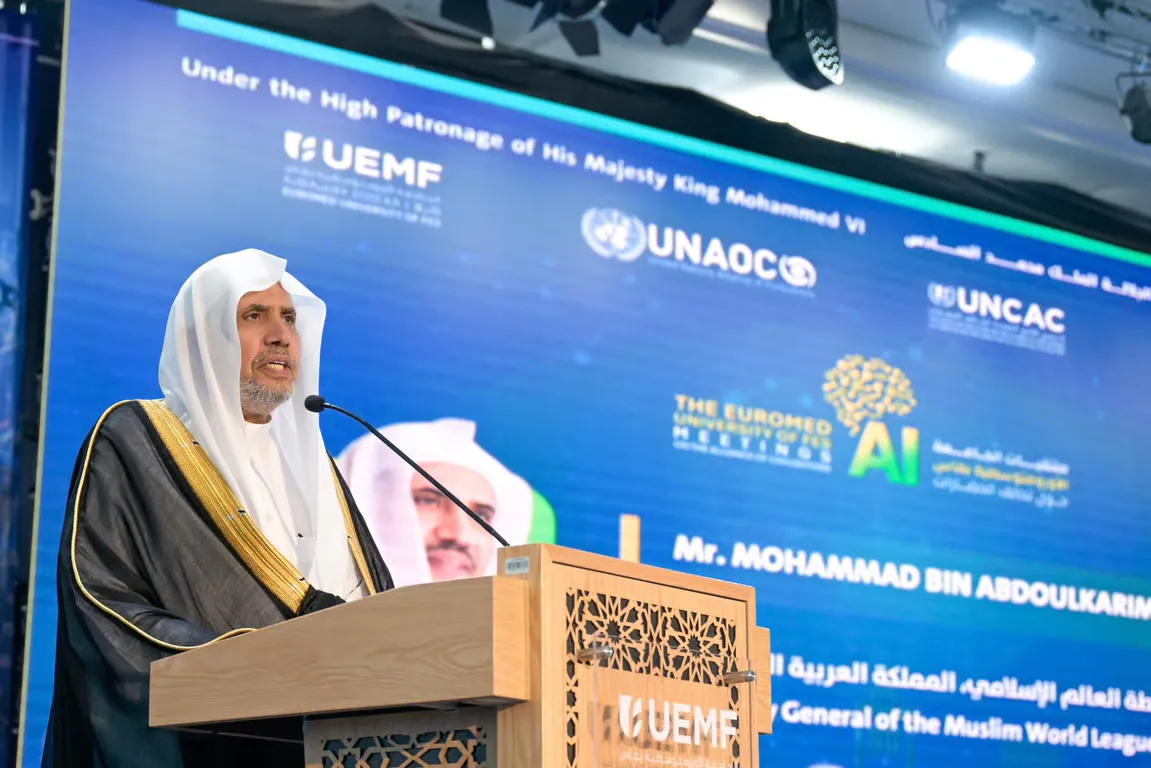
Key Highlights from the International Conference in Fes
The recent International Conference titled "The Future of Humanity in the Age of Artificial Intelligence" was held at the Euro-Mediterranean University in Fes, Morocco, featuring prominent figures and intellectuals from over 75 countries. Among the distinguished speakers was His Excellency Sheikh Dr. Mohammed bin Abdulkarim Al-Issa, Secretary-General of the Muslim World League and President of the Association of Muslim Scholars. His keynote address emphasized the crucial topic of the conference, which revolves around the significant transformation of human civilization in the context of artificial intelligence (AI).
In his speech, Sheikh Al-Issa reflected on the historical evolution of knowledge, tracing back to the cognitive revolution experienced during the 16th and 17th centuries. This period marked a transition from traditional materialistic thinking to the expansion of the scientific experimental method, a foundation laid by Muslim scholars between the 10th and 11th centuries. He underscored how AI has evolved from a mere digital memory for storing knowledge to becoming a powerful analytical tool capable of generating new ideas.
The Ethical Framework for AI Development
During his address, Sheikh Al-Issa stressed the urgent need for a unified ethical framework to govern the development of AI. He advocated for establishing common values before creating AI systems, especially in sensitive areas such as religion, ethnicity, and culture. This proactive approach aims to prevent AI from being misused as a tool for promoting hatred, racism, or supporting theories that exacerbate civilizational clashes. He called upon companies involved in AI development to ensure transparency, accountability, and to impose strict limits in critical areas where human decisions must prevail.
Moreover, he highlighted the distinction between human decision-making and machine operations, asserting that while humans are free to think and can arrive at correct conclusions, machines—including AI—are not free. They operate based on the information fed to them, whether accurate or misleading, and lack consciousness and will. Therefore, he posited that the future of our civilization in relation to AI is intrinsically linked to human values and decisions, positioning AI merely as a reflection of our own directives in its vast operational landscape.
As reported by sabq.org.