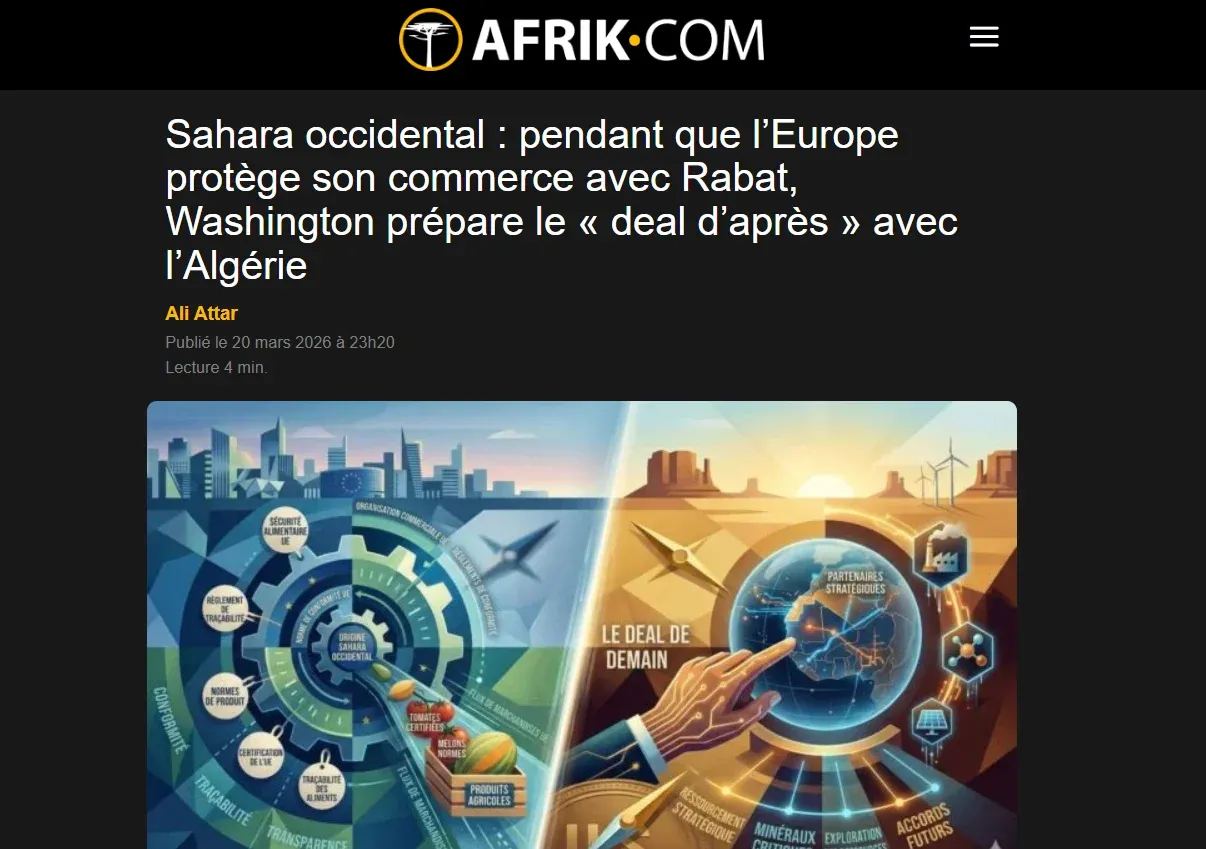
The article titled “Western Sahara: While Europe Protects Its Trade with Rabat, Washington Prepares the 'Post-Deal' with Algeria,” published by Ali Attar on March 20, 2026, presents a clear geopolitical reading of the current situation. It highlights how the European Union (EU) is attempting to safeguard its commercial interests with Morocco while the United States is advancing in strategically reconfiguring the Western Sahara conflict.
At the heart of the analysis is a revealing fact: the European Union's struggle to fully implement the rulings of the European Court of Justice concerning Western Sahara. Despite the European jurisprudence establishing that products from this territory cannot be deemed Moroccan without the consent of the Sahrawi people, Brussels continues to approach the issue as a technical problem—focusing on labeling and trade—while avoiding the deeper political and legal dimensions involved.
In contrast, the article underscores the U.S. strategy, which goes beyond mere diplomatic engagement. Washington is actively facilitating direct negotiations among the involved parties—Morocco, the Polisario Front, Algeria, and Mauritania—while simultaneously strengthening its position regarding strategic resources. The American perspective is not solely fixated on the conflict; it also considers the economic potential of the region, particularly in key sectors such as minerals, renewable energy, and critical raw materials.
A central point emphasized in the text is the increasing role of Algeria as a strategic player. As Morocco traditionally relies on certain resources, the U.S. appears to be exploring alternatives that involve integrating Algeria and the Polisario Front into a potential new governance framework. This would diversify access to resources and anticipate a scenario where the consent of the Sahrawi people becomes crucial once again.
One of the most significant elements of the analysis is the warning regarding Europe's position. By prioritizing the continuity of its trade relations with Morocco, the European Union may be compromising its future capacity for influence. Should the international legal framework prevail—as suggested by the decisions of the ECJ—and Sahrawi consent becomes a decisive factor for resource exploitation, European companies may find themselves in a vulnerable position.
Simultaneously, the United States has reportedly advanced in building relationships with all involved stakeholders, positioning itself for a scenario following the current political deadlock. In this context, Western Sahara is no longer merely a territorial conflict but transforms into a crucial space within global strategic supply chains.
The underlying thesis of the article is explicit: the European Union is managing Western Sahara as a commercial dossier, whereas the United States approaches it as a strategic node of power and resources. This difference in focus not only shapes the present state of the conflict but also its future evolution.
Thus, Western Sahara increasingly appears as a battleground where three dimensions intersect: international law, geopolitical balances, and the control of strategic resources. In this intersection, current decisions could determine who will be present—and who will not—in shaping the future landscape.
Ali Attar’s analysis introduces a key element for understanding the current moment: the shift of the conflict toward a logic of global strategic competition. While the legal framework continues to set boundaries—especially concerning the consent of the Sahrawi people—major powers are beginning to position themselves based on economic and security interests.
In this context, the question is no longer merely how the conflict will be resolved but who will be in a position to benefit from its eventual resolution.
As reported by noteolvidesdelsaharaoccidental.org.