
Half a Century of Suffering
Fifty years have passed since one of the most tragic humanitarian crises in the history of Moroccan-Algerian relations, known as the "Black March". During this dark chapter, the regime of President Houari Boumediene arbitrarily expelled thousands of Moroccans in direct retaliation to Morocco's organization of the Green March. This episode raises an urgent question: Is it finally time for the Moroccan state to fully acknowledge its historical responsibility toward its citizens and actively engage its diplomacy to reclaim the rights that have been lost for half a century?
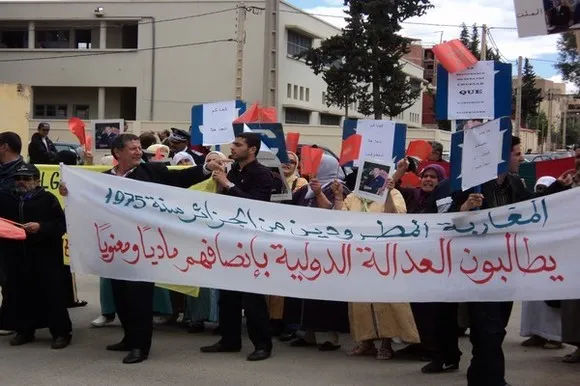
Over the past five decades, the victims of this arbitrary expulsion and their families have tirelessly fought for justice. Through their association, they have successfully brought their cause to the attention of the highest international human rights platforms, securing recommendations from the Human Rights Council in Geneva that condemn Algeria and demand compensation, reparations, and the reunification of dispersed families. However, this relentless human rights advocacy led by the victims themselves starkly highlights what many observers and experts describe as the "official inaction" of the Moroccan state. The expectation was that the state would lead the diplomatic and legal efforts on behalf of its citizens, yet it has lagged in supporting the plight of its nationals, who have been exploited as pawns in Algeria's political disputes.
Calls for Action and Accountability
In this context, international relations expert Ahmed Nour Eddine has pointed out that the Moroccan state has been slow to support the tens of thousands of its citizens who endured a heinous crime classified as crimes against humanity. He emphasizes that the state has failed to provide legal and diplomatic assistance to its citizens whose rights have been violated solely for being Moroccans. Nour Eddine remarked that the state has missed its opportunity to protect its citizens, who were made scapegoats by the Algerian military regime to settle scores with Morocco in response to the Green March aimed at liberating Western Sahara from Spanish colonial rule. The Algerian President Boumediene organized the "Black March" to exert social, economic, and humanitarian pressure on Morocco through the forced displacement of thousands.
Nour Eddine commended the efforts made by the victims' association, which has successfully brought their rights case to the highest international authority, the United Nations Human Rights Council. He noted that the International Committee on Migrant Workers has issued two recommendations in 2010 and 2018, demanding that Algeria compensate the victims for material damages, particularly regarding property and tangible rights, and also calling for reparations for the harm caused by the crime, as well as the reunification of families that were separated.
He stressed that the next step lies with the Moroccan state in advocating for its citizens who were forcibly and collectively expelled from Algeria. He proposed a clear roadmap that delineates responsibilities across various ministries and institutions. Firstly, the Ministry of Foreign Affairs should adopt the victims' case and prioritize it in its political agenda at the United Nations, the African Union, the Arab League, and the European Union. Secondly, it should continue the advocacy work initiated by the victims’ association before the Human Rights Council in Geneva and all relevant bodies and courts. Thirdly, the case should be a top priority in any potential negotiations with Algeria.
Furthermore, the Ministry of Interior should revitalize the files of the expelled individuals and create a national database or registry compiling all information gathered during the registration process in 1975. Nour Eddine pointed out that the ministry's departments in Oujda, Figuig, and the Red Crescent oversaw the census at that time. He considered this task strategic in forming a solid case regarding the victims and their properties, especially since the association was unable to account for all victims and their heirs.
Additional proposals include the communications sector, which should compile archives of international media to bolster the case with foreign documentation, and the Moroccan Archives Institution to create a comprehensive file on the crime, preserving memory to prevent recurrence. He also urged the Ministry of Education to include materials about this crime in school curricula. The National Human Rights Council was called upon to communicate with international human rights organizations to issue resolutions condemning Algeria and demanding compensation while supporting the victims' association in its advocacy efforts.
On the legal front, Nour Eddine called on the Ministry of Justice to appoint both Moroccan and international lawyers to assist the association and build a robust legal case for international courts. He also urged the national television, across all its channels, to produce documentaries and recorded testimonies about this crime. He concluded his remarks by affirming that these proposals are not exhaustive and that there is much more that state institutions need to do, including providing material and social assistance to the families of victims who find themselves in vulnerable situations.
As reported by al3omk.com.