When a university forgets its esteemed professors, it loses a vital part of its essence. However, when it chooses to recognize and honor these educators, it regains its profound significance, transforming from merely an institution that awards degrees into a sanctuary of knowledge, a space for memory, and a place that commemorates those who have made lasting impressions on minds and hearts. This particular moment is significant because it does not merely gather us for a fleeting activity or a formal occasion, but rather presents us with a human and intellectual celebration where we pay tribute to a professor who has turned knowledge into a mission, criticism into a responsibility, and the university into a ground for cultivating free individuals.
A Tribute to Professor Ahmed Yebouri: A Pillar of Moroccan Literary Criticism
Today, we gather to celebrate Professor Ahmed Yebouri, a prominent figure in Moroccan literary and cultural criticism. Our discussion transcends the narrow confines of academic titles; we speak of a man who has shaped modern Moroccan critical consciousness and played a pivotal role in transforming university education from mere rote memorization to a realm of inquiry, from memorizing concepts to generating insight. Professor Yebouri understood early on that criticism is not merely about linguistic flourish or technical display; it is rooted in intellectual and moral responsibility. Therefore, he did not use his critical project as a means to dazzle readers with language but as a pathway to awaken the intellect. He approached texts as if he were listening to the pulse of society within them, perceiving literature as a profound way to understand humanity, its fate, and its profound questions.
The theme of this gathering, “The Renewing Professor between Stance and Responsibility,” encapsulates an entire academic journey. For Professor Yebouri, renewal was not a fleeting intellectual whim or a race after ephemeral critical fashions. He approached renewal as a courageous awareness that true thought cannot thrive on repetition. Throughout his career, he continuously engaged in review and dialogue, raising questions without succumbing to the superficiality of modernity or the pretense of a hollow rupture. In this context, he equated stance with intellectual integrity, never altering his convictions according to transient changes or narrow calculations. He consistently leaned towards serious knowledge and regarded the university as a space for cultivating free individuals, rather than merely an administrative institution that produces certificates. This respect for intellectual diversity was paramount, as a true thinker does not seek the consensus of the masses but earns respect through the depth of their vision and scientific ethics.
Responsibility is perhaps the term that most closely aligns with his legacy. Professor Yebouri practiced teaching as a calling rather than a limited job defined by working hours. He believed that a true educator does not merely present a curriculum but teaches students a way of thinking, a manner of dialogue, a respect for knowledge, and a commitment to reason. Many of his students recall not only what he taught in lecture halls but also his listening skills, his approach to managing differences, and his ability to transform lessons into vibrant intellectual experiences.
This understanding of the relationship between Professor Yebouri and the Narrative Lab is crucial. This lab represents a symbolic extension of the academic path that he helped establish within Moroccan universities. He taught generations that narrative is not merely a story but a means of understanding the world, a sensitive document revealing the transformations of society, language, and consciousness. Thus, the celebration of the Narrative Lab today carries special significance, as if the river returns to its source, and students return to their first teacher, bringing with them the fruits of the passion for thought and knowledge that he instilled in them.
The depth of this moment is enhanced by its occurrence in Fez. Fez is not only an ancient historical city nor merely an architectural space where alleys, domes, and old schools coexist. It embodies a unique cultural and spiritual state, a city imbued with a scientific memory unlike any other, as if knowledge is part of the air one breathes. Those who know Fez understand that it does not easily bestow its spirit, but when it does, it grants a rare emotional belonging. Professor Yebouri's relationship with Fez transcends mere geography; it is deeply meaningful. He lived part of his intellectual project there, and generations of students have passed through who carried his influence to universities and cultural institutions within Morocco and beyond. Thus, this gathering forms a beautiful moment between memory and place; between Fez, which has contributed to shaping many symbols of Moroccan thought, and a great professor who belongs to it in a profound cultural and spiritual sense.
Professor Yebouri has amassed a body of knowledge characterized by rigor, depth, and commitment to the ethics of research and dialogue. He approached critical writing as an act of knowledge and intellectual responsibility, rather than merely producing texts or adding new titles. From this standpoint, his project is interconnected with questioning, listening to texts, and attempting to understand literature in its relationship with humanity, society, and history.
From Lessons in Critique to Lessons in Life
Professor Yebouri's approach to literature stems from a nuanced understanding of the function of criticism. He does not treat criticism as a tool for quick judgment or ready classification but as a field for revelation, analysis, and meaning-making. Consequently, literature, in his view, forms part of the human experience in its complexity and breadth, where individual and collective memory converge, language engages with social and cultural transformations, and writing empowers individuals to grasp what direct discourse struggles to express. This perspective is reflected in his presence in the academic and educational arenas. Within the lecture hall, Professor Yebouri did not present knowledge as ready-made material for memorization but transformed it into an experience of thought and inquiry. He provided students with the tools for reading, encouraged them to discover texts from within, fostered independent understanding, and liberated literary lessons from rote learning and repetition. Hence, he left an impact on his students not only through information but also through the way of perceiving texts, knowledge, and the role of the professor himself.
In his writing, he combined the precision of a researcher with the sensitivity of a reader, balancing methodological rigor with attention to the human dimension in literature. He read novels, stories, and narrative texts as spaces for producing meaning and as mirrors reflecting societal transformations, symbolic memories unveiling the questions and tensions swirling in reality. This is why his critique holds value; he did not confine himself to terminology nor succumb to theoretical display but remained anchored to the essence of the text and the possibilities it opens for understanding and interpretation.
Professor Ahmed Yebouri chose the path of quiet depth, distanced from the allure of transient appearances and cultural noise. His influence is evident in forming generations of students and researchers while establishing critical traditions founded on intellectual integrity, respect for the text, and awareness of the responsibilities of knowledge. Thus, discussing him evokes the archetype of the professor who embodies science as a moral pursuit, criticism as a conscious practice, and culture as a human and intellectual commitment.
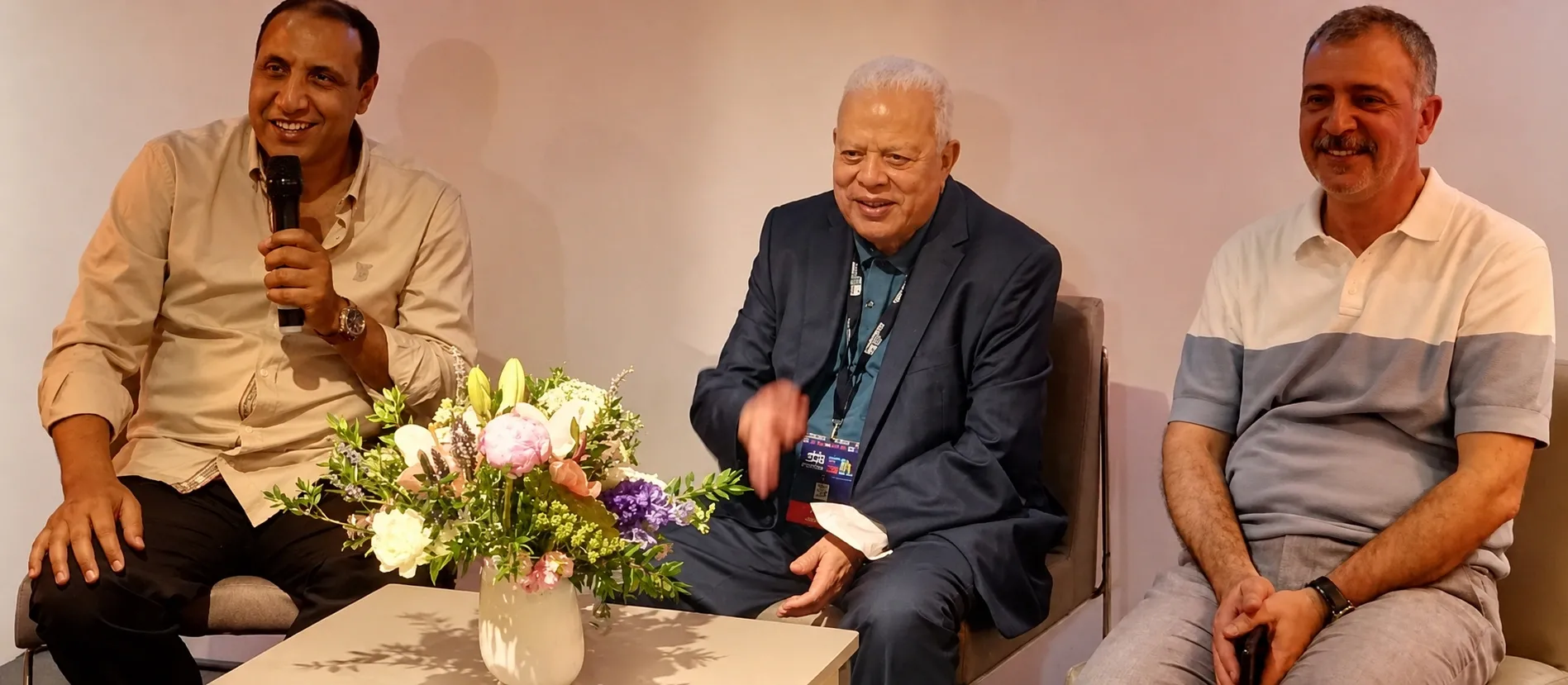
Days ago, I accompanied Professor Chaïb Halifi on a visit to Professor Ahmed Yebouri. That visit turned into another lesson, even though he was away from the classroom. He was joyful, content, and proud of the gathering. However, what truly moved me was not only his happiness but also the deep sense of reassurance that dwelled within him. I felt as if the man looked back at his life’s journey through the eyes of a professor who sees the fruition of his life’s work in his students and admirers and the enduring impact he has left behind.
He spoke of his students with genuine affection, not merely viewing them as names that passed through the lecture hall but as an extension of his human and intellectual legacy. Herein lies the greatness of a true professor: to create an impact without fanfare, to leave in people what time cannot erase. Some professors fill auditoriums with their presence, only to vanish as soon as they leave. In contrast, the great professor remains present even in silence because their influence transforms over time into a part of our cultural formation. Professor Ahmed Yebouri taught us something rare in this age: that culture can become a moral pursuit, that depth does not require pretense, and that humility is not an intellectual weakness but a sign of true maturity. In an era where much of the cultural discourse leans towards display, he remained faithful to the image of the calm intellectual who works deeply, allowing his works to speak for themselves.
In Praise of Quiet Impact
Nations do not measure their greatness solely by what they build but also by what they preserve of their intellectual and human symbols. When a university honors its great professors, it celebrates its most beautiful image and protects its memory from oblivion. The gravest threat to cultural institutions lies not only in material poverty but also in the deprivation of loyalty. Hence, the symbolic value of this gathering is profound. It beautifully announces that Moroccan universities can still acknowledge and celebrate those who have served thought in silence and nobility, far removed from transient calculations. It also sends a message to the new generations that true value is not crafted by speed but through patience, honesty with knowledge, and loyalty to meaning.
In conclusion, we can only say to Professor Ahmed Yebouri: Thank you for not being just a professor; you were a school of thought and ethics. Thank you for teaching us that knowledge is a stance, that criticism is a responsibility, and that the university can be a home of intellectual dignity rather than merely a factory of certificates. Thank you for empowering entire generations to dream of free thought and a culture that serves humanity and opens broader horizons before it.
Special thanks to the Narrative Lab, the Faculty of Arts at Fez Saïs, and everyone who contributed to creating this elevated human moment. May you remain, our esteemed professor, a beautiful impact in Moroccan and Arab memory, and may the university remain loyal to those who have defined its true meaning.
As reported by alittihad.info.