The Unforeseen Mobilization of Moroccan Fans
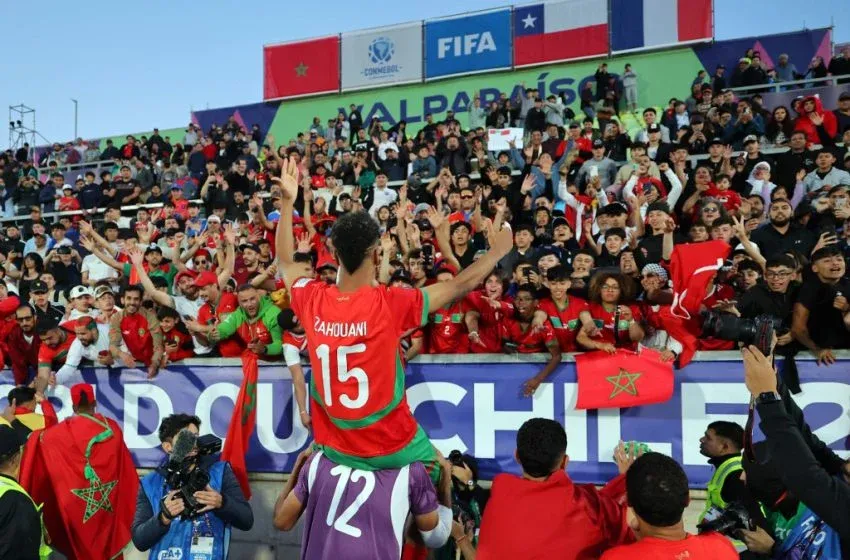
The Moroccan U20 national team’s qualification for the World Cup final in Chile on October 15, 2025, sparked an unexpected phenomenon: a wave of supporters eager to travel to Santiago. In under forty-eight hours, nearly 600 individuals were on their way to the farthest corner of the world. This remarkable mobilization is rooted in a broader narrative that intertwines football with contemporary Moroccan society, its diaspora, new forms of collective engagement, and the evolution of globally connected fandom.
As Moroccan fans accompanied the Lionceaux de l’Atlas in the stands, their journey took on a significance that transcended the pitch. The day after the team eliminated France in the semifinals, social media, WhatsApp groups, and informal conversations buzzed with a singular question: how to get to Chile to support the team in the final? Though the distance of over 10,000 kilometers and the usual visa processing times made the endeavor seem almost absurd, hundreds of Moroccans began searching for solutions. The most striking aspect of this situation was not the logistical plans that emerged but the pre-existing collective will to be present. The desire to support the team preceded any practical arrangements.
Transforming the Impossible into Reality
On Friday, October 17, 2025, as I prepared for a post-lunch nap, my phone lit up with a message from a WhatsApp group. Royal Air Maroc had announced an exceptional flight to Santiago for the World Cup final, offering round-trip tickets and match entry for 10,000 dirhams. Just moments before, traveling to Chile had seemed nearly impossible. Following Morocco's historic victory over France, I, along with many other supporters, had been frantically searching for a feasible way to attend the final. Available flights often required over thirty-five hours of travel and cost upwards of 35,000 dirhams, compounded by the improbability of timely visa approvals. Yet, amidst these hurdles, one question echoed in our discussions: how could we be there for the young players preparing to compete in Morocco's first-ever World Cup final?
Upon the announcement, I quickly filled out the required forms and gathered necessary documents. A few hours later, I found myself at the Royal Air Maroc office in Meknès. The atmosphere was electric; the office buzzed with activity, phones rang incessantly, and employees worked long past usual hours. When I asked them about the sudden surge in demand, their responses surprised me. They didn’t voice complaints about increased workloads; instead, they spoke of participating in a national mission.
That night, sleep eluded me. Like hundreds of other eager travelers, I waited to confirm my departure, engulfed in a palpable excitement reminiscent of a child’s anticipation for their first summer camp. Regularly checking my phone, I hoped for confirmation. With each passing hour, a question loomed larger: if I, a seasoned sports professional, felt this intense emotion, what about the countless others also seeking to reach Chile?
The following day, the long-awaited call came in around 2:30 PM. My departure was confirmed. A few hours later, I was on my way to Mohammed V Airport, armed with 600 copies of a research questionnaire for each traveler. My intent was to conduct a quantitative study to understand the profiles of supporters mobilized for this historic final.
Upon arriving at the airport, another surprise awaited me. The nearly 600 fans preparing to board were a remarkable social mosaic, comprising students, doctors, entrepreneurs, retirees, and civil servants, representing various regions and social backgrounds. Some came from France, Belgium, and Spain, while others traveled from Asia. I even met a Moroccan in his sixties who had come from Sri Lanka in traditional attire to support the national team. Each traveler had a unique story, yet they shared a common goal: to stand by their team.
I boarded that flight as a supporter and returned with dozens of interviews, hundreds of field notes, and the conviction that this journey represented far more than a football final. Throughout the hours spent in airports, planes, and the streets of Santiago, a series of questions began to emerge. Why were so many willing to traverse the globe for a U20 final? Why did some describe their attendance as a duty or responsibility rather than mere sports enthusiasm? What role did the diaspora play in this mobilization? How could football serve as a connector among individuals who might never have interacted otherwise?
Initially, my research aimed to understand who the supporters were in Santiago, but it unfolded into a broader exploration of unprecedented mobilization forms, cross-continental connections, and the evolving relationship between players and fans. This experience revealed much about contemporary Morocco, its collective mobilization capacity, and how football fosters a shared imagination that transcends national borders.
Reflecting on Santiago, it serves as a compelling laboratory for observing dynamics that may resurface during the upcoming World Cup in 2026 across the United States, Canada, and Mexico, and subsequently in 2030 when Morocco co-hosts with Spain and Portugal. This series does not merely recount the final match or analyze the sporting aspects of victory; rather, it delves into the stories and experiences surrounding this triumph. Who were the Moroccans present in Chile? How did they experience the adventure? What insights can be drawn from their mobilization as we approach significant international events?
In the forthcoming episodes, we will meet these remarkable individuals who crossed continents to support a team of young players, uncovering their journeys, motivations, emotions, and sacrifices. We will also examine how this adventure impacted players, coaches, diplomats, and others involved. The series aims to illuminate the evolving nature of Moroccan fandom on an international scale and the implications for future sporting events.
As reported by medias24.com.