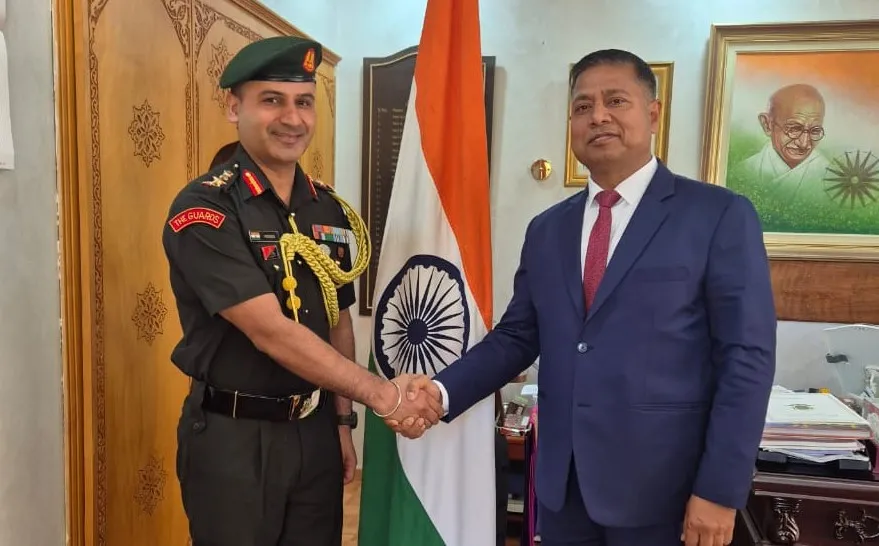

In recent days, India has appointed a new military attaché to the Kingdom of Morocco, marking a significant step as both nations aim to elevate their military partnership beyond traditional cooperation, training, and experience exchanges. The focus is now shifting towards more ambitious goals, including joint military manufacturing and defense technology transfer, as well as potential projects in aerospace and aircraft production.
The Indian Embassy in Rabat announced the welcoming of Colonel Virender from the Indian Army by Ambassador Sanjay Rana, highlighting the ongoing growth and enhancement of the defense partnership between the two countries in areas such as defense industrial production and military training. This appointment is seen as a direct link to the signing of a memorandum of understanding regarding defense cooperation during the visit of Indian Defense Minister Rajnath Singh to Morocco in September 2025. This visit was a pivotal moment in the trajectory of bilateral military relations, solidifying a political will from both sides to expand cooperation beyond traditional defense relationships.
Over recent years, Moroccan-Indian relations have transitioned from a primary focus on diplomatic and economic cooperation to establishing a strategic partnership in the defense industry sector. This evolution is benefitting from Morocco's desire to localize military industries and develop a national industrial base capable of producing an increasing share of its defense requirements. Specialized reports indicate that India views Morocco as an ideal partner to implement its "Make in India" strategy beyond its borders, especially given Morocco's strategic geographic location at the gateway to Europe, its extensive network of free trade agreements, and its advanced industrial and logistical infrastructure, all of which make it an attractive destination for major industrial investments.
Furthermore, this trend has been bolstered by the launch of the Tata Advanced Systems project in the outskirts of Berrechid, which stands as a prominent example of defense industrial cooperation between the two nations. This project is distinguished by its commitment to a broader participation in manufacturing and final assembly processes, gradually increasing local integration levels, rather than merely traditional industrial assembly.
Most sources emphasize that the success of the joint collaboration between Morocco and India in producing military vehicles through the Tata Advanced Systems project will pave the way for further partnerships in various fields, including aerospace. An informed Indian source previously indicated to "Assahifa" that Rabat and New Delhi are discussing the possibility of establishing a factory in Morocco for the production of military aircraft.
Today, Morocco boasts a comprehensive aerospace system consisting of around 150 specialized companies, achieving an annual turnover of approximately 2.5 billion euros, with a strong presence from major global corporations such as Airbus, Safran, Boeing, and Spirit AeroSystems. This positions Morocco as a significant regional hub for aircraft component manufacturing and maintenance. However, Moroccan ambitions extend beyond merely producing components and parts, aiming to reach the stage of manufacturing and assembling complete aircraft within the country. In this context, India emerges as a potential partner capable of supporting this ambition, especially since it possesses several national aerospace programs with full intellectual property rights, providing it with a broader margin for technology transfer and establishing joint production lines outside its borders.
Among the intriguing projects, as reported by specialized defense media, is the "HTT-40" advanced training aircraft developed by Hindustan Aeronautics Limited, which is considered one of the leading candidates for joint manufacturing or assembly outside India, given that New Delhi holds the design rights and has the capacity to scale production to meet new market demands. Moreover, this aircraft is not limited to training missions; it can be developed for close air support and counter-insurgency operations, making it particularly attractive to several African countries seeking cost-effective and operationally suitable defense solutions.
Additionally, the sources pointed out that Morocco has signed agreements and memoranda of understanding with other Indian companies active in the aviation sector, including "Gensar Aerospace," indicating that the bilateral cooperation extends beyond current defense industries to future projects aimed at developing new aerial platforms within the Kingdom.
As reported by assahifa.com.