
Kashgar: A Mirror of Marrakech's Charm
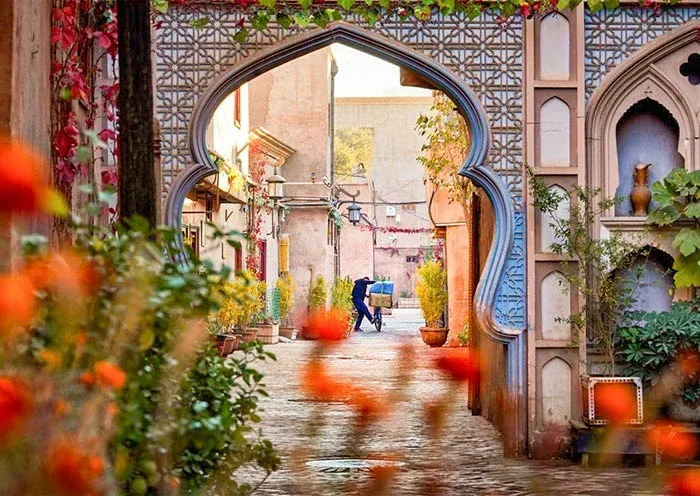
Upon first glance, many Moroccans might easily mistake their surroundings for the narrow alleys of Marrakech's old city. The ochre walls, winding passages, intricately carved wooden doors, vibrant markets, and the artisans working within small workshops all evoke the enchanting atmosphere of the red city. However, this scene unfolds not in Morocco but approximately 8,000 kilometers away in Kashgar, an ancient oasis city located in the Xinjiang Uyghur Autonomous Region, in the far west of China. The striking resemblance between Kashgar and Marrakech has captured the attention of numerous Moroccans, particularly through videos circulating online that showcase the similarities.
During her visit to Kashgar, a Moroccan content creator expressed her astonishment, noting that without the Chinese signage, one could easily believe they were in Morocco. The similarities were so pronounced that she instinctively greeted a local resident in Moroccan Arabic, stating, "I don't know how to explain this; I feel like I'm in Marrakech." Many Arab content creators echoed her sentiments, sharing that they felt as if they were exploring an ancient Moroccan city rather than one of the oldest cities in China.
A Shared Architectural Heritage
These similarities are not merely coincidental; they stem from a broader Islamic architectural tradition that shaped both cities, utilizing comparable building techniques and locally available materials to adapt to similar climates. Established over two millennia ago, Kashgar rose to prominence as one of the most important oasis cities on the ancient Silk Road by the 2nd century BC, making it almost twice as old as Marrakech, which was founded by the Almoravids in the 11th century. Positioned at the crossroads linking China with Central Asia, Persia, and the Indian subcontinent, Kashgar became a thriving commercial and cultural hub where traders, pilgrims, and travelers exchanged not just goods but also ideas and artistic traditions.
The old city of Kashgar, sprawling over 3.6 square kilometers, features a maze of narrow streets designed to provide shade from the intense summer heat. The buildings, constructed from mud and adobe, impart the same earthy tones that characterize Marrakech, while the simple exteriors conceal inner courtyards that offer privacy and natural cooling—elements that are instantly recognizable to anyone familiar with the ancient cities of Marrakech or Fez. Moreover, like Marrakech, Kashgar developed around vibrant markets, traditionally organized according to craft specialties. Today, woodcarvers, metalworkers, potters, weavers, and food vendors continue to practice skills passed down through generations, while tea houses and bakeries breathe life into the streets.
At the heart of the old city stands the Id Kah Mosque, one of the largest mosques in China. Originally built in the 15th century, it remains a spiritual center for Kashgar and a symbol of its rich Islamic heritage spanning centuries. Despite its antiquity, Kashgar thrives as a living city rather than merely an open-air museum. For many Moroccans discovering it online, an intriguing question arises: how can a place located in far-off Asia evoke such a strong sense of Marrakech?
As reported by ar.yabiladi.com.