
Kenya Affirms Support for Moroccan Autonomy Plan at Joint Cooperation Commission
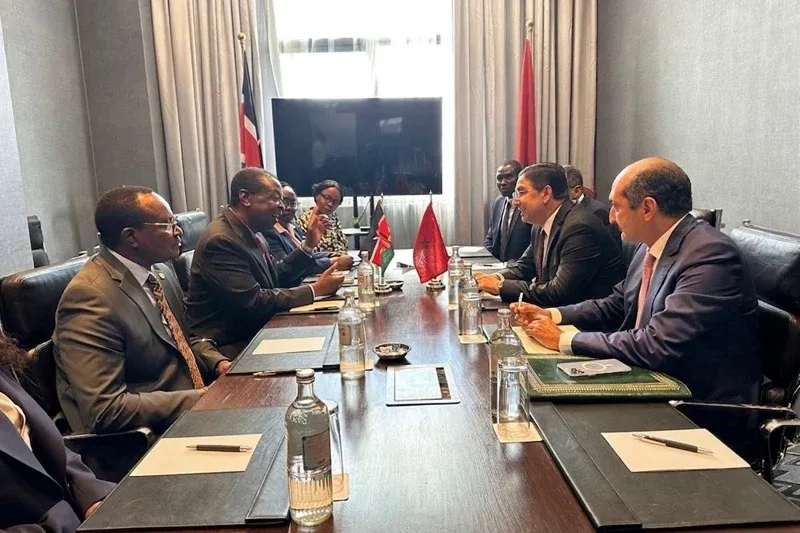
On Thursday, Kenya publicly endorsed the autonomy plan for the Sahara under Moroccan sovereignty, declaring it the most credible and realistic solution to the ongoing dispute in the region. This significant position was articulated during the inaugural session of the Morocco-Kenya Joint Cooperation Commission, which was co-chaired in Nairobi by Kenya's Prime Cabinet Secretary Musalia Mudavadi and Moroccan Foreign Minister Nasser Bourita. During this session, both nations expressed their commitment to collaborate with other like-minded states to facilitate the implementation of the autonomy plan.
The Joint Communiqué, which was adopted at the conclusion of the Commission's meeting, highlighted Kenya's acknowledgement of the increasing international consensus and the momentum generated by His Majesty King Mohammed VI in support of Morocco's autonomy plan. Kenya characterized this autonomy initiative as a "sustainable approach" to resolving the Sahara dispute, reinforcing its intention to work alongside allies to promote the plan's adoption and execution.
Furthermore, Kenya welcomed the recent adoption of United Nations Security Council Resolution 2797, which recognizes the autonomy plan under Moroccan sovereignty as the foundation for a just, lasting, and mutually acceptable resolution to the conflict. In this context, Kenya expressed its endorsement of the efforts made by the UN Secretary-General and his Personal Envoy to facilitate negotiations centered around this autonomy proposal.
Morocco, in turn, expressed appreciation for Kenya's support within the framework of the United Nations, viewing it as the exclusive mechanism to achieve a lasting political solution to the Sahara issue. The Moroccan delegation also acknowledged Kenya's ongoing cooperation with the UN Secretary-General and his envoy, which aims to advance the political process in line with pertinent Security Council resolutions.
The session was not only a platform for political dialogue but also for tangible agreements. Following a previous meeting of senior officials held in Rabat earlier this month, the Joint Cooperation Commission saw the signing of eleven bilateral agreements covering diverse sectors including agriculture, justice, health, maritime fisheries, gender equality, cultural cooperation, and education. These agreements build on five memoranda of understanding that were initiated in May 2025, focusing on areas such as trade cooperation and public service capacity building.
In terms of economic collaboration, both nations addressed the need to rectify the existing trade imbalance and expand market access for agricultural products and value-added goods. They also discussed initiatives to encourage cross-investment in sectors like renewable energy, agro-industry, and pharmaceuticals. Additionally, both parties committed to accelerating negotiations to finalize agreements in critical areas such as ports, energy, and tourism, with an emphasis on reviving direct flights between Kenya and Morocco to enhance trade and tourism exchanges.
As reported by northafricapost.com.