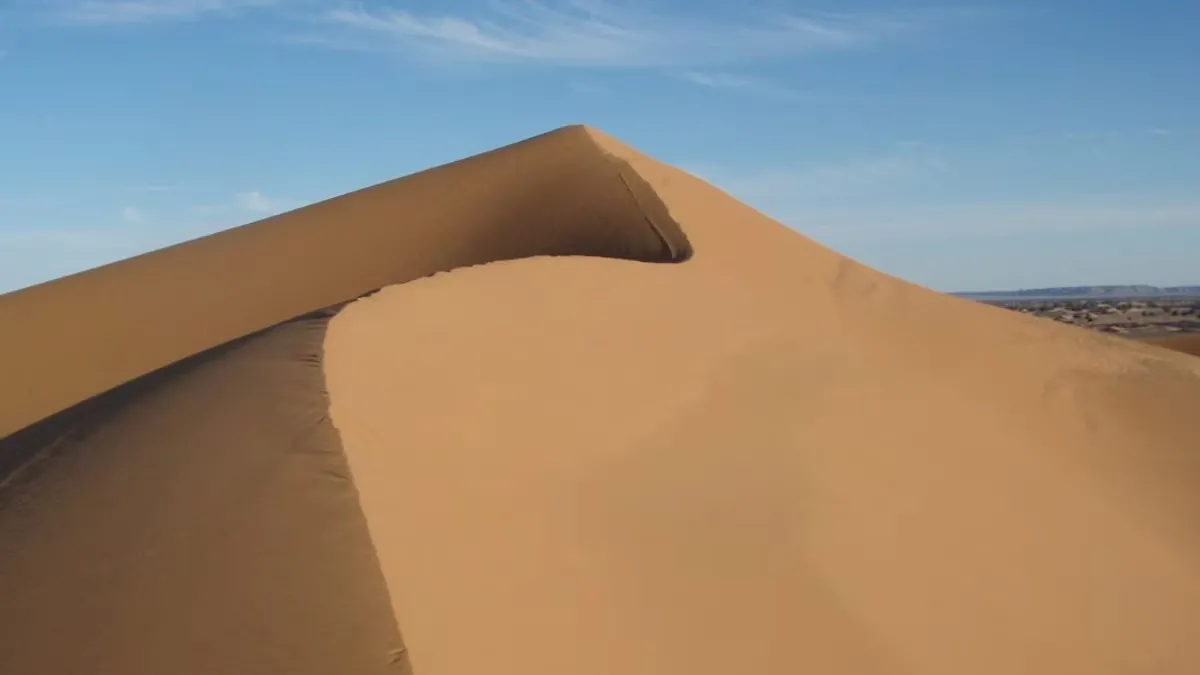
Unveiling Lala Lallia - The Remarkable Star Dune
Nestled in the heart of the Moroccan desert, Lala Lallia stands as a distinguished star dune, recognized for being one of the oldest and most studied sandy structures on Earth. The term 'Lala Lallia', derived from the Berber language, translates to 'the highest point', aptly describing its prominent position within the Sahara landscape. This dune boasts a unique pyramidal shape and remarkable dimensions that set it apart on a global scale. Recent research conducted by experts from the Department of Geography at the University of Oxford has estimated the age of Lala Lallia to be approximately 13,000 years, utilizing luminescence dating techniques that measure the time elapsed since the sand grains were last exposed to sunlight, thereby providing invaluable insights into the climatic and wind patterns that have shaped the region over millennia.
Classified as a star dune—a pyramidal structure characterized by multiple radial arms—Lala Lallia belongs to a rare group that constitutes merely 10% of all dunes studied worldwide, according to analyses published in the scientific journal Geomorphology. Viewed from above, the dune resembles a multi-pointed star, a configuration resulting from the influence of winds blowing from various directions and the significant accumulation of sand around a single core.
The Formation and Significance of Star Dunes
Dunes are wind-shaped formations that are not exclusive to arid and warm climates; they also exist in cold environments such as Antarctica. This phenomenon occurs because the wind's action on exposed sandstone surfaces allows for sand accumulation and shaping even at low temperatures. The largest and most complex dunes can be found in deserts across North America, Asia, and Africa. Lala Lallia is particularly noteworthy due to its size, longevity, and dynamic nature, exhibiting an annual movement of approximately 0.5 meters, as documented by leading international geomorphological research teams and the French National Center for Scientific Research.
The luminescence dating method, crucial for determining the dune's age, measures the energy stored in sand grains when they are buried. In laboratory settings, specialists expose samples to red light, quantifying the energy emitted to ascertain the time since the last solar exposure of the sand; this technique is pivotal for paleoclimatic and archaeological research. Such methodologies have allowed researchers to correlate the formation of Lala Lallia with significant transformations in wind direction and speed that occurred thousands of years ago.
The complexity of the star dune is attributed to the dynamic interactions of variable winds. The Moroccan Institute of Earth Sciences asserts that the existence of star dunes like Lala Lallia illustrates the influence of alternating wind systems, in contrast to linear or parabolic dunes typically formed by persistent and dominant winds. Beneath the desert surface lie strata generated by sandstorms and periods of intense aridity; these sediments provide direct data on environmental fluctuations in the Sahara since the end of the last glaciation, forming a geological record of regional climatic evolution.
The morphological key to star dunes lies in the influence of winds from multiple directions throughout the year or during extended periods, promoting the development of a central core with radial arms and a stable, elevated geometry. The Department of Geography at the University of Oxford has confirmed that despite its annual movement, Lala Lallia retains significant height and a symmetrical structure. “The mobility of Lala Lallia, approximately 0.5 meters each year, is measured through satellite tracking, allowing for the observation of millimeter-scale transformations in its morphology year after year,” the specialists assert.
These studies enable the analysis of the relationship between aeolian sedimentation processes and historical climate changes in the region, highlighting its importance as a research object for understanding desert ecosystem dynamics on a global scale. The inclusion of star dunes in the cartography of the Sahara and other deserts worldwide has demonstrated the diversity of aeolian forms and their significance in reconstructing the history of terrestrial landscapes.
As reported by infobae.com.