Since 2018, Lamine has made the Canary Islands his home, fleeing the repression of Morocco. He succinctly sums up his situation, stating, "Everything stems from politics. Spain has its share of blame, and Morocco does too." After enduring a lengthy three-year process to obtain a prosthesis, he is still waiting for surgery on his other hip. The pain and disability he experiences have significantly hindered his ability to secure stable employment. Lamine, 32, stands as a stark contrast to the fears that the Spanish far-right has been propagating with alarming efficiency over the years. A Sahrawi, a Muslim, and for years living without proper documentation, he fits into a category that many would quickly judge. However, when you meet him, the facade crumbles, revealing a person with hopes and dreams.
On Thursday, Lamine will be among nearly 2,000 individuals — 75% of whom are migrants — attending a meeting with Pope Leo XIV at the Arguineguín dock. The mere thought of this encounter brings a smile to his face, which remains unwavering. It is hard to fathom how a Muslim whose greatest desire is to shake hands with the Pope could be perceived as a threat. When asked by EL MUNDO about what he would say if given a couple of minutes with the Holy Father, he responds, "I wouldn’t know what to say or ask. I would probably just thank him for everything, for coming, for looking at us."
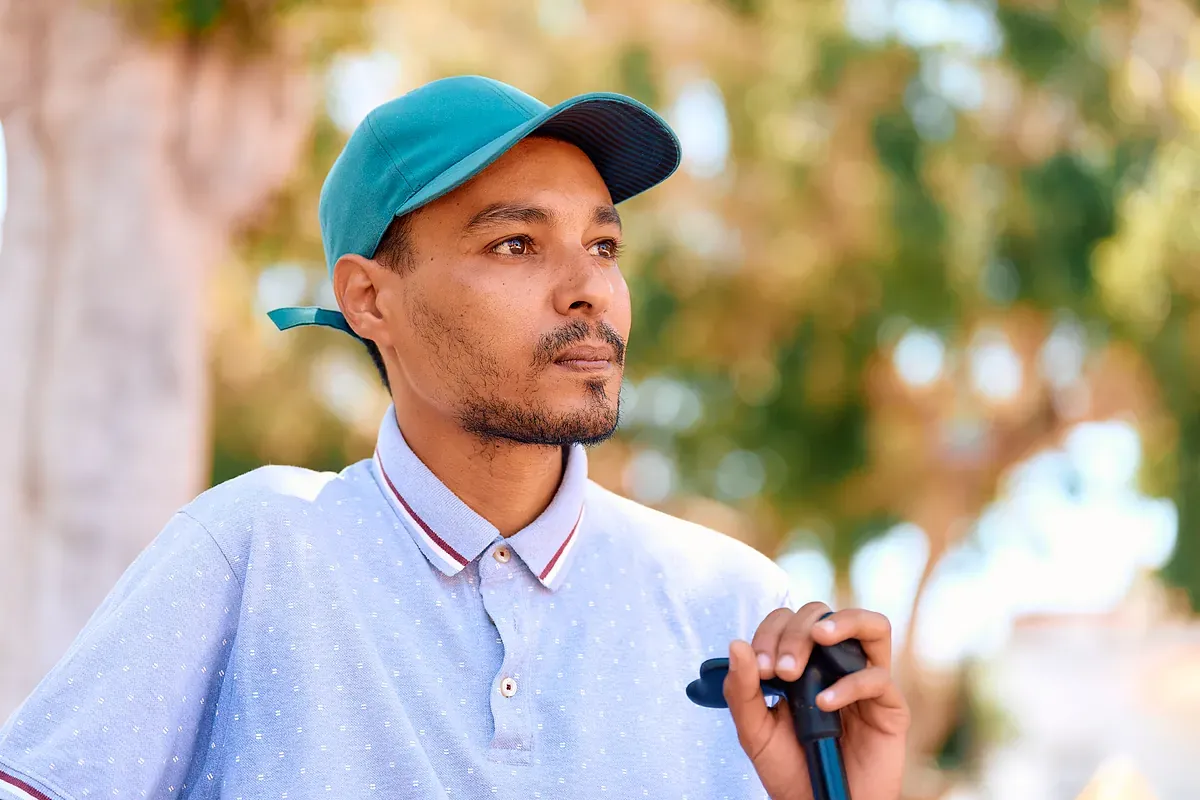
With a mahogany complexion and a slender frame, Lamine visibly limps, relying on a crutch to alleviate the pain in his left hip. On his right leg, he wears a prosthesis, a long-awaited solution that took three years to secure in Spain. For years, he has tirelessly sought legal employment in the islands, eager to contribute economically to society. Yet, his disability and persistent pain remain formidable barriers to securing a job. He speaks fluent Spanish, but occasionally struggles with certain words, snapping his fingers as if to catch them in mid-air. He ponders his responses carefully, often accompanied by a smile that seems almost permanent. It is this resilience that makes his story all the more striking.
Lamine arrived in Puerto del Rosario (Fuerteventura) in 2018 after traversing the Atlantic in a makeshift boat. He and seven other young Sahrawis commandeered an abandoned motorboat from El Aaiún beach. He did not inform his family, knowing they would have urged him to stay, fully aware of the dangers faced by many who make similar journeys. After being fingerprinted by the police for documentation, he remembers the first thing he did with his newfound freedom: "I listened to the people around me as I walked by," he recalls, "wanting to understand them to learn Spanish, because before leaving my country, I knew that understanding the culture and language was crucial for adapting, coexisting, and finding a future."
Born in El Aaiún, Lamine’s identity is intrinsically linked to the Sahrawi struggle against Moroccan oppression, a struggle that has cost countless lives and rights since Morocco's occupation. Spain abandoned the territory in 1976, breaking its neutrality in an area it once governed. Despite this, the Sahrawis, including Lamine and his family, refuse to forget their past. "Three years ago, I managed to gather the documentation linking my ancestors to Spain," he explains. "I was granted residency for a year based on my ties, but it was not renewed after that." The process involves presenting birth certificates of relatives born prior to 1976, allowing descendants to claim this recognition. "Many Sahrawis who had it also had their requests denied," he notes, suggesting that Spain's diplomatic ties with Morocco influenced these decisions.
Lamine criticizes Morocco openly, reflecting the frustrations of a lifetime spent fighting against oppression. He speculates about why King Mohammed VI occasionally opens border crossings, suggesting that it is to send many Moroccans to Europe, particularly Spain, to help defend Morocco’s interests during times of crisis. The Sahrawis belong to a nation that remains unrecognized: the Sahrawi Arab Democratic Republic (SADR). Lamine escaped in 2018, a decision he made reluctantly. "Do you know that they now kill us with drones?" he asks incredulously, using the first-person plural because he still feels a part of that struggle. The indoctrination he faced in school, where maps depicted his land as Moroccan, failed to erase his identity.
As he awaits the Pope's visit, Lamine expresses hope that the Holy Father will take notice of the Sahrawi plight and visit their territory, emphasizing the toll of 53 years of occupation and conflict. "It fills me with joy that he wants to reach out to us [migrants]," he states. "Many of us are Muslims, but we recognize him as a person of peace, and his presence signifies that more help is on the way." At 11:40 today, Lamine will conclude one of many waits in his life — not the longest nor the most consequential, but one he approaches with love and happiness. Perhaps he will shake the Pope's hand, or perhaps not. Regardless, he will continue to wear that smile, for after today, he still has other waits to endure: one for a prosthesis for his left hip and another for the liberation of Western Sahara.
As reported by elmundo.es.