
International Literary Experience in Morocco
The esteemed writer and poet María Vilalta from San Lorenzo recently added an impressive chapter to her literary journey by presenting her novel "Tánger, en los ojos de Drissi" in Morocco, where it has been newly translated into Arabic. This remarkable event took place in the vibrant cities of Rabat and Tetuán, coinciding with cultural activities related to the International Book Fair and various Moroccan artistic spaces.
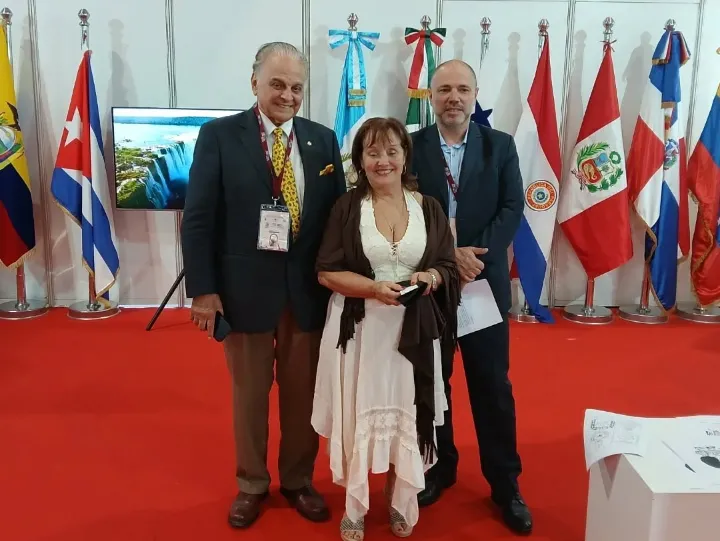
Vilalta shared that her first presentation occurred in Rabat, the capital of Morocco, during a significant international book fair that attracted a large audience in a beautifully arranged open space. The event was held at the stand dedicated to Spain and Latin America, facilitated by the Instituto Cervantes, with the support of the Argentine Embassy in Morocco. She expressed her gratitude particularly to Federico Villalpando, the head of the consular section, and Ambassador Arnaldo Ferrari, for their instrumental role in making this event possible.
Exploring the Life of Drissi
The author described the experience as deeply emotional, especially due to the presence of diplomatic representatives from various Latin American countries and a serendipitous encounter with a Spanish bookseller. "The most touching moment for me, which brought tears to my eyes," she confessed, was discovering that her book "Territorios literarios San Lorenzo" was available in a small Spanish book sales area. The bookseller even mentioned that several copies of her children's book "Las medias perdidas" had been sold.
Vilalta's novel centers around the life of Moroccan artist Drissi, an expressionist painter who created much of his work across Tánger, Tetuán, Spain, Germany, and France. According to Vilalta, Drissi aimed to depict "a genuine Morocco, an Arab Morocco, deeply infused with everyday experiences," steering clear of the typical tourist or folkloric perspectives. During her second presentation in Tetuán, she engaged with artists and educators associated with the art school where Drissi had trained. The director of the institution remembered Drissi as "one of the brightest students" he had encountered.
This discussion led to a passionate debate among attendees and local artists, who even questioned why a Latin American had to come and discuss a Moroccan artist who had not received more recognition in his own country. Vilalta recounted that she learned about Drissi's story through his widow, María Llardén, a Catalan woman she met years ago at a literary event in Tánger. This conversation was pivotal for the novel's inception. "Novels find me; I do not seek them," she stated, explaining that it initiated a research and writing process that blended real testimonies, documentation, and imaginative storytelling.
Initially published in Panama around four years ago, Vilalta revealed that the book sold out quickly, and she still receives requests from readers eager to obtain Spanish copies. Regarding the recent Arabic translation, she noted that it was prompted by the interest of Moroccan translator Mezouar El Idrissi, who had previously worked on one of her novels. Vilalta praised El Idrissi as a writer and poet with a profound understanding of Argentine literature, even having translated works by Jorge Luis Borges. She mentioned that he particularly appreciated the respectful way she approached the Arab universe in her novel, stating, "I tried not to impose my subjectivity."
Vilalta also discussed the unique narrative structure of her work, constructed from "three worlds": the Arab world represented by Drissi, the European perspective embodied in a female character inspired by María Llardén, and a Latin American voice that serves as a commentator on the story. This narrative complexity captivated Moroccan readers and educators, who highlighted the depth of the work.
When asked about her connection to Arab culture, Vilalta expressed that what draws her most is "the strangeness, the difference," highlighting the rich cultural tapestry of a society she views as profoundly sensitive and complex. She also challenged certain Western prejudices against the Arab world, asserting that "they are very profound and have contributed immensely to all the arts, medicine, and architecture."
In conclusion, Vilalta shared that in each of her international presentations, she maintains a symbolic gesture: displaying the Argentine flag. "It’s like my clothing, my sign of distinction," she stated with pride.
As reported by diariosintesis.com.ar.