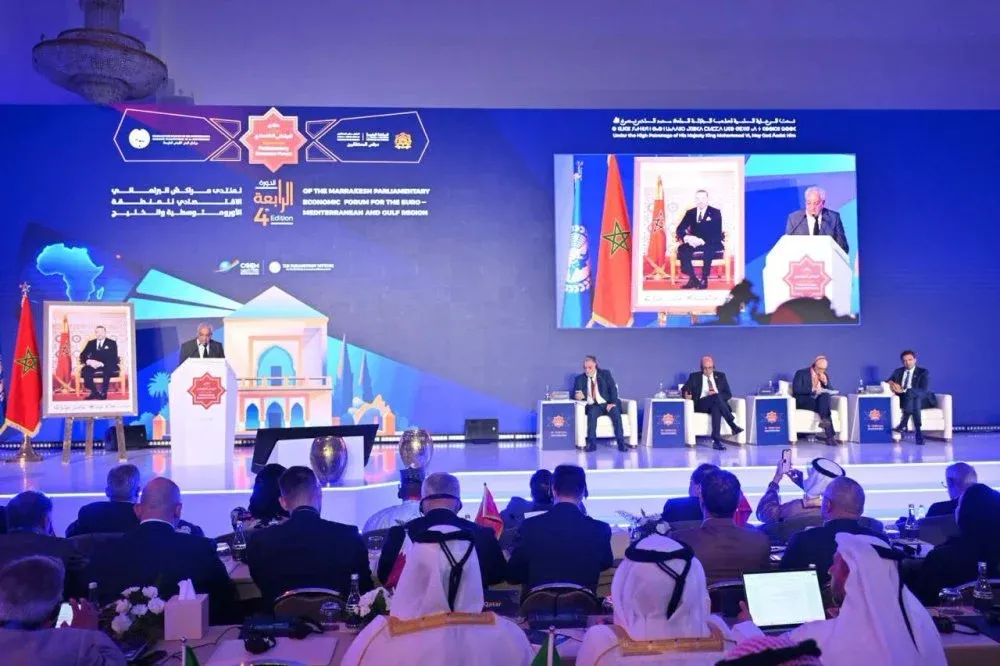

The Marrakech Declaration, adopted on June 21, 2026, presents a groundbreaking vision for economic integration, drawing inspiration from some of the world's largest trade frameworks. This ambitious program includes the establishment of a global and multilateral economic framework, a regional center dedicated to artificial intelligence, a Mediterranean development bank, a pact for food security, and harmonized national legislations. The final declaration emerged from the 4th Economic Parliamentary Forum for the Euro-Mediterranean and Gulf regions, where participants emphasized the necessity of creating a common framework based on successful models like the African Continental Free Trade Area (AfCFTA) and the agreement between the European Union and Mercosur.
Hosted under the High Patronage of His Majesty King Mohammed VI, the forum, organized by the Chamber of Counselors and the Parliamentary Assembly of the Mediterranean (APM), took place on June 19 and 20, 2026, gathering Moroccan and international officials from both shores of the Mediterranean, the Gulf, Africa, and Latin America. By referencing major regional integrations, the organizers highlighted their intention to rethink a long-fragmented space—encompassing the Maghreb, Mashreq, Northern Europe, and Gulf monarchies—often hindered by chronic weaknesses in internal trade.
This ambitious vision contrasts sharply with the usual tone of inter-parliamentary forums. During the inaugural session, Andean Parliament President René Daniel Camacho Quezada warned that while the Euro-Mediterranean dialogue held promise, it needed to manifest in concrete actions and tangible results for the populations. Central American Parliament President Carla Lisbeth Pérez Herrera emphasized that South-South cooperation has become a necessity rather than a choice in light of the evolving international trade and global value chains influenced by geopolitical dynamics. Meanwhile, Arab Parliament President Mohamed Ahmed Al Yamahi succinctly captured the assembly's spirit by stating that resilience is no longer measured by available resources but instead depends on states' ability to forge strong partnerships and achieve genuine economic integration.
Artificial Intelligence at the Core of Integration
The Declaration's most innovative aspect lies in its focus on artificial intelligence. Participants advocated for the establishment of a regional center dedicated to AI, tasked with harmonizing legislations, enhancing governance over cross-border data, and mitigating security risks related to this technology. The proposed architecture would leverage existing frameworks such as the OECD's AI Policy Observatory, the APM's AI Parliamentary Observatory, and the Gulf Cooperation Council's Shura Council.
This idea had been prepped by Moroccan government officials, with Minister of Equipment and Water Nizar Baraka expressing support for initiatives aimed at creating a Euro-Mediterranean and Gulf hub for artificial intelligence, capable of unifying technical standards, enhancing platform interoperability, and facilitating cross-border exchanges. However, the promise of technological advancement comes with concerns, as several speakers expressed apprehensions regarding the disruptions that digital transformation may impose on future employment. Minister of Economic Inclusion, Small Business, Employment, and Skills Younes Sekkouri cautioned that no regional or continental economic integration can be conceived without placing significant importance on human capital, citing projections that indicate a contraction in jobs available to new graduates globally. Faced with the dichotomy between the promise of innovation and employment threats, parliamentarians opted for a balanced approach, favoring regulatory frameworks over abandonment or frenzied pursuits.
Funding emerged as the second, and perhaps most crucial, pillar of the Declaration. Signatories urged states to enhance public-private partnerships and mobilize mechanisms suited for developing digital infrastructures backed by renewable energies. They particularly called for innovative tools to support small and medium enterprises and startups led by youth, who are especially vulnerable in their early years. The Declaration further recommends initiating discussions around the establishment of a Mediterranean development bank intended for financing structural projects, a long-standing Mediterranean idea that Marrakech has revived. Minister Delegate for Investment Karim Zidane framed this ambition within a broader national vision, asserting that Morocco's aspirations extend beyond internal growth to establishing the Kingdom as a strategic economic bridge connecting Europe, Africa, and the Arab world.
Legislating Resilience from Climate to Law
Additionally, the Declaration addressed climatic and food security issues, adopting a prescriptive tone. Participants supported the establishment of a Mediterranean Pact for food security and climate change, designed to bolster agricultural resilience in partnership with the Food and Agriculture Organization (FAO). They also called for national parliaments to legislate unified food and agricultural systems that integrate climate resilience requirements and sustainable management of land, water, and coastal areas to safeguard biodiversity and supply chains against economic and climatic shocks.
This shift in vocabulary reflects a transition from intentions—"promote," "encourage," "support"—to the language of norms—"develop unified legislations," "adopt mechanisms," "create bodies." This same logic guided the launch of a project to structure the Forum itself, now endowed with a governance council responsible for directing its work and monitoring the implementation of its recommendations. This demand for results resonated strongly in the contributions of African leaders.
Abdelilah Hifdi, President of the African Parliamentarians Network for Development Evaluation (APNODE), emphasized that the true measure of public policy success lies in the changes they effectuate in citizens' daily lives, warning against a potential erosion of citizen trust when promises do not translate into concrete results. Across various panels—economic integration, investment in AI, sustainable employment, combating climate impacts on food security—a shared conviction emerged: the resilience of regional spaces must no longer be proclaimed; it must be financed and legislated. A special session focused on Africa, centered on the AfCFTA and the interconnection of Euro-African value chains, firmly anchored this ambition in a specific geography, where Morocco, by multiplying cooperation agreements with West Africa, the Arab world, and Latin America, seeks to serve as a bridge between previously distant entities. Mémounatou Ibrahima, President of the Economic Community of West African States (ECOWAS) Parliament, viewed this as an opportunity to strengthen existing bridges between our regions for the benefit of current and future generations, commending the prospects opened by the Atlantic Royal Initiative for the continent's economic interconnection.
The Marrakech Declaration, while not a panacea for the weak intra-regional trade or the institutional fragmentation plaguing the Mediterranean, establishes targets—such as a bank, an AI center, a food pact, and harmonized laws—that its signatories can strive to meet.
As reported by lematin.ma.