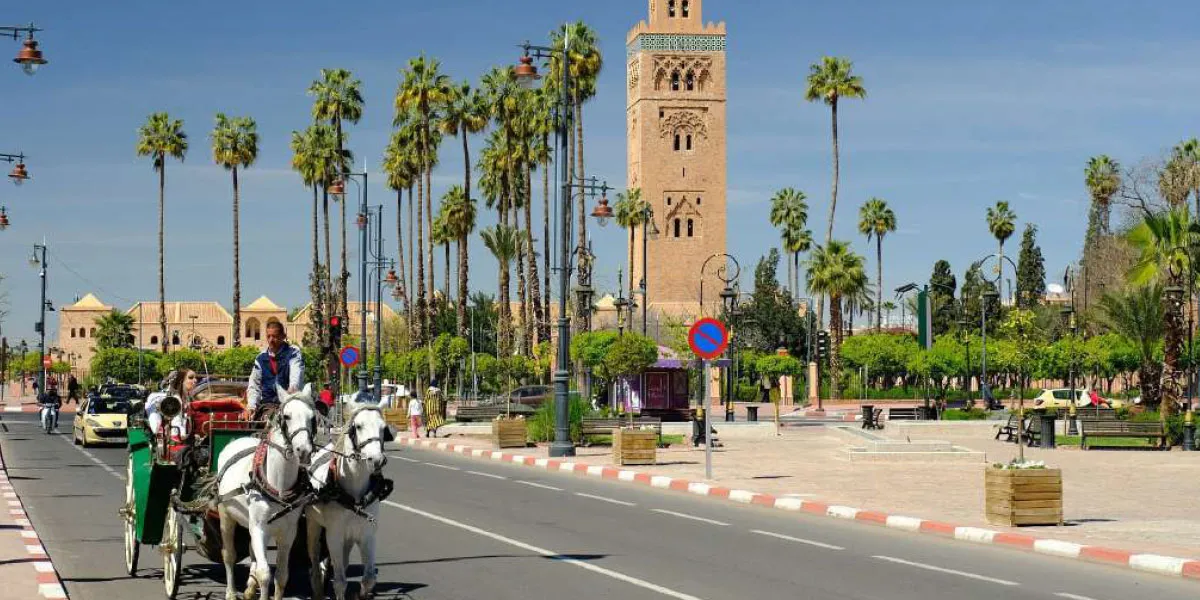

Enduring the Heat: The Struggle for Shade in Marrakech
Under the relentless midday sun, the residents of Marrakech are grappling with the harsh realities of a sweltering heatwave. As temperatures soar close to 42 degrees Celsius, the once vibrant streets of this ochre city have turned into a virtual ghost town, with few daring to venture outdoors. Instead, many Marrakchis find themselves confined indoors, waiting for the sun to dip below the horizon. Those without the luxury of air-conditioned homes, such as public transport users and street vendors, are left exposed to a public space devoid of any refuge, exacerbated by a climate that remains predominantly clear throughout the year. Despite the persistent cries for help from local activists every summer, their warnings seem to fall on deaf ears.
“We have been alerting local officials for years. Meetings come and go, yet the trees continue to fall. It feels like we are preaching to the void,” laments Moulay Abdellah Alaoui, a community activist. Over the years, the fever of real estate development has consumed the leafy villas that once featured lush gardens and patios, replacing them with concrete buildings where greenery no longer holds a place. “In other cities, trees are planted to provide relief from the heat. Here, we are uprooting what our ancestors took decades to cultivate,” he observes, noting the sacrificed green spaces in favor of concrete facilities—a clear indication of an urban planning strategy that fails to recognize the importance of greenery as an integral part of the city.
The Impact on Flora and Fauna
To truly grasp the extent of this loss, one need only walk through the neighborhoods of Guéliz and the Medina, areas that once housed the city’s green lungs. Centuries-old trees have been felled, particularly near Arsat El Harti, one of the last significant gardens from the past. The disappearance of these trees has led to a decline in various small bird species, which have been replaced by pigeons that now dominate the area. The scant shade that remains is monopolized by cafes, whose terraces have sprawled across sidewalks, forcing passersby seeking a moment of respite to pay for the privilege. Activists and botanists argue that shade should be considered a public service, akin to street lighting, rather than a luxury reserved for customers.
The situation is even direr in newer neighborhoods where trees have never taken root. M’hamid exemplifies this glaring absence, with its broad boulevards stretching out devoid of any trees. The malaise also affects the northern part of the city, where the fragrant bitter orange trees lining Boulevard Moulay Abdellah have been replaced with younger ficus trees. While this switch may seem justified on paper, as ficus requires up to 60% less water than citrus trees—a significant consideration in a water-stressed city—activists see it as a false solution, as pedestrians are left without the shade they desperately need. Moreover, maintenance of these new plants is inconsistent, with ficus trees along the boulevards receiving water while those on the sidewalks are left to fend for themselves.
“The ficus in the middle of the boulevard receive water because they are visible, while those on the sidewalks are neglected. Even irrigation adheres to a façade logic,” Alaoui criticizes. This negligence extends to urban furniture as well. Bus stops lack shelters and are often occupied by car guards who park vehicles, leaving users to wait in the scorching sun. On Boulevard Allal El Fassi, another major artery, two gardens have been erased from the map to make way for a nearby soccer field.
The heat is felt most acutely in neighborhoods like Massira, Socoma, and Doha, named after the developer who constructed a massive dormitory where concrete traps heat. The design of standardized collective housing offers no transition between living spaces and the street, unlike the Medina, which features successive sanctuaries that allow for circulating cool air. In this economically-focused housing district, the few scattered trees provide no continuous cover.
“Design not only determines the potential for social connection but also affects the coolness of homes,” explains Ali Gassous, Vice President of the Moroccan Architects' Union. This principle also applies to the interiors of homes. During a recent visit to Marrakech, a foreign delegation studying traditional architecture noted a temperature difference of 20 degrees between the overheated streets and the interiors of buildings in the Medina. This remarkable feat is made possible by patios and thick walls, the scarcity of exterior openings, and the traditional layout of narrow streets that shield one another from sunlight. “This ancestral knowledge has been abandoned in favor of concrete that offers no insulation,” laments Gassous.
Ecological associations view these long-standing oversights as a series of absurdities stemming from governmental negligence. The combination of heat and illegal exploitation of public spaces renders the streets inhospitable. Furthermore, urban mobility management allows heavy vehicles to traverse the main arteries of the city, degrading infrastructure and tarnishing the image of Morocco’s top tourist destination. The consequences also pose a public health risk. As insectivorous birds abandon the area, the ecological balance is disrupted, leading to an unchecked proliferation of mosquitoes and flies.
“I was bitten by an insect while at a café terrace, and the itching sent me straight to the dermatologist,” shares a local resident. In light of this dire situation, activists are calling for a comprehensive greening plan and the establishment of cool zones designed by neighborhood. Meanwhile, in a city where summer feels like a sauna amidst the heatwave, shade remains a commodity that comes at a price.
As reported by leseco.ma.