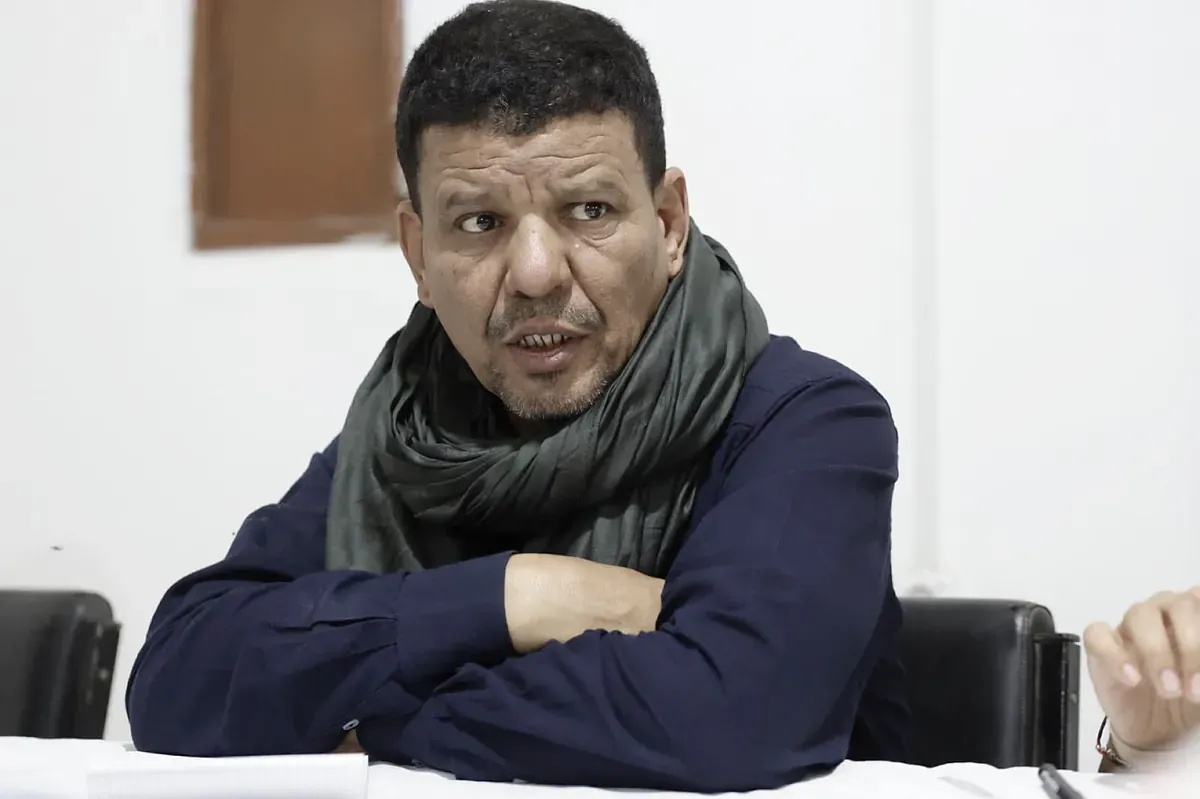
Mohamed Yeslem Beisat, the Foreign Minister of the Sahrawi Arab Democratic Republic (RASD), has been at the forefront of representing his territory in ongoing negotiations with Morocco, mediated by the United States in collaboration with the United Nations. This week, Beisat, along with the RASD government, commemorated the 50th anniversary of the republic's founding in refugee camps, amidst a backdrop of significant political discussions regarding Western Sahara.
In recent months, following three rounds of consultations—two in Washington and one in Madrid—between Morocco and the Polisario Front, Beisat took the opportunity to speak with a select group of Spanish media, including EL MUNDO. The historical context of the conflict dates back to 1975 when Spain relinquished control over the territory, leading to an armed struggle by Sahrawis against Morocco and Mauritania. While the conflict with Mauritania subsided in the late 1970s, tensions with Morocco have persisted, with Morocco currently controlling approximately 80% of the territory. The United Nations has urged Spain to complete the decolonization process, while Morocco actively promotes its autonomy plan for Western Sahara, administered from Rabat. This proposed autonomy is part of the discussions alongside the Polisario Front's bid for independence.
Beisat has expressed that they are willing to engage in dialogue with Morocco in good faith and without preconditions, as per the stipulations of the United Nations resolution. However, he asserts that Morocco's approach has been different, lacking genuine goodwill and imposing preconditions. He justifies this stance by highlighting Morocco's actions in occupied territories, including the imprisonment of Sahrawi political prisoners and military pressure, which he argues undermine the prospects for a fair agreement. He summarizes the situation by stating, "Morocco maintains a conciliatory discourse in negotiations, but on the ground, it acts with coercion and repression."
The Polisario Front has indicated its commitment to finding a solution that aligns with international legality, and according to Beisat, they are prepared to consider any option that leads to a mutually acceptable resolution. However, he emphasizes that any proposal for autonomy must be presented alongside other alternatives, stating, "Our rejection is of any unilateral, imposed option that does not allow the Sahrawi people to freely choose." He articulates that while autonomy could be discussed as one option, it must never be viewed as the sole, obligatory solution, as imposing it would deprive the Sahrawi people of their right to determine their future. He insists that independence must also be included as a viable option in any discussions.
Despite their openness to dialogue, Beisat harbors doubts about Morocco's ability to effectively manage the territory under an autonomy plan. He critiques Morocco's democratic credentials, asserting that it is not a fully democratic regime capable of sustaining reliable autonomy. Therefore, he underscores that "autonomy can only thrive in a truly democratic system."
In recent discussions in Washington, Beisat has acknowledged the significant role of the United States as a mediator, noting its unique position to influence Morocco. Both parties have agreed to continue bilateral meetings, regional visits, and document exchanges, with a fourth round of negotiations anticipated once current avenues are exhausted.
Beisat stresses that imposed solutions, similar to those of the past, have repeatedly failed. He reflects on the historical and cultural ties between Spain and Western Sahara, warning that no government can afford to ignore these connections. He posits that ultimately, Spain will recognize that disregarding the Sahrawi people is a mistake detrimental to its own interests, as well as those of the Maghreb and the international community.
Finally, Beisat describes the relationships with most Spanish political forces as "excellent" and advocates for Spain to align with its Parliament's resolutions. He asserts, "Spain is not just any actor: it remains the administering power of the territory," concluding with a call for action that is legally, morally, and politically appropriate.
As reported by elmundo.es.