The recent visit by the Inspector General of the Royal Armed Forces of Morocco, leading a high-level military delegation, to the United States Africa Command (AFRICOM) headquarters in Stuttgart, Germany, on July 13, marks a significant milestone in the evolving military collaboration between Rabat and Washington. This visit culminated in the signing of a memorandum of understanding which establishes a joint multi-domain training and experimentation center in Morocco, aimed at benefiting Africa as a whole. This center will serve as a permanent establishment to test emerging technologies and develop combat doctrine, reinforcing the long-term strategic partnership between the two nations.
This initiative is part of the newly outlined 2026-2036 defense cooperation roadmap, which was recently signed in Washington. It is not simply a standalone project but rather a component of a ten-year institutional framework focused on preparation, counter-terrorism, and the modernization of capabilities. Morocco, which earned the status of a "Major Non-NATO Ally" in 2004, is evolving beyond being a temporary training destination; it is transforming into a regional hub for military expertise that can be shared with its African partners.
A Multi-Domain Center, Not a Traditional Base
The project is anchored in the concept of "multi-domain" operations, which emphasizes the ability to function across interconnected land, sea, air, space, and cyberspace environments. In modern warfare, readiness is gauged by the capability of forces to seamlessly connect sensors with decision-making centers and subsequently with strike assets in record time, even amidst disruptions. This underscores the significance of the center as a venue for testing the integration of systems comprehensively, rather than merely evaluating the functionality of individual systems in isolation.
The center will feature a multidisciplinary training complex, a drone academy, and an innovation and experimentation hub. These components reflect the ambitions of both nations: the complex is designed to enhance force readiness in conditions closely resembling real-world scenarios, including operations within the electromagnetic spectrum, which involves dealing with jamming, deception, and electronic detection.
The drone academy will focus on training operators and instructors from Morocco and its partner African nations, with an emphasis on integrating unmanned vehicles into military maneuvers while minimizing aerial interference. Moreover, the innovation center will explore cost-effective and scalable solutions, which are critical in regions like the Sahel and West Africa, where armies often cannot rely on expensive and complex maintenance systems.
Drones at the Core of Transformation
The inclusion of drones as a central pillar of the center is far from a mere technical detail; it represents a crucial lesson learned from recent conflicts in Ukraine, the Middle East, and the Sahel. These platforms have demonstrated that the balance of power is no longer solely in the hands of heavy weaponry, as swarms of drones supported by artificial intelligence have opened new horizons for surveillance and target acquisition.
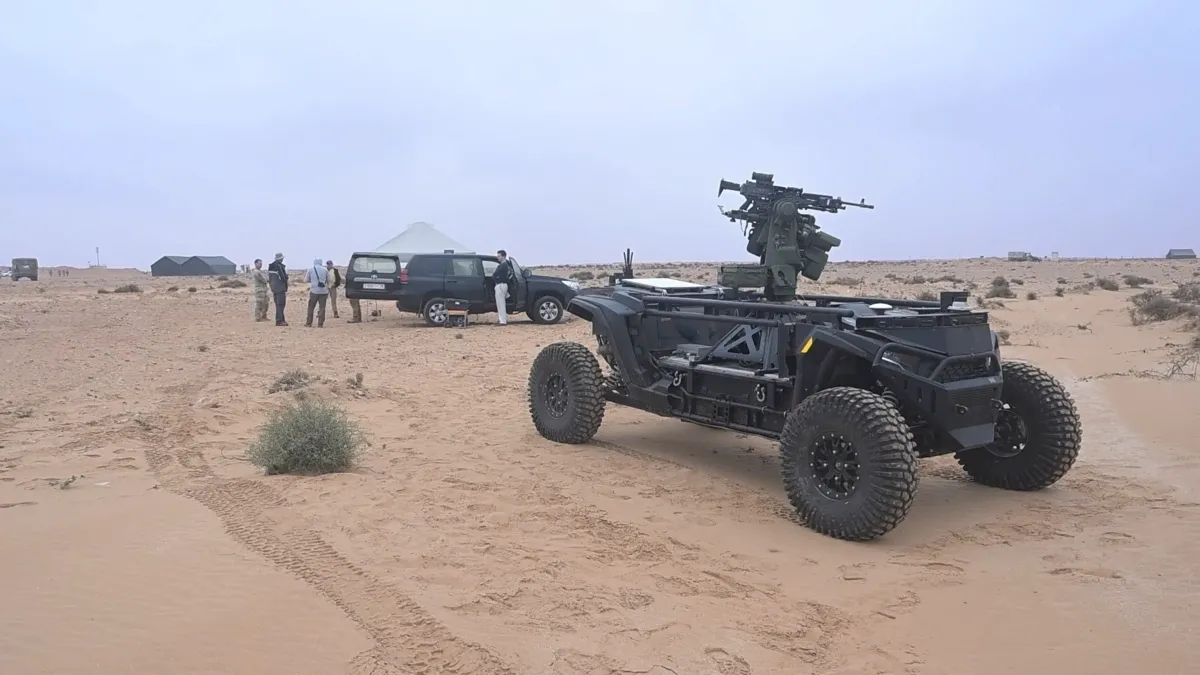
Consequently, this center will not just be a pilot training school; it will function as a laboratory for coordinating aerial, ground, and maritime swarms, testing counter-drone systems, and integrating artificial intelligence into tactical decision-making. This practical approach is particularly relevant for Sahel countries facing mobile threats across vast geographies with weak security infrastructures. Training officers to utilize drones for tracking movements, protecting convoys, and relaying information to command centers will prove far more effective than simply transferring advanced equipment without a clear operational doctrine.
The recently held "African Lion 2026" exercise offered a glimpse into this trajectory, showcasing the involvement of major technology companies like Anduril, Lockheed Martin, and Palantir alongside U.S. and Moroccan units testing autonomous vehicles and artificial intelligence platforms in Tan-Tan and Cap Draa. This elevated the exercise from a mere field drill to a genuine laboratory for integrating human operators with autonomous robotics.
For Washington, Morocco presents a unique geographical and political position: it has coastlines on both the Mediterranean and Atlantic, is close to the Sahel, and possesses a robust military infrastructure that is heavily reliant on U.S. weaponry. For AFRICOM, which oversees a vast continent with limited resources, strengthening the capabilities of a stable and flexible partner represents a strategic choice that ensures rapid access in times of crisis.
For Morocco, this project enhances its image as an active regional security player rather than a passive recipient of aid. The statements from the Moroccan military leadership regarding the Kingdom's readiness to move from concept to execution reflect Rabat's ambition to be a partner in defense innovation and value chains, aligning with its efforts to build a local military industrial base through knowledge transfer and joint experimentation.
The discourse surrounding the U.S. "Cooperative Security Locations" (CSL) in Morocco requires careful analysis. According to U.S. doctrine, these facilities are not traditional military bases but rather a light presence that may include a runway, fuel reserves, and agreements for rapid access when necessary, without a permanent troop presence. Nevertheless, this issue remains sensitive in North Africa, where the term "base" carries significant political weight that touches on sovereignty issues. Algeria, which views U.S. expansion as a cover for future Israeli influence, will scrutinize this development with caution. Therefore, Rabat is likely to handle this matter with transparency to clarify the objective: enhancing readiness and improving training, not establishing large-scale military deployments, particularly amid the geopolitical competition in the Sahel and the Mediterranean.
The implications of this project extend beyond bilateral relations. The security of the Sahel and West Africa is intricately linked to the security of Europe, the Mediterranean, migration, and transnational crime. With the decline of French influence in the Sahel, Washington and Europe are seeking less invasive models to develop local capabilities. This is where Morocco stands out as an African platform with strong Western ties but without the colonial legacy that hampers some European powers.
This center could position Rabat as a key player in establishing regional training standards, evolving into a central node in a security network connecting Washington, Africa, and the Mediterranean. For the European Union, which continues to struggle with translating its defense ambitions into practical tools, the development of such structures south of the Mediterranean warrants rigorous monitoring.
From a political standpoint, the center takes on additional dimensions by incorporating defense cooperation with Morocco into Congressional debates under the National Defense Authorization Act (NDAA) for 2027 and within the framework of the Abraham Accords. Despite this, the project is fundamentally oriented towards Africa. Morocco is aware that the more this center is perceived as linked to counter-terrorism efforts and border protection, the greater its chances of acceptance and overcoming regional sensitivities.
In conclusion, the establishment of the multi-domain training and experimentation center in Morocco signifies a new phase in the regional security architecture. If successful, the country will become a laboratory for transforming defense in Africa and an indispensable axis in Washington and Europe’s security calculations. As reported by defensa.com.