
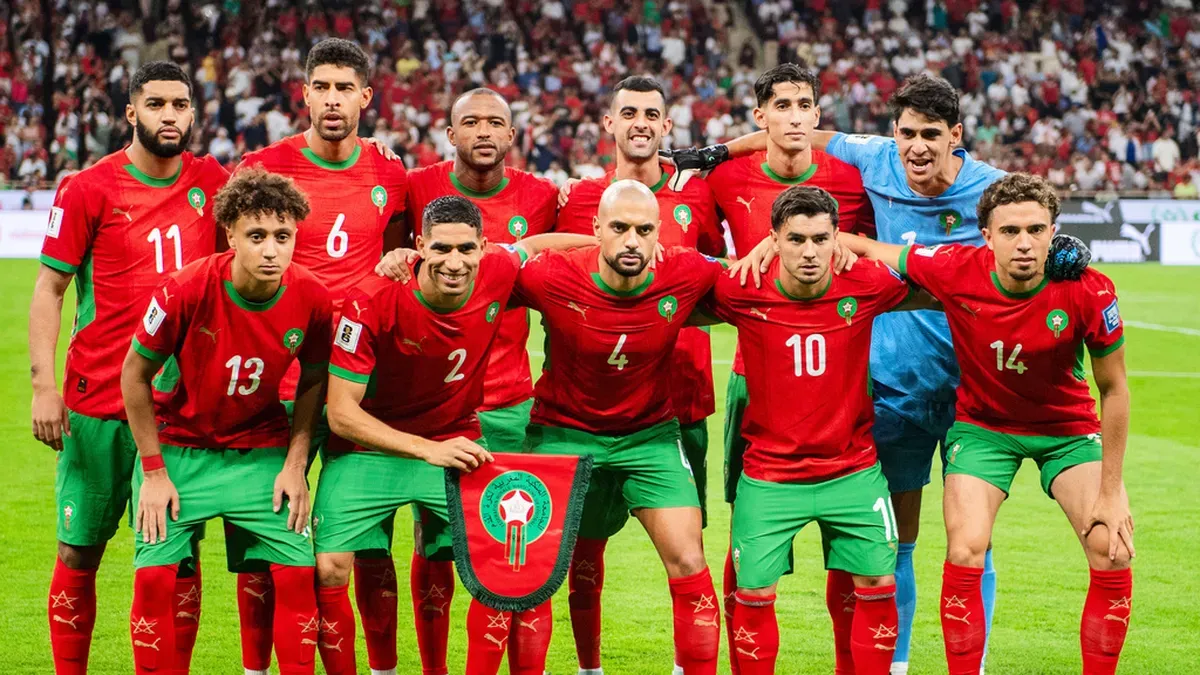
Morocco's Journey from Surprise to Sustained Excellence
Following the historic achievement at the 2022 Qatar World Cup, Morocco now finds itself in North America, tasked with demonstrating that its entry into football's elite ranks was not merely a fleeting miracle but rather the inception of a formidable power capable of thriving under the weight of expectations. The Atlas Lions are determined to transform their surprising success into a lasting legacy, and this is a moment filled with palpable excitement in Moroccan football, where the energy stems not just from talent and physical prowess, but from a more intricate ability to turn heritage into destiny.
The fourth-place finish in Qatar has irrevocably altered the global perception of African football. Morocco has transitioned from being an uncomfortable opponent to emerging as a formidable force capable of challenging historical hierarchies and dismantling long-standing structures. However, the challenge that accompanies such feats is that they rarely remain confined to the initial awe; they inevitably evolve into an obligation to perform. Thus, the upcoming World Cup represents something far deeper than merely another international appearance; it serves as the ultimate test to determine whether the extraordinary events of 2022 were a one-time flash of collective inspiration or the genuine emergence of a new footballing powerhouse. The true measure of Morocco's challenge lies in surviving the legacy it has created.
A New Identity and Ambitions
Under the guidance of head coach Mohamed Ouahbi, the Atlas Lions are attempting to forge a new version of themselves without forsaking the qualities that set them apart. Morocco is no longer clinging to the memories of its recent triumphs; it is propelled by an ambition that has transformed from mere promise into a pressing demand. As they present themselves in North America, the team seeks to break free from its historical confines to craft a new narrative in football. The identity of this squad reflects a unique cultural complexity within contemporary football; it is a team with deep African roots that has been shaped by the cosmopolitan experiences of players raised or developed in Europe. With twenty-two players participating in the top leagues across Europe, this duality is evident in every facet of the team.
Key players such as Achraf Hakimi, Yassine Bounou, and Brahim Díaz have transcended their individual statuses to become symbols of a generation that has blurred the lines between family heritage and sporting affiliation. Many could have chosen to represent other nations; they selected Morocco not solely for regulatory or sentimental reasons but as a powerful act of identity reaffirmation. This constitutes one of the team's greatest emotional strengths. However, every process of reconstruction entails costs. Morocco has resolved to accept these costs, even at the risk of sacrificing some of the experience that led them to celestial heights four years ago. The absence of Youssef En-Nesyri, the fifth all-time leading scorer for the national team, and Sofiane Boufal is not merely a tactical adjustment; it symbolizes the closure of a chapter. Such decisions reveal a commitment to avoiding the sentimental stagnation that often befalls successful teams.
Conversely, a wave of young talent is emerging, eager to usher in a new era. Eighteen-year-old Ayyoub Bouaddi stands out as one of the most exciting faces of this renewal, accompanied by promising players like Chemsdine Talbi, Bilal El Khannouss, and Ayoube Amaimouni. The coaching staff's message is clear: Morocco is willing to embrace the risks associated with youth rather than get trapped in the comfort of fond memories. This transformation has been marked by the controversial victory in the 2025 Africa Cup against Senegal, a final that left emotional scars for the squad. Although the title brought prestige, it also introduced suspicions and debates that will inevitably accompany Morocco during the World Cup.
Perhaps one of the most interesting traits of this team is its ability to navigate the noise. Great national teams are not built solely on harmony; they often find strength amid controversy, pressure, and the perpetual need to justify their existence. Morocco arrives in North America aware that mere excitement will no longer suffice; they must also convince the world of their prowess. Group C presents a true test of maturity, as competing alongside Brazil, Scotland, and Haiti promises encounters filled with both footballing and emotional contrasts. However, the real competitive gauge will be the debut against Brazil on June 13, where Morocco will assess whether its structure possesses the resilience needed to hold its own against the great powers or if it still relies on the emotional impetus of past glories.
The elegance of Hakimi, the reliability of Bounou in goal, and the sporadic creativity of Brahim Díaz will not suffice on their own. The challenge for modern national teams lies not only in amassing talent but in building a collective identity capable of withstanding adversity when individual brilliance fades. This is precisely where Morocco’s destiny will be decided. Today, Morocco finds itself suspended between two equally destructive dangers: nostalgia for the heroes who graced the podium in Qatar and the anxiety of a footballing nation now demanding a repeat of the extraordinary. The challenge lies in navigating both extremes to construct something more challenging and less romantic: continuity. While football often falls in love with sudden breakthroughs, true greatness is measured by the ability to endure. The exceptional feat is not merely reaching a World Cup semi-final once; the truly extraordinary aspect is maintaining a place among the elite when the element of surprise dissipates, and the rest of the world begins to scrutinize and expect.
Ultimately, the 2026 World Cup will serve as the definitive verdict on the resilience of this project. Morocco will no longer be asked for miracles or improbable heroics; it will be required to deliver confirmation of its status. Perhaps this is the heaviest burden of all. In the Atlas Mountains, however, the lions seem to have grasped an essential truth: legends are not forged in the moment of impact but in the ability to endure when the initial fascination begins to fade.
As reported by dib.com.ar.


