
For several years, Morocco has been undertaking a profound transformation of its energy sector, aimed at addressing the rapidly growing demand for electricity while fulfilling its climate commitments. The Kingdom has established a model that relies heavily on the integration of renewable energy sources, energy efficiency, and regional connectivity. This ambitious initiative is supported by the African Development Bank Group, which plays a crucial role in financing structural investments that enhance the country's capabilities and accelerate its energy transition.
“In Morocco, the energy transition is no longer just an ambition; it has become a reality that is gradually strengthening. By combining renewable energy, modernization of networks, and storage solutions, the country is establishing itself as a role model. This momentum is manifested through significant investments, supported by the African Development Bank Group, which expand access to electricity and prepare for a sustainable future,” asserts Achraf Tarsim, the country manager for the African Development Bank Group in Morocco.
Solar Energy: The Noor Ouarzazate Project and the Rise of Renewables
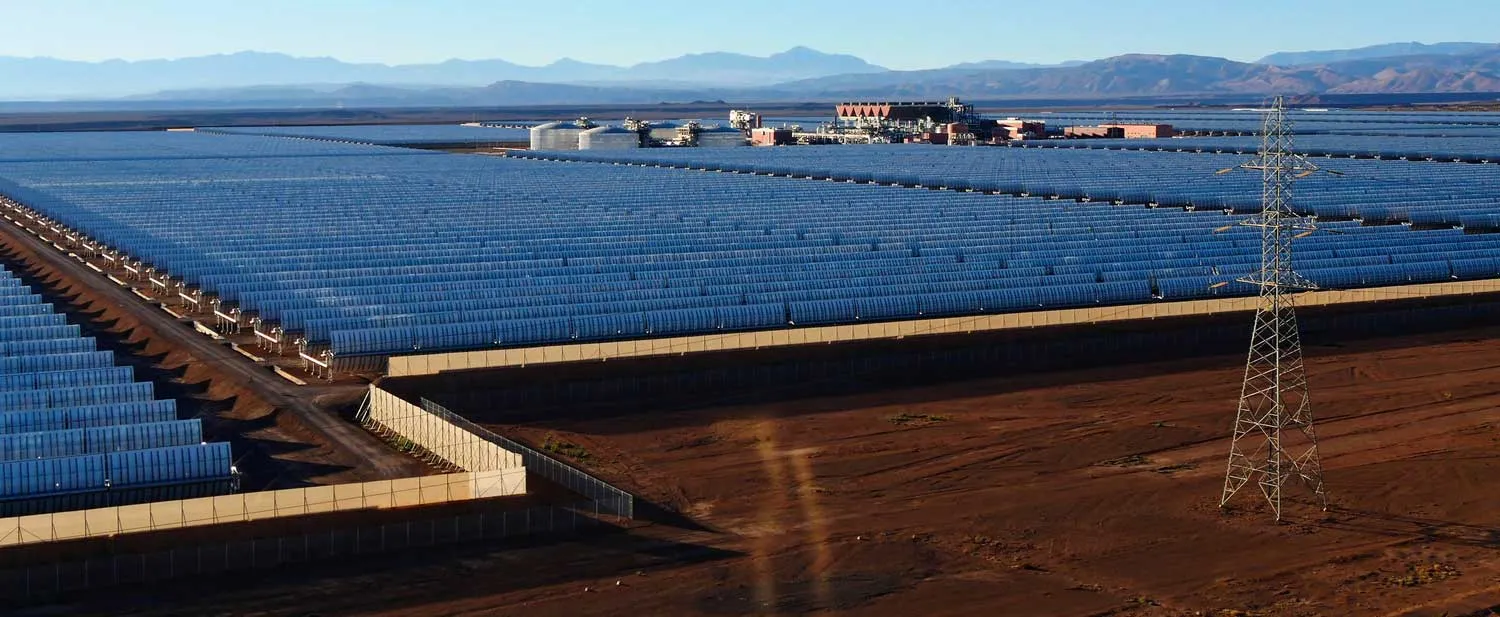
A major milestone has been reached with the Noor Ouarzazate solar complex, one of the largest solar power plants in the world. Supported by the African Development Bank Group, this program allows for the large-scale production of solar electricity. The Bank's contribution amounts to $485 million across all phases of the project. With an installed capacity of 580 MW spread over four plants, the Noor Ouarzazate complex provides electricity to nearly two million people and reduces CO₂ emissions by approximately one million tons annually.
Electricity Networks: The Backbone of the Transition
The rise of renewable energies would not have been possible without significant investments in electricity transportation infrastructure. In this context, the Bank Group approved the Electricity Transmission Network Development and Rural Electrification Program (PDRTE-ER) in 2019, financing nearly €245 million to strengthen electricity networks and accelerate rural electrification. This program has extended high-voltage lines, improved network reliability, and supplied previously isolated areas with electricity. The dual challenge lies in effectively integrating new renewable production capacities while ensuring equitable access to electricity across the territory. This dynamic also contributes to local economic development, resulting in 20,000 new households being connected to the grid thanks to the construction of approximately 1,300 km of medium-voltage lines and 4,000 km of low-voltage lines, along with the installation of 800 MT/BT transformer stations.
As renewable energy sources expand, the stability of the electrical system has become a priority. In this regard, the deployment of the Abdelmoumen pumped energy storage station is critical. Supported by €179 million from the African Development Bank Group under the Integrated Wind, Hydro, and Rural Electrification Program (PIEHER), this station plays a strategic role by storing excess electricity and releasing it during peak demand periods, effectively addressing the intermittency of solar and wind energy. Beyond its energy role, this project supports the country's industrialization by ensuring a stable and reliable power supply. With an installed capacity of 350 MW, the station can provide electricity almost instantaneously, up to 20 times a day, while modulating its power output between 90 MW and 350 MW based on the network's needs.
Alongside projects aimed at strengthening and diversifying energy production, the Bank Group's efforts have significantly contributed to extending electricity access in rural areas. Launched in 1995, the Global Rural Electrification Program (PERG) aimed to connect underserved regions to the national grid. Supported by the African Development Bank for approximately €200 million through PIEHER and PDRTE-ER, this national program has achieved near-universal coverage across the territory. The electrification rate, which was less than 18% at the program's inception in 1995, has now risen to nearly 100%. A total of 4,255 villages, representing over 500,000 inhabitants, have been connected to the grid thanks to this support.
All these interventions illustrate an integrated development approach by the African Development Bank Group in Morocco, aligning with the Kingdom's structured energy vision. This approach has evolved gradually, first through the strengthening of networks aimed at universal coverage, followed by the growth of solar energy, and later by integrating cutting-edge storage solutions. Within this dynamic, the strategic partnership between Morocco and the African Development Bank Group has consistently supported a long-term energy transformation ambition, combining funding mobilization with technical expertise.
As reported by afdb.org.