
Significant Changes Observed from Space
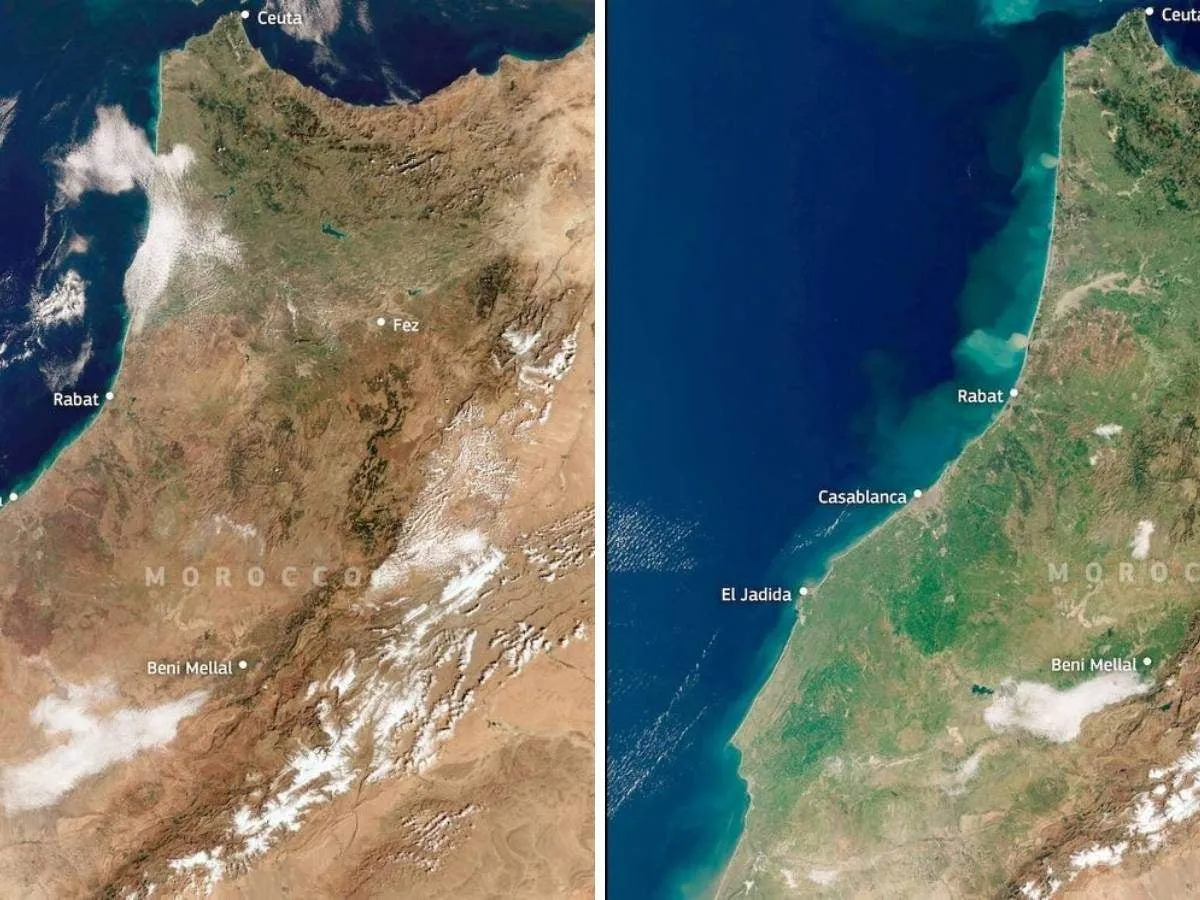
Morocco is currently experiencing a remarkable transformation after enduring years of severe drought, a change so significant that it can be observed from space. The rainfall recorded during the early months of 2026 has revitalized extensive areas across the country, leading to a notable increase in vegetation and a substantial rise in water reserves. This phenomenon has been documented by satellites from the European Earth observation program, operated by the European Space Agency, which have captured comparative images of Moroccan territory before and after the recent precipitation.
The Copernicus Sentinel-3 satellite has provided clear imagery illustrating how regions that appeared arid and sparsely vegetated just a year ago are now lush and green. The intensity of rainfall experienced over the past few months has played a critical role in this transformation. According to official data cited by international media, certain areas of the country recorded approximately 360 millimeters of precipitation by early February 2026.
End of a Critical Drought Period
This rainfall arrived following a particularly challenging period for the North African nation, which had faced seven consecutive years of drought that significantly impacted vital sectors such as agriculture and livestock. Moroccan authorities believe that this recent precipitation marks the conclusion of a critical phase. As stated by the country's Minister of Equipment and Water, the volume of rainfall recorded in recent months has allowed for a significant recovery of water reserves. The minister further explained that the accumulated water could ensure up to three years of potable water supply, a welcome development in a country where water scarcity had become one of the foremost environmental and economic challenges.
The most striking aspect of this phenomenon is that the change in landscape is not only noticeable at a local level; European Earth observation satellites have documented the transformation of the terrain from orbit. A comparison of photographs taken in February 2025 and those captured in February 2026 reveals a remarkable difference: areas that previously displayed a brown hue due to lack of vegetation are now covered in vibrant green.
Satellites like Copernicus Sentinel-3 are part of the European monitoring program known as the Copernicus Programme, which utilizes space technology to study phenomena related to climate, oceans, and terrestrial ecosystems. These satellites enable scientists to analyze the effects of extreme climatic events with greater precision. The impact of the rains extends beyond mere aesthetics, as it has had direct consequences for the country's water reserves. According to data from the European Space Agency, available water resources have reached 11.8 billion cubic meters, representing an approximate increase of 155% compared to the same period in 2025.
Moreover, the country's reservoirs have recorded a significant increase in their storage levels. Reports from Moroccan media indicate that dams have reached about 70.7% of their total capacity, a level not seen since 2018. The recovery of water reserves also holds important implications for the country's economy. During the years of drought, sectors such as agriculture and livestock faced serious challenges due to water shortages, which diminished agricultural production and affected the availability of resources for livestock. With the return of the rains, it is anticipated that these activities will regain much of their productive capacity, and the increase in water levels will benefit other key areas of the economy.
As reported by dineroenimagen.com.