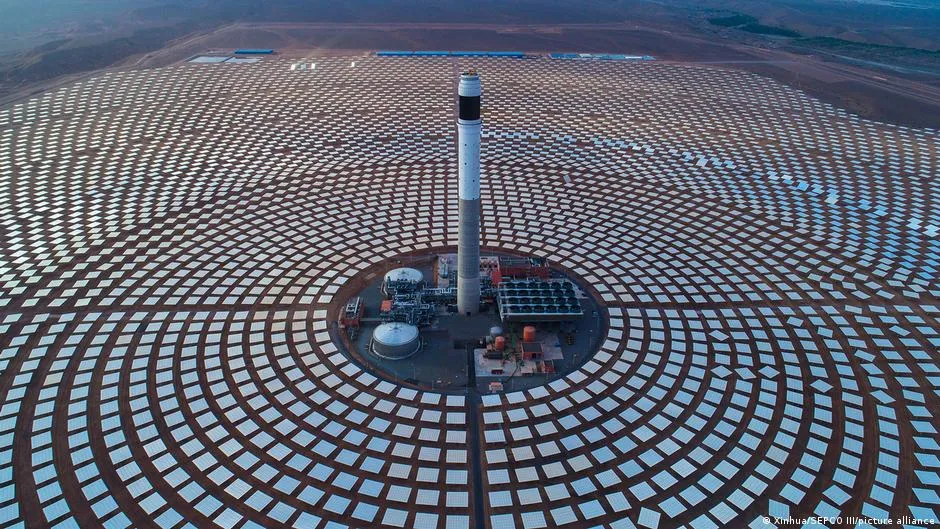

In the vast expanse of the Moroccan desert lies a monumental solar tower, symbolizing an ambitious drive towards a cleaner energy future. However, the path to widespread renewable energy is hindered by the stronghold of fossil fuels and the limitations of the existing electrical grid.
The city of Ouarzazate, located approximately 200 kilometers southeast of Marrakech and at the edge of the Sahara Desert, is often referred to as the "gateway to the desert." This region, famed for the Atlas Film Studios where blockbusters such as "The Mummy," "Gladiator," and "Game of Thrones" were filmed, is now witnessing the emergence of a new industry focused on renewable energy.
Near this city, on an elevated plateau surrounded by the Atlas Mountains, one of the world's largest solar power plants is taking shape. Named Noor, which translates to "light" in Arabic, this remarkable solar facility spans nearly 500 hectares and produces enough energy to power over a million homes.
In contrast to conventional black photovoltaic panels, Noor harnesses concentrated solar power (CSP). This innovative technology employs a field of two million giant mirrors that reflect sunlight onto a central receiver atop a 247-meter-tall tower. The concentrated solar energy heats salts to a scorching 600 degrees Celsius, which in turn heats water to create steam that drives electricity-generating turbines, ensuring energy production even after sunset.
Despite this technological marvel, electricity remains expensive in Ouarzazate. Many households still rely on butane gas rather than solar energy. The question arises: why hasn't clean energy penetrated the local community? One significant factor is Morocco's heavy reliance on fossil fuels, particularly coal, which has slowed the country’s energy transition, as noted by Intissar Fakir, a senior researcher and founding director of the North Africa and Sahel program at the Middle East Institute in Washington D.C.
According to Fakir, "Electricity generated from fossil fuels accounts for approximately 48 percent of the country's energy-related greenhouse gas emissions." With an average income of $550, Moroccans spend around $110 (94 €) on electricity. Given the country’s hot and arid climate, air conditioning and fans are prevalent, particularly as summer temperatures in Ouarzazate often exceed 40 degrees Celsius, with the number of scorching days and nights nearly doubling since the 1970s.
Morocco lacks domestic fossil fuel resources, importing about 90 percent of its coal, oil, and gas. This reliance contributes to high energy costs, and fluctuations in fuel prices significantly impact the national budget, making the green transition all the more pressing.
Nevertheless, Morocco has made notable strides in renewable energy compared to many other North African nations. The Moroccan energy expert believes that, even by global standards, Morocco's transition plan is quite ambitious. By 2030, the country aims for 52 percent of its electricity consumption to come from renewable sources, increasing to 70 percent by 2050, with a complete phase-out of coal by 2040. Given Morocco's abundant sunlight and coastal winds, the conditions for renewable energy production appear favorable.
While the Noor solar power plant stands as a beacon for Morocco's renewable energy aspirations, it is merely one of approximately two dozen solar, wind, and hydroelectric mega-projects already in operation, with numerous others in various stages of development. However, substantial work remains to be done.
Fakir emphasizes the necessity for Morocco to invest in its grid capacity to integrate a greater share of these renewable energies into daily use. This includes investments in energy storage solutions. Furthermore, if Morocco aims to sell its clean energy abroad, particularly to Europe, additional investment will be crucial. "Although solar panels and wind turbines are becoming more affordable, constructing large-scale clean energy systems like Noor still requires significant initial investment from low-income countries," she explained.
Projects like Noor do face criticism as well. Concentrated solar power, for instance, consumes considerable water, necessitating an amount equivalent to filling 1,200 Olympic-sized swimming pools to clean its thousands of mirrors. Local residents are divided on the issue; Imrane, an 83-year-old villager, laments that electricity remains prohibitively expensive and claims that temperatures have risen due to the new installations.
Despite the challenges, Fakir posits that the Noor solar project was a valuable experiment. "These flagship projects showcase the extent of Morocco's technical capabilities," she states. "Yet, they also highlight the ongoing challenge that, even with these massive investments, renewables continue to struggle to displace entrenched coal and fossil fuel generation."
As reported by dw.com.