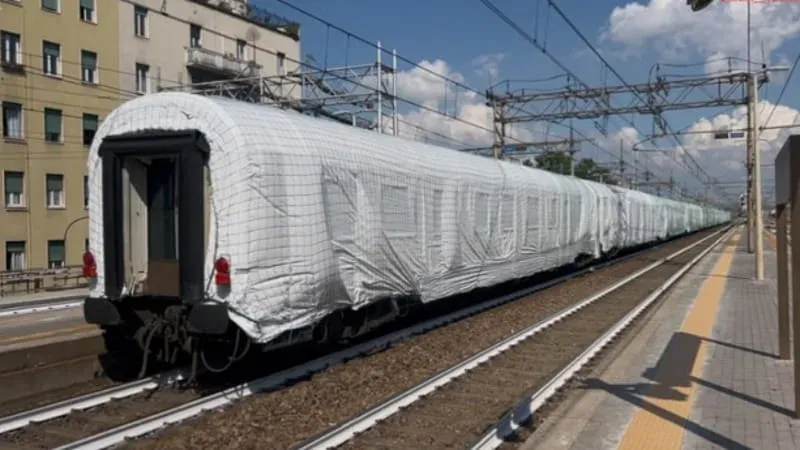

Marrakech – Morocco's national railway operator, ONCF, is strategically enhancing its rail capacity by incorporating retired Italian intercity carriages into its fleet. This initiative is aimed at bolstering transportation capabilities in preparation for the upcoming 2030 FIFA World Cup. The latest reports from Italian media indicate that a convoy consisting of 11 Trenitalia intercity carriages was recently identified at Parma station, meticulously wrapped in white nylon sheets and secured with green protective netting. These carriages departed from Alessandria Smistamento, a major rail hub in Italy, and are en route to the port of Ravenna, from where they will be shipped to Morocco.
ONCF has previously acquired Italian TAF trains, which are high-frequency regional units that served Trenitalia's commuter lines. By selling these retired carriages, the Italian rail operator not only alleviates the costs associated with their demolition, typically managed at its San Giuseppe di Cairo facility, but also supports Morocco's railway development.
In the context of Morocco's railway enhancements, the addition of these retired Italian carriages serves a transitional role. ONCF has made a substantial commitment of $2.9 billion to procure 168 new-generation trainsets from notable manufacturers such as Alstom, CAF, and Hyundai Rotem. This order encompasses 18 high-speed trains, 40 intercity units, and 110 urban rail vehicles. Until these state-of-the-art trainsets arrive, the Italian carriages are expected to significantly increase capacity on existing rail routes.
The acquisition of these carriages aligns with a broader investment initiative totaling $9.6 billion, which focuses on the Kenitra-Marrakech high-speed rail line. This expansive 430-kilometer route will connect key locations, including Rabat, the Grand Stadium of Benslimane, Casablanca, Mohammed V Airport, and Marrakech. According to Transport Minister Abdessamad Kayouh, construction of this ambitious project has reached 30% completion, with land acquisition along the corridor now finalized. Approximately 20 million cubic meters of earthwork have been executed, and construction on fifteen viaducts is currently underway, alongside the commencement of work on 92 rail and road bridges.
ONCF anticipates that all station construction will commence by July, with the line's infrastructure budget set at $5.3 billion. The anticipated completion date is September 2029. Once operational, the travel time between Tangier and Marrakech is expected to be dramatically reduced from six and a half hours to just three and a half hours, while Rabat’s city center will be accessible from Mohammed V Airport in a mere 35 minutes.
In terms of financial performance, ONCF recently reported record results for 2025, with total revenue exceeding $500 million for the first time. Passenger traffic reached an impressive 55.6 million travelers, and Al Boraq, Africa's only high-speed rail service, carried 5.6 million passengers, generating $84.8 million in revenue. Additionally, freight volumes experienced a 6% increase, reaching nine million tons, with phosphate transport surging over 12%. EBITDA rose to $217.3 million.
Future expansions are also on the horizon, with studies for extending the rail network to Agadir already completed. This route will require approximately 70% of its length to be built as bridges and tunnels through the High Atlas mountain range, with an estimated project cost of $5.5 billion. ONCF is actively seeking international financing to support this initiative.
Currently, around 150 companies are mobilized for the project, with nearly two-thirds being Moroccan firms. Additionally, a new industrial site is planned in Benguerir, which will focus on locomotive maintenance and manufacturing, aiming for a local integration rate of 62% with aspirations for future exports.
As reported by moroccoworldnews.com.