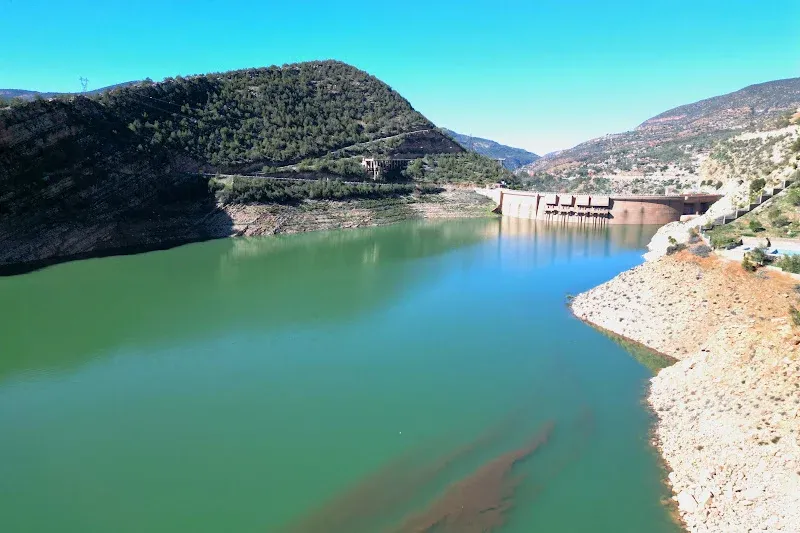
Significant Improvement in Morocco's Water Reservoirs
As spring approaches, Morocco is witnessing a remarkable shift in its water security landscape, with recent data from the Ministry of Equipment and Water revealing an exceptional rise in the capacity of the country's dams. As of Saturday, the total filling rate of Moroccan dams has reached an impressive 71.40%, translating to an overall reserve of approximately 12.38 billion cubic meters. This figure marks a stark contrast to the same period last year, where the filling rate was a mere 32.31%, underscoring the extraordinary nature of the current winter season, which has benefited from consistent rainfall and snowfall across various regions of the kingdom.
Regional Highlights: Recovery and Growth
An analysis conducted by the online news outlet Hespress indicates positive disparities in the water resources map, illustrating a rejuvenation of basins that were previously threatened by drought. The Loukos basin remains at the forefront, boasting a filling rate of 91.70%, with dams such as 'Nakhla,' 'Chefchaouen,' and 'Moulay Hassan Ben Mehdi' nearing or achieving full capacity, thereby ensuring complete security for drinking water and irrigation in northern regions.
Similarly, the Sebou basin, regarded as Morocco's water reservoir, has shown robust recovery with a filling rate of 84.04%. Notably, the Unity Dam, the largest in Morocco, has seen substantial inflows, reaching a filling rate of 85.26%, thereby reinforcing national water balance.
In the Abir Raqraq basin, which caters to major urban areas along the Atlantic coastal axis between Rabat and Casablanca, a remarkable surge has been recorded, reaching 92.70%. The Sidi Mohammed Ben Abdullah Dam has achieved a filling rate of 95.49%, securing the economic hub for many years to come.
The Am Al-Rabi basin, which has suffered from severe droughts in the past, has made a notable recovery, climbing to 53.95% from less than 8% last year. Despite the fact that the Al-Masira Dam, Morocco's second-largest, is still recovering at a rate of 32.38%, this is significantly better than previous critical figures. The water abundance is also benefiting southern and eastern regions, with the Tensift basin recording a filling rate of 89.36% and the Souss-Massa basin at 54.79%, both of which will greatly enhance agricultural activities in the Souss fields.
Furthermore, the Moulouya basin in the eastern regions has also improved to 68.79%, alleviating the water stress experienced by agricultural sectors in Berkan and Nador. With water reserves exceeding 12.3 billion cubic meters, the government is in a favorable position to implement its agricultural plans and manage drinking water without resorting to harsh conservation measures. Nevertheless, experts caution that this newfound water wealth should be managed prudently, continuing projects for seawater desalination and inter-basin water transfers to ensure the sustainability of these gains amid the increasing severity of climate change.
As reported by hespress.com.