
In the 2026 edition of African Lion, Morocco is solidifying its status as a pivotal operational environment for the validation and testing of capabilities tailored to new forms of conflict. This initiative transcends traditional military exercises, evolving into a robust framework where technological innovation, superiority in information, and doctrinal transformations converge. The exercise is especially facilitated by a Moroccan electromagnetic spectrum that is notably less congested and contested, allowing for the seamless integration of advanced systems such as tactical communications, intelligence, surveillance, and reconnaissance (ISR) sensors, data links, and command and control (C2) architectures. This controlled environment also permits experimentation in electronic warfare, significantly enhancing the operational landscape.
Beyond merely testing equipment, African Lion functions as a validation platform for a comprehensive technological ecosystem that amalgamates armed forces, the defense industry, and data architectures. Consequently, Morocco is strategically positioning itself at the forefront of data-centric warfare, which emphasizes the management of information flows, intelligence fusion, and rapid decision-making—elements that are increasingly critical in the evolving security dynamics across Africa and the Euro-Atlantic region.
This strategic shift occurs amid rising global tensions, with Morocco set to co-host African Lion alongside the United States, marking one of the most significant security cooperation platforms on the continent. The momentum generated extends beyond the exercise itself, as Morocco and Washington continue to solidify their partnership through integrated frameworks like Flintlock, Handshake, and Atlas Handshake, reinforcing a sustained logic of strategic alignment from 2026 to 2036. The focus has transitioned from mere cooperation to a co-development of operational responses that are finely tuned to shared interests, enhancing interoperability, strategic projection, and the security of vital flows.
Emerging as a principal mechanism for co-producing security across Africa, African Lion has evolved from a joint training exercise into a comprehensive ecosystem that incorporates fresh operational and doctrinal dimensions. This transformation is evidenced by the introduction of specialized training cycles that prioritize new technologies. The stakes now extend beyond simple joint training to the progressive crafting of a unified security strategy at the continental level, emphasizing the protection of strategic maritime routes and logistical corridors whose resilience is increasingly vital for maintaining power balances.
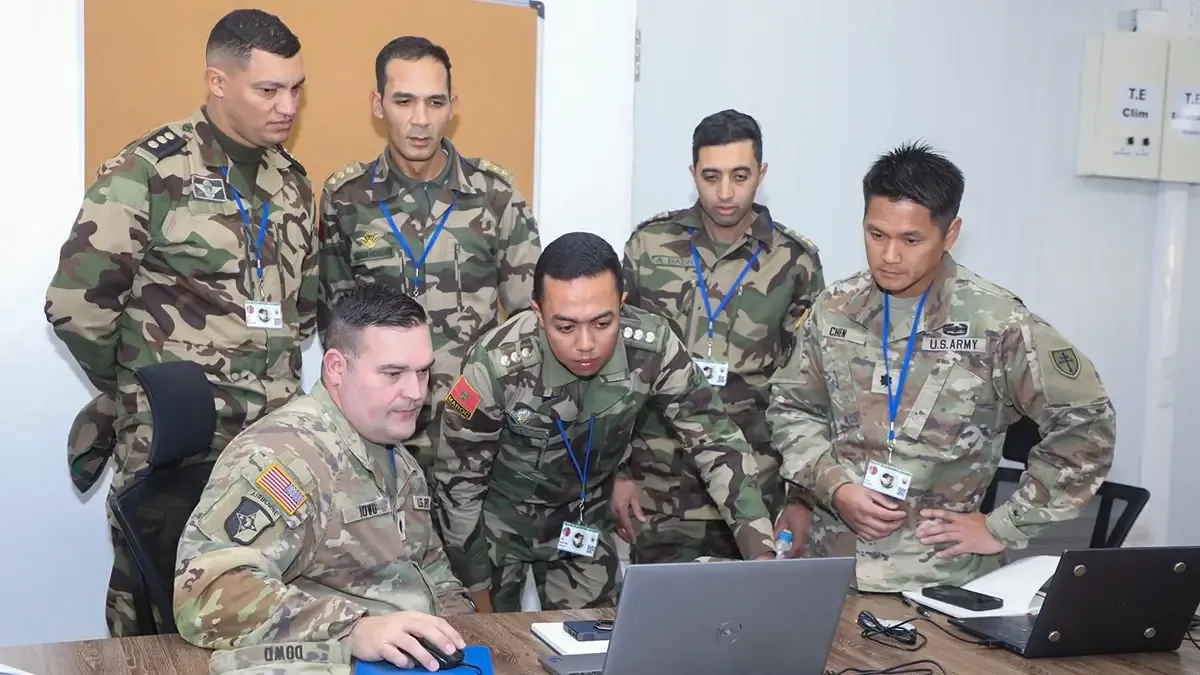
The 2026 edition of African Lion marks a decisive turning point, as Morocco emerges as a comprehensive experimental platform for next-generation combat technologies. Over forty U.S. technology firms are actively participating in the exercise, collaborating with deployed forces to test advanced capabilities with the intent of expediting the timeline between innovation and operational deployment. This initiative is overseen by the U.S. Army Southern European Task Force, Africa, through its Advanced Capabilities Directorate, which acts as a crucial bridge between military operations, industry, and the broader innovation ecosystem. The participating companies range from startups specializing in artificial intelligence and autonomous systems to major defense contractors like Lockheed Martin and Raytheon Technologies.
In this context, African Lion serves as a large-scale, iterative operational validation environment, structured around concrete capabilities such as mission command systems, deep strike capabilities, and integrated counter-strike solutions. The goal is no longer merely demonstrative; it centers on delivering capabilities that are immediately usable in the field, especially concerning the security of critical areas and strategic corridors.
African Lion's Evolution: From Exercise to Strategic Framework
This technological evolution and shift in operational practice find critical application within the African landscape, where the security environment necessitates rapid adaptations in capabilities and engagement strategies. The operational landscape is characterized by a convergence of complex, persistent, and adaptive threats. Violent extremist organizations are exploiting poorly governed areas to expand their networks, while transnational trafficking of arms, narcotics, and illicit goods bolsters their logistical capabilities. These dynamics are further complicated by hybrid conflict forms that blend disinformation, economic pressures, and the exploitation of local vulnerabilities.
The porous nature of borders, the vastness of the Sahel region, and the fragmentation of state capacities hinder early detection and neutralization of threats, particularly along essential logistical routes and strategic corridors. Consequently, the challenges extend beyond tactical levels, operating within a systemic framework where control over information and coordination across multiple domains is critical.
Looking ahead, the increasing availability of drone capabilities among non-state actors in the Sahel can be framed within three trajectories, particularly in light of recent developments in Mali that showcased coordinated offensives by groups like GSIM and ISIS. The first scenario depicts opportunistic diffusion, where drones serve as tools for surveillance and intimidation without significantly altering the power balance. The second scenario involves a tactical concentration of drone capabilities to support attacks and enhance mobility, complicating state forces' maneuvers. The third scenario represents a systemic transformation wherein drones become integral to strategies that disrupt logistical corridors and economic flows, thus placing conflicts within a broader context of "war of flows," where low-cost capabilities yield disproportionate strategic impacts.
Under these conditions, operational priorities now emphasize the consolidation of durable partnerships, the strengthening of command-and-control architectures, and the integration of advanced technologies—especially in ISR, data fusion, and secure communications—to maintain a decision advantage in environments characterized by uncertainty and dispersed threats.
Morocco as a Strategic Operational Environment
In this evolving security landscape, Morocco stands out as a compelling strategic choice. Given its geographical position at the intersection of the Atlantic, Mediterranean, and Sahel, Morocco serves as a natural anchor for securing critical flows and strategic corridors across the continent. Its extensive training ranges and relatively unrestrained airspace provide optimal conditions for large-scale military maneuvers.
The Moroccan electromagnetic spectrum further enhances this position, functioning as a force multiplier in modern warfare that seamlessly integrates advanced military capabilities. This spectrum encompasses various frequency bands utilized for tactical and strategic communications, radar systems for air surveillance and target detection, and ISR sensors. The low saturation and limited operational contestation of this spectrum enable the concurrent deployment of multiple systems with minimal interference, fostering an ideal environment for multi-system experimentation and controlled electronic warfare simulations.
Within this framework, the current shift in military power is taking shape through the ability to integrate and synchronize information flows effectively. The demonstration of strength in this year's exercise is less about visible maneuvers and more about the C4ISR architecture that synchronizes and accelerates military decision-making in a "war of flows" environment. This logic extends the principles of the AirLand Battle doctrine, focusing on depth, simultaneity, and continuity of command, while emphasizing the importance of connecting sensors, decision-makers, and effectors in near real time to achieve a sustained decision advantage across multiple domains.
In an environment where information superiority hinges on effectively exploiting, protecting, and dominating the electromagnetic spectrum, such configurations present a decisive operational advantage. They enable realistic testing of integrated autonomous systems, drones, artificial intelligence, and resilient communication networks, all aligned with contemporary combat requirements. This is amplified by Morocco's stability, ongoing modernization of its Royal Armed Forces, and a high level of interoperability with U.S. forces, which now extends into doctrinal integration.
Several high-profile U.S. units, including the 19th Special Forces Group and the 173rd Airborne Brigade, are actively involved in this dynamic, testing technologies developed by industry under real-world conditions to validate their suitability for coalition use. Central to this transformation is a significant evolution in command structures, aiming to transition Combined Joint Task Force headquarters from manual information processing to real-time, automated exploitation. Leveraging artificial intelligence and ISR systems, the decision-making chain is expedited, drastically reducing the kill chain, thus enhancing the ability to detect, track, and engage targets with greater precision.
This transformation not only accelerates the adoption of critical technologies and interconnected architectures but also enhances the Moroccan armed forces' capability to operate effectively in multi-domain environments, improving intelligence fusion, decision-making speed, and targeting precision. From an industrial and technological standpoint, these changes pave the way for a significant evolution in military operations, establishing Morocco as a leader in the modernization of defense strategies on the African continent.
As reported by atalayar.com.