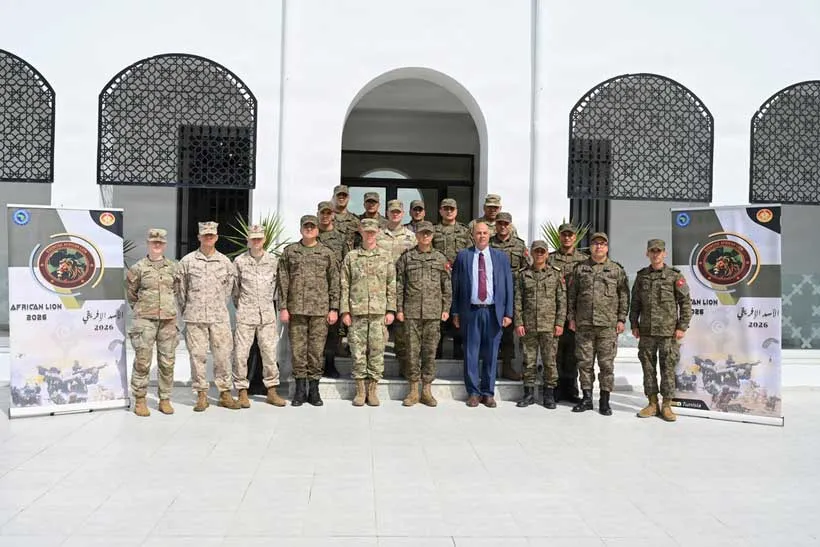
Morocco's Strategic Transformation in Military Operations
The 2026 edition of African Lion marks a significant evolution in Morocco's role as a pivotal operational environment for testing and validating capabilities tailored to emerging forms of conflict. Departing from traditional military exercises, African Lion is transforming into a comprehensive framework where technological innovation, information superiority, and doctrinal transformation intersect. This transformation is particularly facilitated by Morocco's relatively uncongested electromagnetic spectrum, which offers an ideal setting for the integration of advanced systems such as tactical communications, ISR sensors, data links, and command and control architectures, along with experimentation in electronic warfare.
In this evolving context, African Lion transcends the mere testing of equipment; it serves as a validation space for a comprehensive technological ecosystem that unites armed forces, the defense industry, and data architectures. Morocco is strategically positioning itself as a leader in the realm of data-centric warfare, emphasizing the control of information flows, intelligence fusion, and expedited decision-making in response to shifting African and Euro-Atlantic security dynamics.
The exercise unfolds amid escalating global tensions, with Morocco co-hosting African Lion alongside the United States—one of the most significant security cooperation platforms on the continent. This partnership extends beyond the exercise itself, as evidenced by recurring frameworks such as Flintlock, Handshake, and Atlas Handshake. Together, Rabat and Washington are deepening their strategic alignment from 2026 to 2036, transitioning from mere cooperation to the co-development of operational responses that are aligned with shared interests in security, interoperability, and the protection of strategic flows.
Evolution of African Lion: From Joint Training to Strategic Architecture
Initially designed as a joint training exercise, African Lion has matured into a critical mechanism for the co-production of security across Africa. The introduction of specialized training cycles focusing on emerging technologies underscores this transformation. The stakes now extend beyond joint training to the development of a unified security strategy at the continental level, which emphasizes the importance of securing strategic routes and corridors—maritime, energy, and logistical—that are vital to maintaining a balance of power in the region.
The 2026 edition is pivotal in this transformation, positioning Morocco as a full-scale experimental platform for next-generation combat technologies. Over forty U.S. technology firms are participating in the exercise, collaborating with deployed forces to hasten the transition from innovation to operational deployment. This initiative is overseen by the U.S. Army Southern European Task Force, Africa, which acts as a key bridge between military, industry, and the broader innovation ecosystem. Notable participants include both innovative startups specializing in artificial intelligence and autonomous systems like Anduril Industries and established defense giants such as Lockheed Martin, Raytheon Technologies, and Northrop Grumman.
In this context, African Lion evolves into a large-scale operational validation environment—an iterative process of testing, adapting, and validating concrete capabilities. The focus has shifted from demonstration to the delivery of immediately usable capabilities for the warfighter, particularly in securing critical spaces and strategic corridors.
As reported by moderndiplomacy.eu.