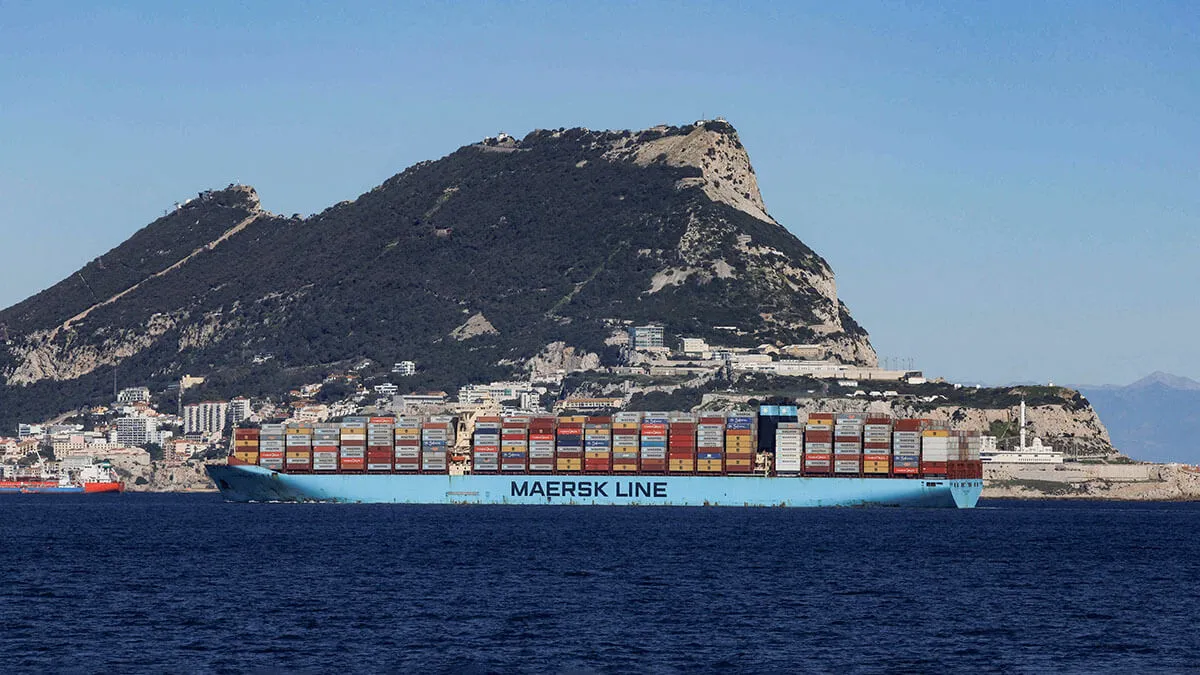

At the narrow strait between two continents, the **Strait of Gibraltar**, approximately **300 ships cross every day**, averaging one every five minutes. This crucial waterway does much more than connect the Atlantic Ocean to the Mediterranean; it regulates access between these two significant bodies of water. More than **10% of the world's maritime trade** navigates through this narrow passage, which is scarcely **14 kilometers** wide at its narrowest point. On a clear day, standing on the Spanish coast, one can see **Morocco in plain sight**. This proximity elucidates why the **Tanger Med** port, located just across the water, has emerged as one of the **largest container ports** in Africa. A temporary closure of the strait would have an **immediate impact on numerous economies** at once.
For the better part of the **last two decades**, global discussions have primarily focused on Morocco's **maritime ambitions** symbolized by Tanger Med, the transshipment giant that transformed the western Mediterranean into one of the busiest maritime areas globally. However, the narrative surrounding this port has evolved beyond its initial scope, as it now embodies a broader movement. Shipping companies, forced to reroute around the **Cape of Good Hope** due to instability in the Red Sea, have spent the last two years rediscovering the extent to which **global trade continues to depend** on a handful of maritime gateways, Gibraltar being one of them. Morocco has quietly transitioned from merely functioning as a top-tier port operator to becoming the **architect of Africa's primary Atlantic entryway**, establishing a corridor that extends from the Mediterranean through the Atlantic and deep into the Sahel region.
From Transshipment Port to Global Logistics Platform
The recent strategy adopted by Morocco signifies a genuine shift in **economic geography**. Tanger Med is no longer merely a final destination; rather, it has evolved into the first step of a much larger system. The fundamental facts about Tanger Med are well established: it stands as one of the leading transshipment hubs in the Mediterranean, bolstered by the automotive and aerospace manufacturing industries, logistics parks, and customs procedures designed for efficiency. However, Rabat's decision to extend its ambitions beyond simple port operations into a visionary role is less understood. _"Tanger Med was never meant to be the end of Morocco's maritime story; it was merely the opening chapter."_
Consequently, Morocco's goals have evolved from merely managing a successful port to **building an interconnected network** where its Atlantic strategy facilitates trade across entire borders.
Building the Backbone of the Atlantic
Within the realm of global affairs, the concept of a **rail tunnel under the Strait** of Gibraltar periodically captures headlines. Although a feasibility study completed in 2025 confirmed the technical viability of such a tunnel, it remains a project for the future. However, Morocco has not remained idle. Instead of waiting for a northern link to Europe, it is actively looking southward and westward, connecting Tanger Med to the Atlantic and beyond. Key infrastructures in Morocco range from the proposed **Dakhla Atlantic Port**, which would provide the nation with a second deep-water anchorage further down its coast, to the **Nigeria-Morocco gas pipeline**, which will traverse over a dozen coastal jurisdictions, spearheaded by **ONHYM** and **NNPC**.
The Atlantic Initiative aims to offer landlocked states in the **Sahel** access to this interconnected network, transforming what was initially a purely Moroccan port strategy into a regional one. Additionally, the expansion of railway connectivity through **ONCF** is designed to articulate this into a single corridor rather than a series of isolated projects.
Morocco's initiatives are not solely about ports and pipelines; they are as much about **governance as they are about engineering** and energy. A gas pipeline crossing over a dozen jurisdictions requires a regulatory framework as much as it needs steel. A port developed under a **landlord port** model necessitates a legal architecture that investors and insurers can effectively evaluate and price. Similarly, the arbitration law that Morocco updated in 2022 will hold value only if stakeholders trust its application. _"For shippers, insurers, and financiers, legal issues must be treated as matters of 'compliance and due diligence' rather than political discussions."_
By treating legal risk as a manageable business variable rather than a political debate, **Morocco seeks to create an environment** where the commercial viability of these massive projects remains stable, regardless of the political climate. This precisely highlights the gap referred to by the _Global Academy for Future Governance_ when discussing **'governance corridors'**: the institutional layer of laws, regulations, and dispute resolution that determines whether a physical corridor truly operates or merely exists on a map.
As Morocco continues to shape its ambitious strategy, it stands out distinctly compared to other major infrastructure projects across Africa. While Egypt is transforming the **Suez Canal** into an industrial ecosystem, Angola and Zambia are rehabilitating a colonial-era railway to establish the **Lobito Corridor**, and East Africa is weaving its own network of ports, trains, and pipelines, most of these new "blue lines" connect a single coastline to its inland influence area. **Morocco's continuity sets it apart**: its project runs in a continuous line from the Mediterranean, wraps around the Atlantic façade, and delves into the Sahel. This is a far more ambitious wager and presents a governance challenge that no single port can resolve alone.
When the _Global Academy for Future Governance_ convenes its inaugural **Global Maritime Governance Forum** (GMGF) in Gibraltar this coming September, Morocco's Atlantic strategy should be perceived as more than just an upgrade of regional infrastructure. It represents a real-time test of whether a **governance framework can keep pace** with continental ambitions and if the legal, regulatory, and dispute resolution architecture can be constructed with the same deliberation and robustness as the ports and pipelines themselves. **Morocco has already answered** the engineering question. The question of governance remains open, and it is here that the GMGF, along with the experts gathered, should focus their attention.
As reported by atalayar.com.