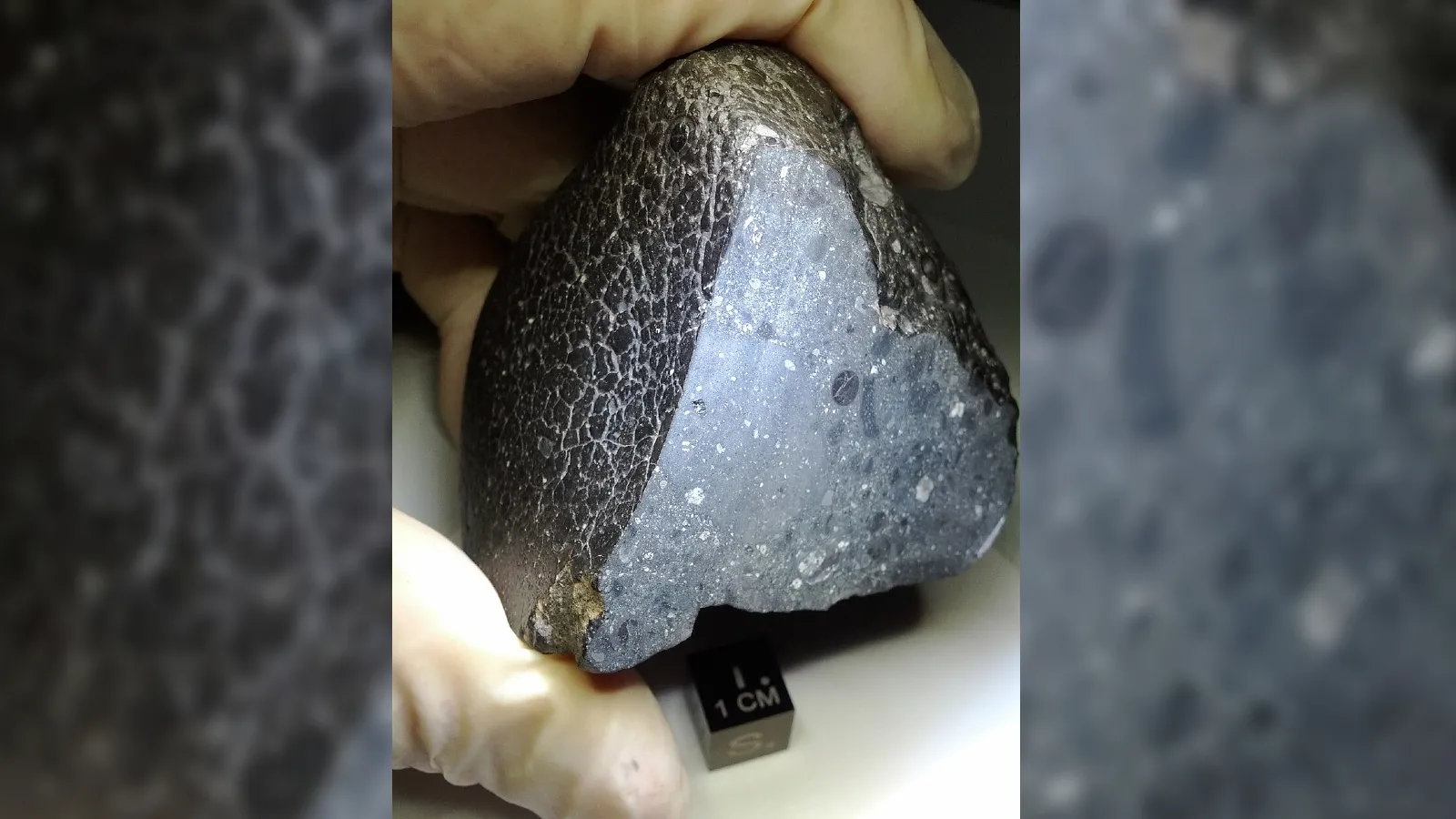

Breakthrough Findings from the Sahara's 'Black Beauty'
One of the most significant challenges in space exploration is reaching Mars. However, while we await that monumental achievement, scientists are gleaning valuable information from Martian rocks found here on Earth. A particularly intriguing discovery has emerged from Morocco, in the meteorite trading circuit, where a Martian meteorite known as NWA 7034, or 'Black Beauty,' was fortuitously uncovered in the Sahara Desert in 2011.
This fascinating fragment is believed to belong to Mars' ancient crust. According to a study titled Direct detection of hydrogen reveals a new macroscopic crustal water reservoir on early Mars, the rock contains hydrogen, suggesting that it could have stored water. NWA 7034 is not just any Martian meteorite; researchers regard it as the only known material on Earth directly linked to the ancient surface crust of Mars.
Innovative Techniques Uncover Water Signatures
This discovery marks a significant advancement for scientific researchers, especially as robotic missions like Perseverance continue to work on Mars to bring back new samples. Recently, a section of this meteorite appeared on the Moroccan meteorite market, measuring 12 by 8 by 2 millimeters. Instead of destroying the sample for analysis, the research team employed advanced techniques such as neutron tomography, X-ray imaging, and X-ray diffraction.
X-rays are beneficial for visualizing internal structures, while neutrons are exceptionally sensitive to hydrogen. In this context, hydrogen acts as a direct indicator of materials associated with water. It is essential to clarify that while no liquid water has been found within this Martian rock, the meteorite exhibits signs of hydration in minerals that either formed or altered on the Red Planet.
The analysis revealed hydrogen-rich regions within small clasts, which are fragments of rock embedded within the meteorite. These zones are associated with iron oxyhydroxides and form highly localized hydrated areas. Remarkably, these hydrogen-rich clasts constitute approximately 0.4% of the sample's volume, potentially containing up to 635 parts per million of water equivalent. This indicates that a small portion of the rock holds a significant fraction of its water signal, accounting for around 11% of the total estimated water content in NWA 7034, which is roughly 6,000 parts per million.
Moreover, the research suggests that these clasts may contain as much as 15% by weight of OH. This finding leads to the conclusion that the hydration is not uniformly distributed but rather exists in small mineral reservoirs within the rock itself. The implications of this research extend beyond initial observations—it could radically alter the methodology used for studying Martian fragments.
Historically, many meteorite analyses required cutting, polishing, or altering the material, which poses a significant cost, as each millimeter may yield irreplaceable information about Mars. Therefore, the development of less invasive techniques is crucial. For instance, the study demonstrates that combining neutron and X-ray techniques with diffraction allows researchers to map hydrogen in three dimensions, enabling not just the detection of hydration but also the visualization of its spatial distribution and mineral context.
This initiative has received funding from the Government of Spain, co-financed by the European Regional Development Fund for outermost regions to facilitate the transportation of goods in the Canary Islands. In essence, it's a way of fostering European collaboration.
As reported by okdiario.com.