
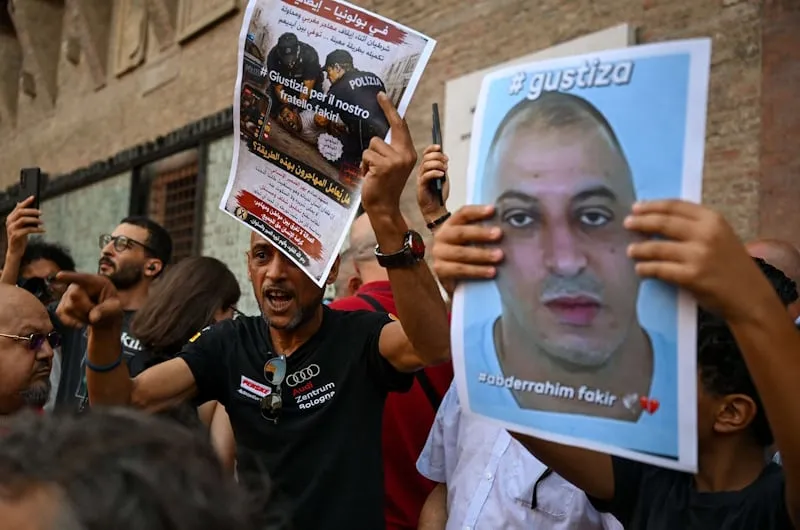
Demand for Accountability and Transparency in the Wake of Tragic Incident
The repercussions of the death of Moroccan migrant Abdel Rahim Fakir in Bologna, Italy, are reverberating across both Moroccan and Italian societies, transforming what began as a criminal investigation into a significant human rights and diplomatic issue. Citizens from various backgrounds are increasingly calling for transparency and accountability regarding the circumstances surrounding this tragic event, which has sparked protests and widespread outrage. A video circulating on social media depicts Italian police officers forcefully restraining the 42-year-old Moroccan as he cries out for help, ultimately leading to his untimely death.
This incident has not only ignited anger among human rights activists but has also compelled Italian politicians to call upon the government for clarity and answers about the circumstances leading to this tragic event. The Moroccan Foreign Ministry has expressed its deep concern and is actively monitoring the situation, urging the Italian authorities to expedite a thorough investigation that unravels all aspects of the case, ensuring accountability and adherence to legal protocols. The Ministry's statement emphasized its commitment to protecting the interests of Moroccan citizens abroad, directing the Moroccan embassy in Rome and the relevant consulate to closely follow the developments and assist in the ongoing investigation.
In a similar vein, the Moroccan embassy in Italy has been closely monitoring the case since its inception, with Ambassador Youssef Bla expressing condolences to Fakir's family and pledging full support. The embassy has tasked the consulate in Bologna with providing legal and moral assistance to the grieving family, as well as ensuring continuous communication with Italian judicial authorities regarding the investigation.
Social Media and Civil Society Response
Social media platforms have emerged as a vital channel for Moroccans to express solidarity, condolences, and outrage regarding this incident. Posts condemning the actions of the police and highlighting the video footage capturing Fakir's final moments have dominated discussions. This event has reignited discourse around the boundary between law enforcement and respect for human rights, with many human rights organizations, including the Moroccan Organization for Human Rights and the Moroccan League for the Defense of Human Rights, demanding an independent and transparent investigation into the circumstances of Fakir's death.
The Moroccan Organization for Human Rights has formally requested an inquiry into the events leading to Fakir's death, emphasizing the essential right to life as guaranteed by international treaties. They have called for the verification of whether Italian police adhered to principles of necessity and proportionality in their use of force, as well as an examination of whether Fakir's nationality or migrant status affected the police's response to him. The organization has also urged for transparency throughout the investigation process, allowing Fakir's family to participate and stay informed in accordance with international standards.
On the other hand, the Moroccan League for the Defense of Human Rights has likened this incident to the case of George Floyd in the United States, which underscored issues of racial discrimination and police brutality. They have also called for a swift and independent investigation, asserting that the footage depicting Fakir's restraint and cries for help necessitates a thorough and transparent inquiry. The rights group has drawn attention to historical patterns of racial discrimination against migrants in various countries, reinforcing the importance of human dignity and the right to life, irrespective of nationality or legal status.
Moreover, the incident has also caught the attention of the Moroccan legislative body, with parliamentary representative Khaled Al-Sati submitting a written inquiry to Foreign Minister Nasser Bourita. His questions revolved around the measures taken by the Moroccan government through its diplomatic channels in Italy to ensure a fair and transparent investigation, as well as the support provided to Fakir's family during this harrowing time.
As the discourse surrounding this incident continues to evolve, various narratives have emerged. Some reports suggest that Fakir was visiting relatives in Bologna when he experienced a mental health crisis, leading to a confrontation with local authorities. Others have criticized the Italian police's handling of the situation and the Moroccan government's diplomatic response prior to the issuance of official statements regarding the case. This tragic event highlights the urgent need for accountability and a reassessment of the interactions between law enforcement and marginalized communities. As reported by alquds.co.uk.


